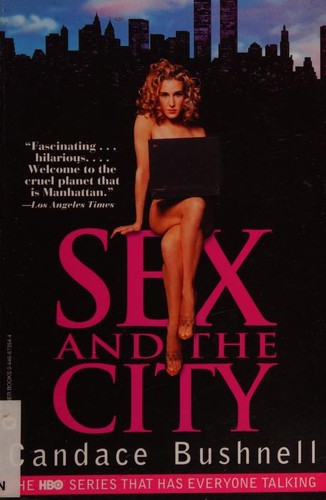
Sex and the City
by Candace Bushnell
★ Top 25 book of 1997 · #13 on Best Books of 1997
This chronicle explores the mating habits and rituals of America's cultural elite. Topics include sex clubs, suburban sexuality and celebrity affairs.
Best for: Readers curious about dating culture and the social lives of the elite
Sex and the City is #13 on BookWard's Best Books of 1997, out of 28 1997 books that cleared our data bar.
What Sex and the City is about
Before it became a television phenomenon, Sex and the City was a newspaper column. Candace Bushnell wrote it for The New York Observer from 1994 to 1996, drawing on the lives of her friends and herself in 1990s New York. This 1996 book gathers those columns into an anthology.
Bushnell watches the mating habits and rituals of America's cultural elite with a sardonic eye, moving through sex clubs, suburban sexuality and celebrity affairs. The result is glossy, observational and curious about status, money and friendship as much as romance. can see where it all began, and anyone who enjoys sharp social commentary on dating and city life will find plenty to savor.
Sex and the City on the Best Books of 1997
Sex and the City came out in 1997. Of the 28 books first published in 1997 that met BookWard's data bar, it ranks #13 on our Best Books of 1997 list.
Why it made the list: 267 readers have shelved it on Open Library; 21 are reading it right now. The list ranks each year’s books on how many readers have picked them up, how highly readers rate them, and how many are reading them right now.
Nearby on the 1997 list
- Killing Floor Lee Child, #11
- The Spirit Catches You and You Fall Down Anne Fadiman, #12
- A Walk in the Woods Bill Bryson, #14
- Out of the Dust Karen Hesse, #15
See all Best Books of 1997 Best books by year
More years: Best Books of 1996 Best Books of 1998.
The numbers behind it
- Readers: 224 want to read it, 21 are reading it now and 22 have read it, according to Open Library.
| Signal | This book (0 to 100) | Weight |
|---|---|---|
| Reach | 54 | 55% |
| Reader love | 14 | 25% |
| Being read right now | 71 | 20% |
Questions about Sex and the City
When was Sex and the City published?
Sex and the City by Candace Bushnell was first published in 1997.
Was Sex and the City one of the best books of 1997?
Sex and the City is #13 on BookWard's Best Books of 1997, out of 28 1997 books that cleared our data bar. 267 readers have shelved it on Open Library; 21 are reading it right now.
Why is Sex and the City on the Best Books of 1997 list?
267 readers have shelved it on Open Library; 21 are reading it right now.
More of the best books of 1997
- Harry Potter and the Philosopher's Stone J. K. Rowling, #1
- Rich Dad, Poor Dad Robert T. Kiyosaki, #2
- Guns, Germs, and Steel Jared Diamond, #3
- The Adventures of Captain Underpants Dav Pilkey, #4
- The Power of Now Eckhart Tolle, #5
- Into Thin Air Jon Krakauer, #6
See the full Best Books of 1997, the Top 100, or new books on Rising.
How we know
This page uses public data: Open Library reader counts and ratings, and Wikipedia page views for recent years. The description is paraphrased from real source text. Rankings reflect reading interest, not quality or sales, and can be affected by data gaps. Lists update monthly.
Best suited to adult readers, given its frank and frequent discussion of sex.
Depends on the edition you pick.
Bushnell's 1990s Manhattan columns, sharp and brisk, though thin on depth. 51% taste match
 BookWard’s take
Bushnell's 1990s Manhattan columns, sharp and brisk, though thin on depth
This collects Candace Bushnell's New York Observer columns about the mating habits of Manhattan's cultural elite, and the column format shapes everything. Short pieces mean a quick start every time and a book that never sags, so it moves along at a brisk clip and hooks you fast. The voice is unmistakable and opinionated, and it carries the whole collection. Where it falls short is depth of character: columns sketch people rather than drawing them fully, so the figures here lean toward types. It is also deeply of its moment, anchored in 1990s New York, which leaves open the question of how well it will last. Expect observation and attitude over plot, and expect it to move quickly.
A collection of short newspaper columns keeps the whole book compact and quick, close to BookWard's preference for tight.
Short, punchy pieces move briskly, matching BookWard's taste for speed.
The candid, anthropological take on 1990s Manhattan dating was a fresh angle, though the genre has absorbed it since.
Clean, conversational newspaper prose, plain rather than ornate.
Neither plot nor deep character leads; social observation sets the course, with a slight tilt toward people.
The tone is skeptical about love and status games, with only flickers of optimism.
A string of standalone columns is less conventional than a single narrative, though not experimental.
Dry social comedy runs through the observations, a good fit with BookWard's appetite for humor.
Cynical about relationships but mostly witty rather than grim.
Observation and irony keep feelings at arm's length.
See all 50 dialsEvery position, side by side with this book
Where it lines up
- PaceBookWard 8 · book 8
- Authorial voiceBookWard 9 · book 9
- Sagging middleBookWard 8 · book 7
Where it pulls apart
- Familiar tropesBookWard 10 · book 5
- Internal logicBookWard 10 · book 6
- Rigor (nonfiction)BookWard 9 · book 3
A collection of short newspaper columns keeps the whole book compact and quick, close to BookWard's preference for tight.
Dating and city-life archetypes recur, though the insider angle on Manhattan's elite gives some freshness; BookWard would want fewer familiar beats.
Columns stand on observation rather than plot mechanics, so internal logic is loose but rarely strained.
Short, punchy pieces move briskly, matching BookWard's taste for speed.
The candid, anthropological take on 1990s Manhattan dating was a fresh angle, though the genre has absorbed it since.
Columns sketch social types and moments rather than building deeply drawn people, short of what BookWard prefers.
A column collection resolves piece by piece rather than through one arc, leaving the whole more open than BookWard likes.
Wry detachment dominates, with some romantic yearning underneath, so it sits mid-range against BookWard's restraint.
Candid talk of sex clubs and affairs is more revealing than gratuitous, and mostly observational in tone.
Reported from the author's own social circle, so it works as anecdote rather than systematic study.
A confident, wry, opinionated narrator gives the book a strongly recognizable personality, which BookWard rewards.
Pieces are built around observations about mating rituals rather than a driving storyline, so ideas lead.
The narrator often explains what the scene means, more telling than BookWard's preference for showing.
Short columns reset the energy constantly, so there is little room for a middle to sag.
Clean, conversational newspaper prose, plain rather than ornate.
Neither plot nor deep character leads; social observation sets the course, with a slight tilt toward people.
The tone is skeptical about love and status games, with only flickers of optimism.
A string of standalone columns is less conventional than a single narrative, though not experimental.
Dry social comedy runs through the observations, a good fit with BookWard's appetite for humor.
Short, chatty pieces make for easy reading that needs little effort.
The columns draw on the author's circle, so several lives and attitudes appear across the pieces.
Pieces follow one era without much time-jumping, though standalone columns do not form a single timeline.
Entirely grounded in real New York social life.
A rotating gallery of friends, acquaintances and social figures across many columns makes for a sizable cast.
Focused on one social set in one city, so intimate rather than epic.
Balanced between social events and the author's reflections on them.
Dating, mating and relationships are the subject of nearly every column.
For most readers the Manhattan elite is a somewhat unfamiliar world, seen from the inside.
Rooted in the mid-1990s, so it reads as a period piece today.
Its themes of dating and status persist, but its specifics are tied to a particular moment.
A candid, first-person-style observer that is more reliable than not, though the opinions are the author's own.
The book observes behavior with irony rather than handing down verdicts, leaving judgment open.
Social settings and scenes are sketched economically rather than richly.
Reads as anecdotal storytelling about people rather than analysis.
Drawn from the author's own life and friends, so strongly personal.
Stands as a self-contained anthology, though it spawned a famed franchise.
Columns deliver small reveals and punchlines more than plot surprises.
A light, entertaining read that rarely pushes the reader.
Cynical about relationships but mostly witty rather than grim.
Observation and irony keep feelings at arm's length.
Wry and knowing humor sits between dry and broad.
Social drama here rarely involves physical violence.
Sex is the central subject, discussed openly and frequently.
Social status and gender dynamics matter, but formal politics hardly appear.
Conversational, plain language throughout.
The narrator offers strong, unmistakable opinions on the people and habits described.
A snapshot of its present moment more than a look forward.
Skeptical about love and status, leaning cynical.
Review written by BookWard, dial version 1, November 2026.
Who is Sex and the City right for?
Best suited to adult readers, given its frank and frequent discussion of sex. Some material about affairs and sex clubs may not suit younger or more sensitive readers.
Short, chatty pieces make for easy reading that needs little effort.
Cynical about relationships but mostly witty rather than grim.
Observation and irony keep feelings at arm's length.
Social drama here rarely involves physical violence.
Book CompanionSex and the City: ideas, characters, themes
A witty insider chronicles how Manhattan's cultural elite date, mate and posture in the 1990s.
- Column origins. The book grew from Bushnell's New York Observer column, written between 1994 and 1996.
- Drawn from life. The columns were based on her own and her friends' lives in 1990s New York.
- Mating rituals. The book treats dating habits as social customs to be observed and catalogued.
- Range of settings. Topics include sex clubs, suburban sexuality and celebrity affairs.
- A franchise begins. The material became the basis for the HBO series and later films.
Themes
Courtship treated as a set of social customs with unwritten rules.
How wealth, fame and image shape who pairs up with whom.
Friends as a support network for navigating a tough city and tougher romance.
Frank discussion of sexual behavior as social commentary.
Skepticism about love sitting alongside a desire for connection.
Discussion questions
- Which observations about 1990s dating still feel true today?
- How does the column format shape the way people are portrayed?
- Is the narrator an insider, an outsider, or both?
- What does the book suggest about status and romance?
- How does reading the book compare with what you know of the TV adaptation?
Personalize your Book Companion
This is the general edition. In BookWard, the Companion is written for you: your reading profile, your notes, and spoiler-safe to the page you are on.
Buy, listen or borrow Sex and the City
Each link opens a search for this book on that store, in a new tab.
Read on a device
Borrow
Reviews and community
If you liked Sex and the City
Upper East Side teens, a gossip blogger, and a fast, glossy debut
Looking for AlaskaJohn GreenA boarding-school coming-of-age novel split by a single event
Tortilla FlatJohn SteinbeckA mock-Arthurian comedy of poverty on a Monterey hillside
Kitchen ConfidentialAnthony BourdainBourdain's unfiltered, funny tour through the back of the house
Find your own best books
Add what you have read, rate it, and BookWard will recommend what to read next.
Free to start. No credit card needed.