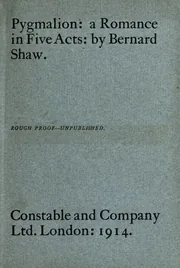
Pygmalion
by George Bernard Shaw · 1912
Suits older teens and adults, and is a staple of school and stage study.
136 pages, about 2 to 3 hours.
Shaw's sharp comedy about speech, class and who gets to be someone. 71% taste match
What is inside
Pygmalion is a comic play by George Bernard Shaw, written in 1912 and set in London. It takes its title from a figure of Greek myth. The drama centers on a phonetics professor, Henry Higgins, and a Cockney flower seller, Eliza Doolittle, and it looks at how the way a person speaks shapes the place that person is given in society. Language teaching, dictionaries and the English tongue run through the story, along with questions of class and the relations between men and women. Other characters include Colonel Pickering, Alfred Doolittle, Mrs. Higgins and Freddy Eynsford Hill.
The play opened in a German translation at the Hofburg Theatre in Vienna in October 1913. Audiences in London saw it in April 1914 at His Majesty's Theatre in the West End, with Herbert Beerbohm Tree and Mrs Patrick Campbell in the leading roles. Shaw also supplied a sequel to follow the play. The work belongs to British and Irish drama, runs to roughly 136 pages in a typical printing, and has appeared in 143 editions, including collected volumes of his plays alongside Major Barbara and other titles.
London at 11.15 p.m. Torrents of heavy summer rain.
Characters
PygmalionHenry HigginsEliza DoolittleColonel PickeringAlfred DoolittleMrs. Higgins
Setting
LondonEngland
Period
1912
Themes
DramaFlower vendingLinguistics teachersSocial classesSpeech and social statusMan-woman relationshipsGermanDictionaries
- Want to read 233
- Reading now 17
- Read 64
Most people shelving it are saving it for later.
Of 314 readers who put it on a shelf, 74% want to read it, 5% are reading it now, 20% have finished it and 0% stopped before the end.
By the numbers
- The median edition runs 136 pages. Counting about 275 words a page and an adult reading pace of 250 words a minute, that is about 2.5 hours of reading.
- Open Library tracks 143 editions from 89 publishers, the earliest dated 1912 and the latest 2022, across 8 languages.
- On reader demand it ranks in the top 3% of the classic books in our catalog (8,749 of them).
- Libraries shelve it under Dewey 822.91 and Library of Congress class PR-5363.00000000.P8 2008.
 BookWard’s take
Shaw's sharp comedy about speech, class and who gets to be someone
Pygmalion is short, quick and built almost entirely out of talk. At 136 pages it suits a reader who loves a tight book, and the hook is immediate: a London street, a flower seller, a phonetics professor with a wager in mind. The internal logic is airtight, every scene pushing the central bet forward. Shaw keeps sentiment restrained and lets the dialogue carry nearly all the weight, while the authorial voice is sharp and unmistakable. It is more idea-led than I usually like, and the exposition arrives in Shaw's own explanatory asides, which runs against a preference for showing things in scene. The ending is the famous sticking point, deliberately unsettled in its feeling, though the plot itself is clear. A comedy with a spine.
At 136 pages it is a lean play with no padding, which BookWard rewards.
Short scenes and fast exchanges keep it moving, though it pauses for argument now and then.
A comic look at how accent fixes social place was bold in 1912 and still bites.
The language is clear and brisk, with flourish saved for the sharpest lines.
The wager drives events, yet the shifting relationships are what make it stick.
Eliza's rise gives it a hopeful turn, tempered by Shaw's skepticism about the people around her.
A conventional run of acts and scenes, with no formal experiment.
Comedy of manners runs through it, with serious points landing inside the jokes.
The tone stays comic, with only the cruelty of class casting a shadow.
Feeling is present, but wit keeps it from tipping into the intense.
See all 50 dialsEvery position, side by side with this book
Where it lines up
- LengthBookWard 1 · book 1
- PaceBookWard 8 · book 8
- Character depthBookWard 8 · book 8
Where it pulls apart
- Familiar tropesBookWard 10 · book 7
- Story or ideasBookWard 3 · book 7
- ExpositionBookWard 2 · book 6
At 136 pages it is a lean play with no padding, which BookWard rewards.
The play opens in a London street scene that sets the central wager moving almost at once.
The transformation premise became a template, but Shaw's treatment of class and speech stays pointed and fresh.
Each scene follows from the bet at the center, so cause and effect hold firmly throughout.
Short scenes and fast exchanges keep it moving, though it pauses for argument now and then.
A comic look at how accent fixes social place was bold in 1912 and still bites.
Higgins and Eliza are drawn through what they say and refuse to say, with real contradiction in both.
The plot resolves clearly, but the relationship at its heart is left deliberately unsettled.
Shaw undercuts warmth with wit, so feeling is present but kept dry and controlled.
Whatever bite it has comes from argument about class, not from cheap provocation.
This is a play, so the rigor dial does not apply.
Shaw's wit, his stage directions and his argumentative streak are unmistakable on every page.
Story carries it, but the ideas about speech and class are the real engine.
Shaw explains his characters and themes in lengthy stage directions, more than BookWard likes.
A compact structure means no middle slump; each scene earns its place.
The language is clear and brisk, with flourish saved for the sharpest lines.
The wager drives events, yet the shifting relationships are what make it stick.
Eliza's rise gives it a hopeful turn, tempered by Shaw's skepticism about the people around her.
A conventional run of acts and scenes, with no formal experiment.
Comedy of manners runs through it, with serious points landing inside the jokes.
Easy to follow on the page, though the dialect and argument reward slow reading.
The play moves among a handful of characters but stays rooted in the central pair.
Events unfold in order across a short stretch of time.
Entirely grounded in a realistic London, with the myth only in the title.
A handful of main characters keeps the stage focused.
Drawing rooms and a street corner keep the stakes personal rather than epic.
Action is mostly talk, but the talk exposes inner shifts as much as outer events.
It is almost all dialogue, as a play must be, and the exchanges are the pleasure.
A relationship sits at the core, but Shaw resists the conventional romantic payoff.
Early twentieth century London class life will feel somewhat distant to many readers.
Set in 1912, firmly in the past, though its concerns still feel current.
Its questions about accent, status and self-making have lasted well over a century.
A play has no narrator, so this dial does not apply.
Shaw invites judgment of Higgins and society without handing down a tidy verdict.
Settings are sketched by stage directions, kept spare rather than lush.
This is drama, so the nonfiction style dial does not apply.
It is drama rather than nonfiction, so the perspective dial does not apply.
It stands alone, with only a sequel essay from Shaw attached.
Events are driven by the bet more than by surprise, though a few turns land well.
It asks readers to look at their own assumptions about speech and worth.
The tone stays comic, with only the cruelty of class casting a shadow.
Feeling is present, but wit keeps it from tipping into the intense.
Mostly dry and verbal, with a streak of broader comedy in Alfred Doolittle.
Essentially absent from the stage.
Barely present; the tension is social and verbal rather than physical.
Class and social status run through the play, though Shaw argues them through character.
Eliza's Cockney speech is rendered phonetically, which slows the eye for a moment.
Shaw's own views on class and language press through the characters and directions.
It looks toward a more mobile society, with Eliza's change pointing forward.
A belief in self-improvement sits against Shaw's clear-eyed view of social cruelty.
Review written by BookWard, dial version 1, November 2026.
Who is Pygmalion right for?
Suits older teens and adults, and is a staple of school and stage study. Nothing graphic, though its class attitudes and period language reflect its time.
Easy to follow on the page, though the dialect and argument reward slow reading.
The tone stays comic, with only the cruelty of class casting a shadow.
Feeling is present, but wit keeps it from tipping into the intense.
Essentially absent from the stage.
Book CompanionPygmalion: ideas, characters, themes
How a person speaks shapes the place society gives them, and changing the voice raises hard questions about who a person really is.
- A bet that drives everything. Henry Higgins, a phonetics professor, stakes his skill on remaking a Cockney flower seller's speech.
- Speech as social passport. The play shows accent deciding how people are treated, long before any change in character.
- A myth turned inside out. The title borrows the Greek figure of the creator and his creation, then complicates who is shaped by whom.
- Talk as action. Shaw moves the plot almost entirely through argument and conversation.
- An unsettled relationship. The pair at the center never settle into a simple romantic or professional arrangement.
Characters
Henry Higgins
Phonetics professor
Brilliant, impatient and careless of feelings, he treats the experiment as a game.
Eliza Doolittle
Cockney flower seller
Quick and proud, she wants a better life and discovers what it costs.
Colonel Pickering
Fellow student of language
A courteous counterweight to Higgins's roughness.
Alfred Doolittle
Eliza's father
A blunt, comic voice on respectability and money.
Mrs. Higgins
Henry's mother
A composed observer who sees the consequences her son ignores.
Themes
How accent and manners decide a person's social standing.
Speech as both identity and a tool of power.
Whether changing the surface changes the person underneath.
Eliza's push to be treated as a person, not a project.
The unequal footing on which men and women meet.
Discussion questions
- Does changing how someone speaks change who they are?
- Is Higgins a villain, a fool, or something in between?
- What does Eliza gain and lose by the end?
- Why might Shaw resist a conventional romantic ending?
- Which of the play's ideas about class still ring true today?
Personalize your Book Companion
This is the general edition. In BookWard, the Companion is written for you: your reading profile, your notes, and spoiler-safe to the page you are on.
Buy, listen or borrow Pygmalion
Each link opens a search for this book on that store, in a new tab.
Read on a device
Borrow
Reviews and community
If you liked Pygmalion
A midnight caper that turns into a search for a person
A Man of the PeopleChinua AchebeAchebe's short, sharp satire of Nigerian politics and a corrupt charmer
Lucky JimKingsley AmisA sharp, funny academic satire that still bites
Harriet the SpyLouise FitzhughA sharp, unsentimental school story that still bites
Sources: Open Library.
Track Pygmalion and find your next favorite
Add it to your shelf, rate what you have read, and BookWard will recommend what fits you.
Free to start. No credit card needed.