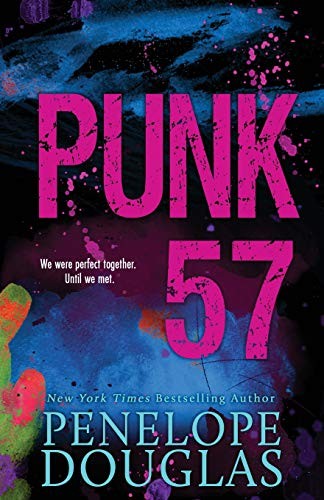
Punk 57
by Penelope Douglas
★ Top 10 book of 2016 · #8 on Best Books of 2016
Misha and Ryen spent seven years as pen pals, trading letters and arguments while keeping strict rules against photos, phone numbers or social media. When Misha finds a girl online who might be Ryen, he decides he must meet her.
Best for: Readers who enjoy edgy contemporary romance with an enemies-or-more, pen pal twist
Punk 57 is #8 on BookWard's Best Books of 2016, out of 70 2016 books that cleared our data bar.
What Punk 57 is about
In fifth grade, two kids at different schools are matched as pen pals. A mix-up gets things off to a funny start: Misha's name leads the other teacher to assume he is a girl, and Ryen's teacher assumes Ryen is a boy. They argue about everything, from the best take-out pizza to Android versus iPhone to whether Eminem is the greatest rapper, and for seven years the letters keep crossing, Ryen's written in silver on black paper.
Three rules keep the friendship intact: no social media, no phone numbers, no pictures. Then Misha spots a photo online of a girl who matches Ryen's details and decides he has to meet her. He does not expect to hate what he finds. Told in the alternating voices of Misha and Ryen, the story plays with the gap between the person you imagine and the person who turns up, and with what happens when a long-held trust is tested.
Punk 57 on the Best Books of 2016
Punk 57 came out in 2016. Of the 70 books first published in 2016 that met BookWard's data bar, it ranks #8 on our Best Books of 2016 list.
Why it made the list: 2,520 readers have shelved it on Open Library; readers rate it 4 out of 5 (65 ratings); 119 are reading it right now. The list ranks each year’s books on how many readers have picked them up, how highly readers rate them, and how many are reading them right now.
It earns Being read right now.
Nearby on the 2016 list
- Born a Crime Trevor Noah, #6
- Ikigai Héctor García, #7
- When Breath Becomes Air Paul Kalanithi, #9
- Deep Work Cal Newport, #10
See all Best Books of 2016 Best books by year
More years: Best Books of 2015 Best Books of 2017.
The numbers behind it
- Readers: 2,302 want to read it, 119 are reading it now and 98 have read it, according to Open Library.
- Ratings: 4 out of 5 from 65 Open Library ratings.
| Signal | This book (0 to 100) | Weight |
|---|---|---|
| Reach | 94 | 55% |
| Reader love | 56 | 25% |
| Being read right now | 91 | 20% |
Questions about Punk 57
When was Punk 57 published?
Punk 57 by Penelope Douglas was first published in 2016.
Was Punk 57 one of the best books of 2016?
Punk 57 is #8 on BookWard's Best Books of 2016, out of 70 2016 books that cleared our data bar. 2,520 readers have shelved it on Open Library; readers rate it 4 out of 5 (65 ratings); 119 are reading it right now.
Why is Punk 57 on the Best Books of 2016 list?
2,520 readers have shelved it on Open Library; readers rate it 4 out of 5 (65 ratings); 119 are reading it right now.
More of the best books of 2016
- It Ends with Us Colleen Hoover, #1
- Dog Man Dav Pilkey, #2
- The Subtle Art of Not Giving a F*ck Mark Manson, #3
- Never Split the Difference Chris Voss, #4
- The Hidden Oracle Rick Riordan, #5
- Born a Crime Trevor Noah, #6
See the full Best Books of 2016, the Top 100, or new books on Rising.
How we know
This page uses public data: Open Library reader counts and ratings, and Wikipedia page views for recent years. The description is paraphrased from real source text. Rankings reflect reading interest, not quality or sales, and can be affected by data gaps. Lists update monthly.
Best suited to older teens and adults, as it is a steamy contemporary romance with mature content.
Depends on the edition you pick.
Pen pals turn enemies in a heated, hooky enemies-to-lovers romance. 55% taste match
 BookWard’s take
Pen pals turn enemies in a heated, hooky enemies-to-lovers romance
Punk 57 opens on a strong premise: two people who wrote to each other for seven years, then meet and can't stand each other. That hook lands at once, and it's the kind of opening that earns a reader's attention right away. Where I part ways with it is in how familiar the territory feels. Enemies-to-lovers and the bad boy with a soft center are well-worn ground, even with the letter-writing twist giving it a fresh face. Two alternating narrators give each side of the story its own voice. The drive is firmly character-led, built on friction and longing. Romance is central, the content runs on the darker, steamier side, and the ending is fully resolved. A fast, absorbing read, more pleasure than surprise.
A contemporary romance that reads quickly rather than sprawling, which suits BookWard's preference for tight books reasonably well.
Constant friction between the leads keeps things moving fast, close to BookWard's quick-paced taste.
The long-running pen pal premise is a fresh angle, but the overall shape of the romance is familiar.
Plain, conversational sentences keep the focus on feeling and banter rather than ornament.
The story runs on the leads' emotions and clashing personalities more than on external events.
It travels through anger and hurt, but a romance like this leans toward connection, landing on the hopeful side.
Alternating narrators and letters add a little shape, but the layout is conventional romance.
Sharp banter and sarcasm lighten a tense story without making it a comedy.
Emotional hurt and a charged, sometimes edgy tone give it more bite than a gentle romance.
Longing, anger and tenderness run high throughout.
See all 50 dialsEvery position, side by side with this book
Where it lines up
- PaceBookWard 8 · book 8
- EndingBookWard 8 · book 8
- OpeningBookWard 10 · book 9
Where it pulls apart
- Familiar tropesBookWard 10 · book 3
- Internal logicBookWard 10 · book 5
- Shock for effectBookWard 9 · book 4
A contemporary romance that reads quickly rather than sprawling, which suits BookWard's preference for tight books reasonably well.
The pen pal mix-up and the meeting that goes wrong grab you early, matching BookWard's love of an immediate start.
Enemies-to-lovers and the brooding love interest are well-trodden, though the letters give them a twist; BookWard wants fewer familiar beats.
The setup works on its own terms, though a few choices run on romance logic rather than strict plausibility.
Constant friction between the leads keeps things moving fast, close to BookWard's quick-paced taste.
The long-running pen pal premise is a fresh angle, but the overall shape of the romance is familiar.
Both leads are driven by need and longing, giving more depth than stock types, though not the deepest portraits BookWard favors.
The central relationship reaches a clear resolution, in line with BookWard's liking for closure.
Big emotions and grand romantic gestures lean sentimental rather than restrained, which is less BookWard's style.
The tension and intensity are tied to the characters' histories more than to cheap jolts, though some beats push for drama.
Two narrators with distinct, attitude-heavy voices give the book a recognizable personality.
This is story-led all the way, driven by the relationship rather than any argument or concept, as BookWard prefers.
Backstory comes through the narrators' own recollections and letters, a bit more told than shown.
The push and pull between the leads keeps the middle charged, with only occasional repetition.
Plain, conversational sentences keep the focus on feeling and banter rather than ornament.
The story runs on the leads' emotions and clashing personalities more than on external events.
It travels through anger and hurt, but a romance like this leans toward connection, landing on the hopeful side.
Alternating narrators and letters add a little shape, but the layout is conventional romance.
Sharp banter and sarcasm lighten a tense story without making it a comedy.
Easy to read in big gulps, with no density or complexity to slow you down.
Two alternating narrators give a balanced pair of perspectives.
The seven years of letters sit behind the present-day meeting, but the story is built on a straightforward line.
Entirely grounded in everyday contemporary life.
The story is built around two leads, so the cast stays small.
A personal story about two people and their history, not a sweeping canvas.
Feelings, resentments and desire drive the telling more than outside action.
Argument and banter carry a large share of the story, making it dialogue-forward.
The love story is the whole engine of the book.
A recognizable modern setting with nothing foreign to learn.
Set firmly in the present day, with phones and the internet shaping the plot.
Rooted in contemporary romance conventions and reading culture, so it feels tied to its moment.
The narrators tell their own stories plainly, though they misjudge each other at times.
Right and wrong are fairly clear, as in most romance, though the leads clash and misread each other.
Description serves mood and attraction without lingering much.
Reads as a complete standalone love story.
Mistaken identity drives the setup, though the shape of the romance is predictable.
A familiar, immersive genre read more than a book that pushes you.
Emotional hurt and a charged, sometimes edgy tone give it more bite than a gentle romance.
Longing, anger and tenderness run high throughout.
Sarcastic and bantering, sitting in the middle between dry and broad.
Romance first, so violence is not the focus, though the tone carries some edge.
Romantic and sexual tension are prominent, with steamy content.
Politics barely register; this is about two people.
Clear modern English with casual slang and no barrier to understanding.
The narrators are opinionated and quick to judge, which colors everything we see.
Oriented toward what the characters might build next rather than what they lost.
Cynical defenses give way to a belief that real connection is possible.
Review written by BookWard, dial version 1, November 2026.
Who is Punk 57 right for?
Best suited to older teens and adults, as it is a steamy contemporary romance with mature content. It includes charged sexual tension and an edgy, emotionally intense tone.
Easy to read in big gulps, with no density or complexity to slow you down.
Emotional hurt and a charged, sometimes edgy tone give it more bite than a gentle romance.
Longing, anger and tenderness run high throughout.
Romance first, so violence is not the focus, though the tone carries some edge.
Book CompanionPunk 57: ideas, characters, themes
Two people who built an intimate bond through anonymous letters discover that the real person in front of them is nothing like the one they imagined.
- A mix-up that starts it all. A fifth-grade pen pal assignment pairs two kids who assumed they were writing to someone else, and the friendship grows from their arguments.
- Seven years of letters. Their connection is built on a steady habit of writing, with black paper and silver ink as a signature touch.
- Three simple rules. No social media, no phone numbers, no pictures: the rules keep the friendship pure and also keep them in the dark about each other.
- A photo changes everything. One image online sparks a decision to meet, setting up a collision between the person on paper and the person in real life.
- Two narrators, two sides. Alternating voices let you see how each character misreads the other.
Characters
Misha
Narrator and pen pal
The letter writer who relies on his pen pal to keep him steady and decides to track her down.
Ryen
Narrator and pen pal
The other half of the correspondence, who worries when the letters stop and clings to the idea of someone listening.
Themes
How honest you can be with someone you cannot see.
The gap between the person you imagine and the person who shows up.
The need for someone who listens and accepts you as you are.
Whether a bond built on words survives face-to-face contact.
What you reveal, and hide, about yourself in writing versus in person.
Discussion questions
- Do the three rules protect the friendship or sabotage it?
- Why might it be easier to be honest in letters than in person?
- How do the alternating narrators change the way you judge each character?
- Is the pull of the enemies-to-lovers dynamic more about chemistry or conflict?
- What does the letter-writing detail add to the story compared with texting?
Personalize your Book Companion
This is the general edition. In BookWard, the Companion is written for you: your reading profile, your notes, and spoiler-safe to the page you are on.
Buy, listen or borrow Punk 57
Each link opens a search for this book on that store, in a new tab.
Read on a device
Borrow
Reviews and community
If you liked Punk 57
A secrets-driven Dallas romance that favors feeling over surprise
HopelessColleen HooverA high-school romance with a buried trauma and a twist
Game OnNavessa AllenA steamy fake-dating revenge romance with banter and a morally gray hero
Heart BonesColleen HooverA summer fling with a rip current underneath
Find your own best books
Add what you have read, rate it, and BookWard will recommend what to read next.
Free to start. No credit card needed.