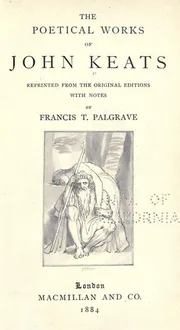
Poems by John Keats
by John Keats · 1800
Best suited to older teens and adults who enjoy poetry and can handle dense, archaic language.
337 pages, about 5.5 to 8 hours.
Keats's early verse: lush, musical, and unlike anything tidy. 42% taste match
What is inside
Poems by John Keats gathers the verse of one of the English Romantic poets, who lived from 1795 to 1821 and wrote in the early nineteenth century. This is a poetry collection, and the volume centers on twenty-five of his poems, opening with the line "I stood tiptoe upon a little hill," an invitation into the outdoor scenes that run through much of his early work.
The book belongs to the tradition of English poetry and sits among the collected works of a single author. Editions of Keats's poems have appeared in many forms over the years, with some drawing on his manuscripts and letters or presenting facsimile pages, and others adding biographical material and critical commentary alongside the poems themselves. A typical edition runs to roughly 337 pages. It suits readers who want to read Keats in his own words, or who are exploring the poets of the Romantic era and the English verse of the nineteenth century more broadly.
I stood tiptoe upon a little hill,
Period
19th century
Themes
English poetryCorrespondenceEnglish PoetsManuscriptsCriticism and interpretationFacsimilesBiographyPoetry
- Want to read 167
- Reading now 10
- Read 7
Most people shelving it are saving it for later.
Of 184 readers who put it on a shelf, 91% want to read it, 5% are reading it now, 4% have finished it and 0% stopped before the end.
By the numbers
- The median edition runs 337 pages. Counting about 275 words a page and an adult reading pace of 250 words a minute, that is about 6.2 hours of reading.
- Open Library tracks 200 editions from 139 publishers, the earliest dated 1800 and the latest 2009, across 3 languages.
- On reader demand it ranks in the top 13% of the classic books in our catalog (8,749 of them).
- Libraries shelve it under Dewey 821 and Library of Congress class PR-4832.00000000 1993b.
 BookWard’s take
Keats's early verse: lush, musical, and unlike anything tidy
This is Keats in his own words, and the opening line, "I stood tiptoe upon a little hill," sets the tone: outdoor scenes, close looking, a young poet testing his ear. The prose is ornate and sensuous, richer than the plainer line I tend to favor. The description is lush, with landscape and feeling pressed together. The staying power is considerable, since poems from the early nineteenth century still read as fresh. It won't grab you at once, because poetry opens at its own pace, and the effort is real, since the lines reward slow attention. The pace is slow by design. It suits readers who want to taste Romantic verse directly, and it rewards going one poem at a time rather than cover to cover.
A mid-sized volume at around 337 pages, though poems read in short bursts so it never feels sprawling.
Dense, musical lines invite lingering, which is the opposite of fast and a slower fit for BookWard.
Keats's sensory language and phrasing stand out even among the English Romantics.
The language is rich, ornate and sensuous, well past plain and a clear contrast with BookWard.
With little plot, the pull comes from the speaker's inner life and imagery.
Longing and loss sit alongside delight in beauty, leaving a mildly hopeful overall pull.
A collection of separate poems in recognized verse forms, conventional in shape.
This is serious, reflective verse with almost no comic intent.
The tone leans toward longing and wonder rather than grim content.
Feeling runs high, often yearning and ecstatic, expressed through image.
See all 50 dialsEvery position, side by side with this book
Where it lines up
- Shock for effectBookWard 9 · book 9
- ExpositionBookWard 2 · book 2
- OriginalityBookWard 9 · book 8
Where it pulls apart
- Internal logicBookWard 10 · book 4
- OpeningBookWard 10 · book 5
- LengthBookWard 1 · book 5
A mid-sized volume at around 337 pages, though poems read in short bursts so it never feels sprawling.
Poems begin with scene and image rather than a plot grab, so the pull is gentle rather than immediate.
Romantic nature imagery is a known register, yet Keats's handling stays fresh within it.
Poetry runs on feeling and image rather than strict cause and effect, so tight logic is not the aim.
Dense, musical lines invite lingering, which is the opposite of fast and a slower fit for BookWard.
Keats's sensory language and phrasing stand out even among the English Romantics.
Lyric poems center on a speaker's feeling rather than drawn characters, so depth of cast is not the point.
Individual poems close in their own ways, often on an image or a feeling rather than a neat resolution.
Warm, yearning feeling runs through the verse, though it is expressed through image more than sugar.
The book does not lean on shock; its intensity comes from beauty and longing rather than provocation.
This is verse, not argument, so the rigor dial does not apply.
Keats is instantly recognizable, and the voice is the main reason to read him.
Poems explore feeling, beauty and ideas more than they tell a story.
Meaning arrives through image and sound, never through explaining, which BookWard likes.
Variation between poems keeps things moving, though a long run of verse can blur in one sitting.
The language is rich, ornate and sensuous, well past plain and a clear contrast with BookWard.
With little plot, the pull comes from the speaker's inner life and imagery.
Longing and loss sit alongside delight in beauty, leaving a mildly hopeful overall pull.
A collection of separate poems in recognized verse forms, conventional in shape.
This is serious, reflective verse with almost no comic intent.
The syntax and imagery reward slow rereading, so this asks real attention from the reader.
A single lyric speaker carries nearly every poem.
Moments unfold in the present of the poem rather than jumping around in time.
Some imagery drifts toward the mythic and dreamlike while staying rooted in the natural world.
Few figures appear; the focus rests on the speaker and the scene.
Poems are intimate in scope, even when the images reach toward the grand.
Feeling and perception dominate over action, so the weight is on inner response.
Love and longing surface in many poems but are not the single organizing subject.
Early nineteenth-century English landscape and classical reference can feel remote to a modern reader.
Written two centuries ago, firmly of the past.
The verse is still read and loved long after its moment, a strong sign of staying power.
The poems linger on beauty and feeling without handing down clear verdicts.
Natural scenery and sensation are rendered with abundant, vivid detail.
Warm first-person voice, close to the speaker's own perception.
A standalone collection with no sequel structure.
Poems build mood rather than plot, so surprises are few.
The effort lies in the language rather than in a hard message, so it sits in the middle.
The tone leans toward longing and wonder rather than grim content.
Feeling runs high, often yearning and ecstatic, expressed through image.
Humor is largely absent.
Violence is not a feature of this verse.
Sensual imagery appears but remains mild and indirect.
Politics sits in the background and is not the book's concern.
Archaic phrasing and dense imagery make the language more challenging than plain modern prose.
The speaker is full of personal feeling and view, far from neutral.
Poems often look back to myth and nature, with a lean toward reflection over prediction.
A belief in beauty and imagination as worth living for gives the work an idealist glow.
Review written by BookWard, dial version 1, November 2026.
Who is Poems by John Keats right for?
Best suited to older teens and adults who enjoy poetry and can handle dense, archaic language. Nothing here is graphic, though some imagery is sensual and the tone can be melancholy.
The syntax and imagery reward slow rereading, so this asks real attention from the reader.
The tone leans toward longing and wonder rather than grim content.
Feeling runs high, often yearning and ecstatic, expressed through image.
Violence is not a feature of this verse.
Book CompanionPoems by John Keats: ideas, characters, themes
A young Romantic poet turns close attention to nature and feeling into rich, musical verse.
- Open air. The collection begins outdoors with the line "I stood tiptoe upon a little hill," setting scenes of landscape at the heart of the early work.
- One poet, many poems. The volume gathers the verse of a single author, so the pleasure is in following one voice across several pieces.
- Romantic roots. Keats belongs to the English Romantic poets of the early nineteenth century, and his poems reflect that tradition.
- Many editions. Versions of Keats's poems come with manuscripts, letters, facsimile pages, biography and commentary alongside the verse.
- Short life, lasting work. Keats lived from 1795 to 1821, and his poems have kept readers across the centuries since.
Themes
The natural world is a source of wonder and a mirror for feeling.
Beauty is treated as something worth lingering over and valuing for itself.
The poet's inner vision shapes how the outer world is seen.
Desire and yearning drive many of the poems.
Awareness of passing time colors the verse.
Discussion questions
- How does Keats use outdoor scenes to express feeling?
- Which image from the poems stays with you, and why?
- How does the sound of the verse shape its meaning?
- What makes this collection feel Romantic rather than merely old?
- Does knowing the poet's short life change how you read the poems?
Personalize your Book Companion
This is the general edition. In BookWard, the Companion is written for you: your reading profile, your notes, and spoiler-safe to the page you are on.
Buy, listen or borrow Poems by John Keats
Each link opens a search for this book on that store, in a new tab.
Read on a device
Borrow
Reviews and community
If you liked Poems by John Keats
Wordsworth's 1807 verse: nature, childhood and feeling in plain speech
Narziss und GoldmundHermann HesseTwo opposite men, one friendship, and a debate Hesse refuses to settle
John Donne PoetryJohn DonneDonne's poems, from bawdy elegies to holy sonnets, with scholarly notes
WaldenHenry David ThoreauTwo years by a pond, and a case against busyness
Sources: Open Library.
Track Poems by John Keats and find your next favorite
Add it to your shelf, rate what you have read, and BookWard will recommend what fits you.
Free to start. No credit card needed.