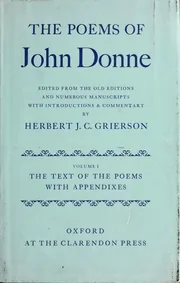
John Donne Poetry
by John Donne, John Booty · 1633
Best for mature teens and adults ready for dense early modern language.
274 pages, about 4.5 to 6.5 hours.
Donne's poems, from bawdy elegies to holy sonnets, with scholarly notes. 58% taste match
What is inside
This is a collection of the poetry of John Donne, the English writer who lived from 1572 to 1631, with first publication dating to 1633. It belongs to the seventeenth century and to the early modern period in English literature, and it gathers work across several kinds of verse. The poems are arranged under headings for satires, elegies, verse letters to various people, songs and sonnets, and divine poems, so love poetry and devotional poetry sit side by side in one volume.
The edition is a scholarly one in the Norton Critical series. Its texts draw on the Westmoreland manuscript where possible and are checked against other important manuscript families and against the seventeenth-century printed editions. Notes accompany the poems to explain unfamiliar words and point out historical references. A critical section follows, with writing on Donne and metaphysical poetry from figures such as Ben Jonson, Izaak Walton, John Dryden, Samuel Johnson and John Carey, along with studies of his early satires, elegies and verse letters by scholars including Arthur F. Marotti and Achsah Guibbory. The book runs to roughly 274 pages and has appeared in more than a hundred editions.
Away thou fondling motley humourist,
Period
Early modern, 1500-170017th century
Themes
Criticism and interpretationEnglish Christian literatureCorrespondenceEnglish Love poetryLiteratura inglesa (historia e critica)Critique et interprétationPoetryDevotional literature
- Want to read 136
- Reading now 6
- Read 10
Most people shelving it are saving it for later.
Of 152 readers who put it on a shelf, 89% want to read it, 4% are reading it now, 7% have finished it and 0% stopped before the end.
By the numbers
- The median edition runs 274 pages. Counting about 275 words a page and an adult reading pace of 250 words a minute, that is about 5.0 hours of reading.
- Open Library tracks 105 editions from 74 publishers, the earliest dated 1633 and the latest 2008, across 3 languages.
- On reader demand it ranks in the top 14% of the classic books in our catalog (8,749 of them).
- Libraries shelve it under Dewey 343.77107869 and Library of Congress class PR-2246.00000000.C37 1998.
 BookWard’s take
Donne's poems, from bawdy elegies to holy sonnets, with scholarly notes
This is John Donne's verse gathered in one Norton Critical volume, from the early satires and elegies through the Songs and Sonnets to the Divine Poems. The voice is unmistakable, and the originality still startles: Donne's argumentative, surprising conceits feel unlike anyone else's. The logic holds too, since his poems reason their way through a conceit step by step. The language is ornate and the reading demanding, so expect to slow down and lean on the notes, which gloss uncommon terms and historical references. Don't come here wanting an instant hook or a quick pace; these are poems to reread, not race through. The critical essays add useful context, with voices ranging from Ben Jonson to John Carey.
At 274 pages with critical essays and notes, it is mid-length, longer than BookWard's tight preference but easy to dip into.
Dense and compressed, the poems ask for slow reading, well below BookWard's fast-paced preference.
Few poets before or since match his startling comparisons, a strong fit with BookWard's love of the original.
Dense, metaphor-heavy seventeenth-century diction is ornate, further from BookWard's middle position.
Without plot, the poems are driven by the speaker's mind and feeling, aligning with BookWard's character lean.
Love poems celebrate and the divine poems wrestle with doubt and faith, balanced between hope and struggle.
The book is organized by genre sections, with poems themselves mildly unconventional in form and argument.
Wit is everywhere, but it is intellectual play more than comedy, so the tone stays mostly serious.
Death, sin and desire recur, yet the tone is intense rather than grim throughout.
Erotic longing and religious anguish give many poems high emotional intensity.
See all 50 dialsEvery position, side by side with this book
Where it lines up
- OriginalityBookWard 9 · book 9
- Familiar tropesBookWard 10 · book 9
- Internal logicBookWard 10 · book 9
Where it pulls apart
- LengthBookWard 1 · book 5
- Story or ideasBookWard 3 · book 9
- OpeningBookWard 10 · book 7
At 274 pages with critical essays and notes, it is mid-length, longer than BookWard's tight preference but easy to dip into.
Many poems open with a jolt, but the volume as a whole rewards patience, a partial match for BookWard's taste for instant hooks.
Donne's conceits broke with the conventional Petrarchan love language of his day, which BookWard values highly.
His poems argue a case in tight steps, even when the conceit is outrageous, which suits BookWard's airtight taste.
Dense and compressed, the poems ask for slow reading, well below BookWard's fast-paced preference.
Few poets before or since match his startling comparisons, a strong fit with BookWard's love of the original.
A speaker emerges through shifting moods of lover, skeptic and penitent, though these are voices rather than full characters.
Most poems close on a decisive turn or argument's end, so they land firmly, near BookWard's preference.
Donne is passionate but rarely soft; wit and argument check sentiment, which BookWard likes.
Bold sensual and spiritual imagery serves the argument rather than merely shocking, close to BookWard's taste.
The edition is carefully sourced from manuscripts and printed editions, with annotations, which BookWard rewards.
Donne's voice is among the most distinctive in English poetry, a top match for BookWard.
These are poems of argument and conceit rather than narrative, leaning well toward ideas, unlike BookWard's story lean.
Poems imply rather than explain, though the notes and essays supply explanation separately.
Across varied sections from satires to divine poems, the interest stays high through the volume.
Dense, metaphor-heavy seventeenth-century diction is ornate, further from BookWard's middle position.
Without plot, the poems are driven by the speaker's mind and feeling, aligning with BookWard's character lean.
Love poems celebrate and the divine poems wrestle with doubt and faith, balanced between hope and struggle.
The book is organized by genre sections, with poems themselves mildly unconventional in form and argument.
Wit is everywhere, but it is intellectual play more than comedy, so the tone stays mostly serious.
Archaic vocabulary, compressed argument and historical references make this demanding, more than BookWard's usual taste.
Each poem has a single speaker, though the volume ranges across lover, satirist, friend and penitent.
Poems are self-contained moments, not narrated across time, so the book reads as linear in effect.
Imagery is vivid and metaphysical, but the poems stay rooted in real experience and belief.
A speaker and an addressee, with occasional named patrons in the verse letters, make the cast small.
Poems are intimate, concerned with a lover, a friend or the soul, even when cosmic imagery appears.
Thought, feeling and argument dominate, with almost no outward action.
Poems are spoken to an addressee, but there is almost no exchanged dialogue.
Love and desire fill the Songs and Sonnets and elegies, making romance a major thread.
Seventeenth-century England and its assumptions are unfamiliar, and the notes help bridge the gap.
Written in the late sixteenth and early seventeenth centuries, far from the present day.
Love, death and faith keep the poems alive four centuries on.
Speakers argue persuasively and sometimes slyly, but are largely sincere.
Poems grapple with love, lust, faith and doubt, leaving real ambiguity, as in the Holy Sonnets.
Imagery comes through conceit and metaphor more than scene-setting, so description is moderate.
As a critical edition, the apparatus leans analytical, with annotations and scholarly essays.
Poems speak from an intensely personal stance, even when conventions shape them.
This is a single standalone volume.
Arguments turn unexpectedly, but within each poem rather than across a plot.
Demanding language and bold ideas about love and faith push the reader rather than comfort.
Death, sin and desire recur, yet the tone is intense rather than grim throughout.
Erotic longing and religious anguish give many poems high emotional intensity.
Humor is dry and ironic, built on wit and paradox.
Violence is rare and mostly figurative.
Some elegies and love poems are frankly erotic, though expressed through wit and metaphor.
Some satires touch on court and religious issues, but politics is not central.
Early modern English spelling, syntax and allusion make the language dense, though annotations help.
Donne's speakers argue forcefully and take strong positions throughout.
The poems draw on tradition and belief, looking inward and back more than ahead.
Love is often exalted, but cynicism and doubt appear throughout, so the worldview is mixed.
Review written by BookWard, dial version 1, November 2026.
Who is John Donne Poetry right for?
Best for mature teens and adults ready for dense early modern language. Some love poems are frankly sensual and the divine poems deal with sin and death.
Archaic vocabulary, compressed argument and historical references make this demanding, more than BookWard's usual taste.
Death, sin and desire recur, yet the tone is intense rather than grim throughout.
Erotic longing and religious anguish give many poems high emotional intensity.
Violence is rare and mostly figurative.
Book CompanionJohn Donne Poetry: ideas, characters, themes
Donne's poems turn love, desire and faith into sharp, witty arguments, collected here with the scholarship needed to read them well.
- Five kinds of verse. The book groups poems into satires, elegies, verse letters, Songs and Sonnets, and divine poems.
- Careful texts. Poems are drawn from the Westmoreland manuscript where possible and checked against other manuscripts and early printed editions.
- Notes for the reader. Annotations define uncommon words and explain historical references.
- Critical essays. Writing on Donne and metaphysical poetry runs from Ben Jonson and Dryden to modern scholars.
- Love beside devotion. Erotic and religious poems share one volume, inviting comparison of their methods.
Themes
How the poems treat passion, fidelity and the body.
The struggle of a Christian speaker in the Divine Poems.
Poems that persuade through surprising comparisons.
Death as a recurring pressure on love and belief.
The satires and verse letters show the social world around the poet.
Discussion questions
- How does a surprising conceit make a poem's argument more persuasive?
- What do the love poems and the divine poems share in method?
- How do the satires and elegies differ in tone from the Songs and Sonnets?
- Does the critical apparatus change how you read a poem you already know?
- Why might a poet use argument instead of plain statement to express feeling?
Personalize your Book Companion
This is the general edition. In BookWard, the Companion is written for you: your reading profile, your notes, and spoiler-safe to the page you are on.
Buy, listen or borrow John Donne Poetry
Each link opens a search for this book on that store, in a new tab.
Read on a device
Borrow
Reviews and community
If you liked John Donne Poetry
Baudelaire's scandalous, tightly built verse collection that founded modern poetry
Narziss und GoldmundHermann HesseTwo opposite men, one friendship, and a debate Hesse refuses to settle
Le rouge et le noirStendhalA provincial climber's ambition, studied with cold clarity across 518 pages
Der SteppenwolfHermann HesseA suicidal outsider's inner life, told with startling directness
Sources: Open Library.
Track John Donne Poetry and find your next favorite
Add it to your shelf, rate what you have read, and BookWard will recommend what fits you.
Free to start. No credit card needed.