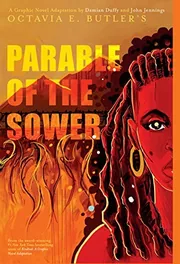
Parable of the Sower
by Octavia E. Butler · 1993
Best suited to mature teens and adults.
320 pages, about 5 to 7.5 hours.
A walled neighborhood burns, and one girl invents a religion. 70% taste match
The story
Parable of the Sower is a dystopian science fiction novel by Octavia E. Butler, first published in 1993. It is set in California in the year 2025, in a future shaped by climate change, social inequality, drugs, disease, war and chronic water shortages. The story centers on Lauren Olamina, a young African American woman who lives with her family in a walled neighborhood on the outskirts of Los Angeles. Her father is a preacher, and Lauren lives with hyperempathy, a condition that lets her feel the pain of the people around her.
When fire destroys the compound and her family is killed, Lauren is forced onto dangerous roads and heads north with a small group of refugees. Along the way she develops a belief system she calls Earthseed, built on the idea that God is Change and that people can shape it through deliberate effort. It also holds that humanity's destiny lies on other planets. The novel runs to roughly 320 pages and has appeared in 23 editions, including audiobook and graphic novel formats.
I had my recurring dream last night.
Setting
Southern CaliforniaCalifornia
Period
2025
Themes
Twenty-first centuryAfrican AmericansAudiobooksAmerican literatureNew York Times bestsellerDystopiasAfrican American womenPsychic ability
- Want to read 816
- Reading now 21
- Read 104
Most people shelving it are saving it for later.
Of 941 readers who put it on a shelf, 87% want to read it, 2% are reading it now, 11% have finished it and 0% stopped before the end.
By the numbers
- The median edition runs 320 pages. Counting about 275 words a page and an adult reading pace of 250 words a minute, that is about 5.9 hours of reading.
- Open Library tracks 23 editions from 17 publishers, the earliest dated 1993 and the latest 2024, across 4 languages.
- On reader demand it ranks in the top 1% of the modern books in our catalog (15,152 of them).
- Libraries shelve it under Dewey 813.54 and Library of Congress class PS-3552.00000000.U827 P37 2007.
 BookWard’s take
A walled neighborhood burns, and one girl invents a religion
Octavia E. Butler's 1993 novel puts Lauren Olamina in a walled neighborhood outside Los Angeles in 2025, in a country worn down by drought, drugs and war. It grips hard, because the world is under pressure from page one. It is strikingly original: Earthseed, the belief that God is Change, is an idea you will not have met elsewhere, and hyperempathy turns a small invented condition into a lens on cruelty. The pace is brisk once the journey north begins, and the world's logic holds, with every hardship following from the collapse around it. It is driven more by story than by argument, yet the ideas sit inside the scenes. The book is bleak but not gratuitous, and that restraint matters: the darkness serves the argument. At 320 pages it stays lean.
At roughly 320 pages it is compact for a novel of this ambition, which matches BookWard's taste for tight books.
Once the compound falls and the road north begins, momentum is steady, a little below BookWard's preferred speed.
A religion built on God is Change, paired with a character who feels others' pain, is genuinely fresh, as BookWard prizes.
The prose is clean and functional, plainer than BookWard's mid-range preference but in service of the story.
Events are forceful, yet they matter because of Lauren's convictions, so it tilts slightly toward character.
Earthseed offers real purpose within bleak circumstances, leaving it balanced, a little less hopeful than BookWard's lean.
Told as a personal account of a journey, it is mildly unconventional but easy to follow, near BookWard's middle.
This is a serious, grim book with almost no comic relief, and BookWard's lean toward humor finds little here.
Fire, death and brutality define the setting, making it darker than BookWard's balanced stance.
Grief and fear land hard through Lauren's empathy, comfortably within BookWard's range for emotional intensity.
See all 50 dialsEvery position, side by side with this book
Where it lines up
- OriginalityBookWard 9 · book 9
- Character depthBookWard 8 · book 8
- SentimentBookWard 8 · book 8
Where it pulls apart
- LengthBookWard 1 · book 3
- OpeningBookWard 10 · book 8
- Familiar tropesBookWard 10 · book 8
At roughly 320 pages it is compact for a novel of this ambition, which matches BookWard's taste for tight books.
The unstable, water-starved world presses on the reader from the opening, close to BookWard's love of an immediate pull.
Earthseed and hyperempathy keep it clear of stock dystopian furniture, which suits BookWard's dislike of leaning on tropes.
Collapse, scarcity and danger follow from one another credibly, so the world feels earned and consistent, as BookWard wants.
Once the compound falls and the road north begins, momentum is steady, a little below BookWard's preferred speed.
A religion built on God is Change, paired with a character who feels others' pain, is genuinely fresh, as BookWard prizes.
Lauren is drawn through her beliefs, her condition and her choices, giving the book the depth BookWard values.
The journey reaches a purposeful point but the larger project stays unfinished, more open than BookWard's taste for resolution.
Suffering is presented plainly without wringing the reader, close to BookWard's preference for restraint.
The brutality is tied to the world's logic and Lauren's condition, so the darkness feels earned, as BookWard wants.
Not a work of nonfiction, so this dial does not apply.
Butler's plain, urgent, diary-like address is unmistakable, and BookWard rewards a voice this distinctive.
Ideas about change and humanity's future drive it, but they arrive through a story, leaning more toward narrative than BookWard's story-first stance.
Beliefs and background are explained fairly directly at times, more than BookWard's show-in-scene preference.
The travelling structure keeps new dangers and encounters arriving, so it stays sustained, close to BookWard's taste.
The prose is clean and functional, plainer than BookWard's mid-range preference but in service of the story.
Events are forceful, yet they matter because of Lauren's convictions, so it tilts slightly toward character.
Earthseed offers real purpose within bleak circumstances, leaving it balanced, a little less hopeful than BookWard's lean.
Told as a personal account of a journey, it is mildly unconventional but easy to follow, near BookWard's middle.
This is a serious, grim book with almost no comic relief, and BookWard's lean toward humor finds little here.
The prose is accessible while the themes are weighty, making it a moderately easy read for BookWard.
The story stays with Lauren's perspective, narrower than BookWard's taste for many viewpoints.
The story proceeds in sequence along the journey, more linear than BookWard's preference for shifting time.
Aside from hyperempathy it is grounded in a plausible collapse, leaning realistic compared with BookWard's mid-range.
A small group gathers around Lauren, a cast neither tiny nor sprawling, near BookWard's comfort.
It covers a wider world but through one small band of travellers, so the feel is personal, near BookWard's middle.
Lauren's beliefs and sensitivity weigh as much as the dangers outside, leaving a mild tilt to action.
Conversation carries plenty of the group's debates and negotiations, close to BookWard's liking for dialogue.
The story is about survival and belief, with romance minor and below BookWard's middle setting.
A ruined future California is both recognizable and strange, less foreign than BookWard's usual setting preference.
It looks ahead from the early 1990s to a near future, a decent step from BookWard's present-day lean.
Its concerns about scarcity, inequality and belief keep resonating, sitting at the high end of BookWard's staying power.
Lauren records events directly and earnestly, making her a reliable guide, unlike BookWard's lean toward unreliable.
Choices carry real cost and the survivors compromise, so the morals are ambiguous in a way BookWard approves.
Environments are sketched with enough detail to feel threatening, but economy rules, a little under BookWard's lean.
Fiction, so this nonfiction-style dial does not apply.
Fiction, so this nonfiction-perspective dial does not apply.
It is the first of Earthseed books, which pushes it toward the series end, a little beyond BookWard's middle.
Disasters and turns arrive often, but they feel inevitable rather than clever, slightly below BookWard's appetite for surprise.
It confronts hard questions about society and survival without comfort, aligning with BookWard's taste for challenge.
Fire, death and brutality define the setting, making it darker than BookWard's balanced stance.
Grief and fear land hard through Lauren's empathy, comfortably within BookWard's range for emotional intensity.
Almost no humor appears, and what does is dry and brief, below BookWard's middle.
Killing and assault are part of the landscape, leaning toward a lot, more than BookWard's middle.
Sexual threat exists in the world but is not dwelt upon, somewhat below BookWard's middle.
Inequality, wealth and governance are central to the collapse, so the book is pointedly political, beyond BookWard's middle.
The language is plain and direct, easy to follow, well below BookWard's middle on difficulty.
Lauren's convictions colour her account, so narration is clearly opinionated, near BookWard's lean.
Earthseed's focus on change and the stars points forward, in line with BookWard's lean toward the future.
Lauren holds fast to a constructive vision amid ruin, balancing cynicism and idealism, close to BookWard's lean.
Review written by BookWard, dial version 1, November 2026.
Who is Parable of the Sower right for?
Best suited to mature teens and adults. It contains violence, death and threat of sexual assault within a harsh dystopian setting.
The prose is accessible while the themes are weighty, making it a moderately easy read for BookWard.
Fire, death and brutality define the setting, making it darker than BookWard's balanced stance.
Grief and fear land hard through Lauren's empathy, comfortably within BookWard's range for emotional intensity.
Killing and assault are part of the landscape, leaning toward a lot, more than BookWard's middle.
Book CompanionParable of the Sower: ideas, characters, themes
In a collapsing near-future California, Lauren Olamina forms a belief that God is Change and sets out to shape what comes next.
- A walled refuge. Lauren lives with her family in a defended neighborhood outside Los Angeles, safe only by comparison with the surrounding ruin.
- Hyperempathy. Lauren feels the pain of others, a condition that makes violence personal for her.
- The fire. When the compound is destroyed and her family killed, Lauren is forced onto the roads.
- North with refugees. She joins a small group of travellers heading north in search of safety.
- Earthseed. Along the way she develops a belief system built on change, deliberate action and humanity's future among other planets.
Characters
Lauren Olamina
Protagonist and narrator
A young woman with hyperempathy who develops the belief system Earthseed.
Lauren's father
Preacher
A preacher who tries to keep the community on a righteous path.
Themes
Earthseed holds that God is Change, and that people can shape it through conscious effort.
Lauren's ability to feel others' pain makes compassion a burden as well as a gift.
Social divisions and scarcity shape who survives in the collapsing world.
A new faith offers direction when old institutions fail.
Staying alive requires hard choices and uneasy alliances.
The book looks beyond ruin toward humanity's destiny among the stars.
Discussion questions
- Why does Lauren's hyperempathy matter so much in a violent world?
- Does Earthseed read as hope, ideology, or both?
- How does the walled neighborhood shape Lauren's view of safety?
- What does the book suggest about the role of leadership when systems collapse?
- Which of the story's hardships feels closest to the present day, and why?
Personalize your Book Companion
This is the general edition. In BookWard, the Companion is written for you: your reading profile, your notes, and spoiler-safe to the page you are on.
Buy, listen or borrow Parable of the Sower
Each link opens a search for this book on that store, in a new tab.
Read on a device
Borrow
Reviews and community
If you liked Parable of the Sower
A chilling dystopian chase built on a monstrous compromise
MockingjaySuzanne CollinsCollins ends The Hunger Games with a darker, angrier war story
Persepolis 1 & 2Marjane SatrapiA child's-eye memoir of revolution, drawn in stark black and white
Catching FireSuzanne CollinsA sequel that raises the stakes and widens the story
Sources: Open Library.
Track Parable of the Sower and find your next favorite
Add it to your shelf, rate what you have read, and BookWard will recommend what fits you.
Free to start. No credit card needed.