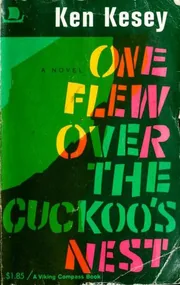
One Flew Over the Cuckoo's Nest
by Ken Kesey · 1962
Best suited to mature teens and adults.
311 pages, about 5 to 7.5 hours.
A ward, a rebel, and a narrator you cannot take at face value. 69% taste match
The story
Ken Kesey's One Flew Over the Cuckoo's Nest, first published in 1962, is a novel set in a psychiatric hospital in Oregon. It belongs to the tradition of literary fiction and medical novels, and it works as an allegory, using the ward as a lens on how institutions operate and how the human mind is treated within them. The book takes a critical look at psychiatry while also standing up for individualistic principles.
The story centers on the patients and staff of the ward, among them Randle Patrick McMurphy, Broom Bromden, and Nurse Ratched, who is also called the Big Nurse. The narration has an unusual point of view, which shapes how events on the ward are presented. The novel runs to roughly 311 pages in its median edition, and more than a hundred editions have been issued. It was adapted into a Broadway play by Dale Wasserman in 1963, and Bo Goldman's screenplay became a 1975 film directed by Miloš Forman, which won five Academy Awards.
Characters
Randle Patrick McMurphyBroom BromdenNurse RatchedBig Nurse
Setting
United StatesOregon
Themes
Allegoriespsychiatric nursingmedical novelsBelletristische DarstellungPsychiatrische KlinikPsychiatric hospital patientsPsychiatric nursesMentally ill
- Want to read 445
- Reading now 33
- Read 81
Most people shelving it are saving it for later.
Of 559 readers who put it on a shelf, 80% want to read it, 6% are reading it now, 14% have finished it and 0% stopped before the end.
By the numbers
- The median edition runs 311 pages. Counting about 275 words a page and an adult reading pace of 250 words a minute, that is about 5.7 hours of reading.
- Open Library tracks 103 editions from 67 publishers, the earliest dated 1962 and the latest 2019, across 13 languages.
- On reader demand it ranks in the top 2% of the classic books in our catalog (8,749 of them).
- Libraries shelve it under Dewey 813.5 and Library of Congress class PS-3561.00000000.E667 O5 2007.
 BookWard’s take
A ward, a rebel, and a narrator you cannot take at face value
Kesey's 1962 novel puts an Oregon psychiatric ward under a microscope and lets Randle McMurphy loose inside it. It is character-driven and tightly staged, and it reads faster than its length would suggest: at 311 pages it moves quickly, and the Big Nurse gives the story a steady pressure that keeps the middle from sagging. The allegory and the unusual narration still feel fresh, and Broom Bromden's perspective is unmistakable. It is more openly emotional than I tend to like, and its moral outlook is closer to clear-cut than ambiguous, but it earns its darkness rather than leaning on shock. A hard book to forget.
At 311 pages it is compact and purposeful, which suits BookWard's love of tight books.
Scenes on the ward move briskly and the book rarely lingers, close to BookWard's own appetite for speed.
An allegory told through an unusual narrator was distinctive in 1962 and still stands out.
The language is vivid and at times lyrical, more ornate than BookWard's middle-of-the-road preference.
The story runs on who these people are and how they clash, which BookWard enjoys.
It offers moments of defiance and solidarity but leans toward the bleak, below BookWard's outlook.
The structure is conventional in sequence, with the narration doing the unusual work.
There is dark, rebellious humor in the ward's antics, balanced against a serious core.
The subject matter is heavy, though handled with purpose.
The conflicts land hard and the book is emotionally intense, a touch above BookWard's level.
See all 50 dialsEvery position, side by side with this book
Where it lines up
- Character depthBookWard 8 · book 8
- EndingBookWard 8 · book 8
- Authorial voiceBookWard 9 · book 9
Where it pulls apart
- OpeningBookWard 10 · book 7
- Familiar tropesBookWard 10 · book 7
- Internal logicBookWard 10 · book 7
At 311 pages it is compact and purposeful, which suits BookWard's love of tight books.
The ward and its characters draw you in quickly, though the book builds its pressure rather than detonating at once.
The rebel-versus-institution setup is familiar, but the ward setting and the narration keep it from feeling stock.
The ward's rules and power structure hold together consistently, which BookWard values.
Scenes on the ward move briskly and the book rarely lingers, close to BookWard's own appetite for speed.
An allegory told through an unusual narrator was distinctive in 1962 and still stands out.
McMurphy, Bromden and Nurse Ratched are vividly drawn, though some lean toward symbol, a slight gap from BookWard's ideal.
The story resolves with real finality rather than drifting, which matches BookWard's preference.
It does reach for feeling, but through hard scenes rather than softness, so it sits mid-range on restraint.
The darkness serves the critique of the institution instead of existing for effect, which BookWard respects.
This is fiction, so the nonfiction rigor dial does not apply.
Bromden's narration gives the book a voice that is unmistakably its own.
It carries a clear argument about institutions, but it is delivered through story and character first.
Ideas arrive through scenes and behavior on the ward rather than lectures, in line with BookWard's taste.
The contest between McMurphy and the Big Nurse keeps tension up from start to finish.
The language is vivid and at times lyrical, more ornate than BookWard's middle-of-the-road preference.
The story runs on who these people are and how they clash, which BookWard enjoys.
It offers moments of defiance and solidarity but leans toward the bleak, below BookWard's outlook.
The structure is conventional in sequence, with the narration doing the unusual work.
There is dark, rebellious humor in the ward's antics, balanced against a serious core.
Accessible to read, though its allegory and viewpoint reward attention.
Everything is filtered through a single narrator, well below BookWard's taste for many viewpoints.
The story moves forward in a largely linear way.
Mostly realistic, with the narrator's perception adding a slightly heightened edge.
A ward full of patients and staff gives it a moderately sized, memorable cast.
Nearly everything happens inside one hospital, an intimate canvas with outsized stakes.
It balances the narrator's perceptions with the action of ward life.
Group sessions and ward confrontations give conversation a major role.
Romance is a very minor thread beside the struggle for control of the ward.
A psychiatric ward is unfamiliar territory for most readers, which BookWard enjoys.
Its early 1960s setting places it firmly in the past.
Its questions about institutions and individuality have kept it in print and in conversation for decades.
The narrator's perspective shapes and filters what we see, giving the book an unsettled edge BookWard likes.
The book clearly sides with the individual against the system, though not without complexity.
The ward and its inhabitants are rendered in concrete, vivid detail.
This is a novel, so the nonfiction style dial does not apply.
This is fiction, so the nonfiction perspective dial does not apply.
It stands alone as a single complete novel.
The plot develops in satisfying turns without relying on constant reversals.
It confronts uncomfortable questions about conformity and control rather than soothing the reader.
The subject matter is heavy, though handled with purpose.
The conflicts land hard and the book is emotionally intense, a touch above BookWard's level.
The humor mixes dry wit and broader ward high jinks.
Some scenes are harsh, but violence is not the book's main currency.
Sexual content is present but limited.
It is a critique of institutional power, giving it a clear political charge without being polemic.
The language is plain and readable with a colloquial flavor.
The narrator's lens is distinctly opinionated rather than neutral.
It is rooted in its moment and looking at the present more than forward.
It champions individual spirit while staying clear-eyed about institutional power.
Review written by BookWard, dial version 1, November 2026.
Who is One Flew Over the Cuckoo's Nest right for?
Best suited to mature teens and adults. It deals with mental illness, institutional cruelty and some harsh scenes, so readers sensitive to those topics may want to be prepared.
Accessible to read, though its allegory and viewpoint reward attention.
The subject matter is heavy, though handled with purpose.
The conflicts land hard and the book is emotionally intense, a touch above BookWard's level.
Some scenes are harsh, but violence is not the book's main currency.
Book CompanionOne Flew Over the Cuckoo's Nest: ideas, characters, themes
A psychiatric ward becomes a stage for the struggle between an individual's spirit and an institution that demands conformity.
- The ward as allegory. Kesey uses a single hospital ward to examine how institutions operate and how people are treated inside them.
- Individual versus system. McMurphy's arrival sets one man's independence against the ward's rigid order.
- A critique of psychiatry. The novel takes a critical look at how the mind is treated in institutional settings.
- An unusual point of view. The narration shapes how events on the ward are presented and what the reader can trust.
- A story that traveled. It became a 1963 Broadway play and a 1975 film that won five Academy Awards.
Characters
Randle Patrick McMurphy
Patient who disrupts the ward
His independence challenges the routines that govern everyone else on the ward.
Nurse Ratched
The Big Nurse
She represents order and control on the ward and is McMurphy's chief antagonist.
Broom Bromden
Patient and narrator
His unusual perspective shapes how the ward and its events are presented.
Themes
The value of a person's own will and spirit against pressure to conform.
How systems control the people inside them through rules and routine.
Who gets defined as mentally ill and what that definition does to them.
What resistance costs and what it can inspire in others.
How the narrator's way of seeing colors what we understand.
Discussion questions
- How does the narrator's point of view change the way you read events on the ward?
- Is McMurphy a hero, a disruptor, or both?
- What does the Big Nurse represent beyond one person?
- How does the novel balance critique of psychiatry with its story about individuals?
- Why do you think this story has been adapted for stage and screen so often?
Personalize your Book Companion
This is the general edition. In BookWard, the Companion is written for you: your reading profile, your notes, and spoiler-safe to the page you are on.
Buy, listen or borrow One Flew Over the Cuckoo's Nest
Each link opens a search for this book on that store, in a new tab.
Read on a device
Borrow
Reviews and community
If you liked One Flew Over the Cuckoo's Nest
A Burundian childhood breaks apart as history reaches the street
The Color of WaterJames McBrideA son's memoir, and his mother's own voice breaking through it
Different SeasonsStephen KingFour King novellas, one for each season, with horror held back
To Kill a MockingbirdHarper LeeWarm, funny and morally clear: a classic that earns its reputation
Sources: Open Library.
Track One Flew Over the Cuckoo's Nest and find your next favorite
Add it to your shelf, rate what you have read, and BookWard will recommend what fits you.
Free to start. No credit card needed.