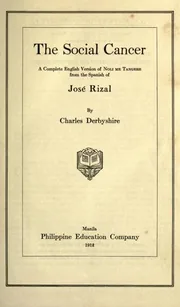
Noli Me Tangere
by José Rizal · 1887
Best for mature teens and adults, and it is a common school text in the Philippines.
449 pages, about 7 to 10.5 hours.
Rizal's satirical colonial novel opens at a dinner and aims at power. 52% taste match
The story
Noli Me Tangere is a historical novel by José Rizal, first published in 1887 and written in the Philippines under Spanish colonial rule. It belongs to Philippine literature and is widely read in English translation, with a median length of around 449 pages across 135 editions.
The story follows Crisostomo Ibarra, who returns to his hometown of San Diego after time in Spain, where he learns of the hardships his father, a wealthy illustrado, faced before his death. He takes up his father's plan to build a school and hopes to be reunited with his childhood sweetheart, Maria Clara, while the priest Padre Damaso stands in opposition. The novel opens with a dinner given by Don Santiago de los Santos, known as Capitan Tiago. Its cast of characters represents many kinds of Filipinos, and it examines unequal treatment of local people by the colonial government and the Spanish Catholic friars in the late nineteenth century. Settings include San Diego, Manila, and Spain, with some humor and romance woven through the narrative.
On the last of October Don Santiago de los Santos, popularly known as Capitan Tiago, gave a dinner.
Characters
Maria ClaraFilipino
Setting
PhilippinesSan DiegoSpainManila
Period
1812-189817th century Philippines
Themes
EconomicsClassic LiteratureHistoryPhilippine literaturePhilippinesTagalog languageSpanish erahistorical novel
- Want to read 350
- Reading now 25
- Read 11
Most people shelving it are saving it for later.
Of 386 readers who put it on a shelf, 91% want to read it, 6% are reading it now, 3% have finished it and 0% stopped before the end.
By the numbers
- The median edition runs 449 pages. Counting about 275 words a page and an adult reading pace of 250 words a minute, that is about 8.2 hours of reading.
- Open Library tracks 135 editions from 73 publishers, the earliest dated 1902 and the latest 2026, across 6 languages.
- On reader demand it ranks in the top 6% of the classic books in our catalog (8,749 of them).
- Libraries shelve it under Dewey 863.5 and Library of Congress class PZ-0003.00000000.R5285.
 BookWard’s take
Rizal's satirical colonial novel opens at a dinner and aims at power
Rizal's 1887 novel begins at a dinner given by Capitan Tiago, a scene that sets a large, varied cast moving all at once. The voice is a real strength: the satire is unmistakably his own, and the characters have depth, since together they stand for many kinds of Filipinos. It is a long book, 449 pages in a typical edition, longer than I usually like, and its politics sit front and center, aimed at colonial rule and the friars. The pace is steady rather than fast, and the prose is more formal than plain. The humor and the romance with Maria Clara bring warmth, but the book argues as much as it narrates. Read it for the history it carries and the nerve it took to write.
At 449 pages in a typical edition it runs long, well above the tight books BookWard favors.
The story moves steadily through town life and conflict, slower than BookWard's preferred brisk pace.
A satirical novel of colonial Philippine society was bold for its time, and BookWard values that.
The 19th-century style is formal and more ornate than plain, a bit beyond BookWard's middle ground.
Plot and character share the work, with characters standing in for society's types as the story advances.
The book dwells on injustice and loss more than on hope, cooler than BookWard's mildly hopeful lean.
The structure is largely conventional, with chapters moving through a connected story.
There is satirical humor woven through, though the book's tone stays mostly serious.
See all 50 dialsEvery position, side by side with this book
Where it lines up
- Character depthBookWard 8 · book 8
- Authorial voiceBookWard 9 · book 9
- OriginalityBookWard 9 · book 8
Where it pulls apart
- LengthBookWard 1 · book 7
- OpeningBookWard 10 · book 6
- Familiar tropesBookWard 10 · book 6
At 449 pages in a typical edition it runs long, well above the tight books BookWard favors.
It opens on a dinner party that introduces a crowd quickly, a decent start though not an instant grab.
Some romance and villain-priest patterns are familiar, but the colonial setting and satirical aim keep it fresh.
Events follow from the social and political order Rizal builds, which holds together well and suits BookWard.
The story moves steadily through town life and conflict, slower than BookWard's preferred brisk pace.
A satirical novel of colonial Philippine society was bold for its time, and BookWard values that.
The cast is built to represent many kinds of Filipinos, drawn with more depth than types.
The story gives a firm sense of where its conflicts lead, close to BookWard's liking for resolution.
The romance carries feeling, but the satire keeps the book sharper than sentimental.
Its harsh treatment of injustice serves the argument rather than being there for effect, which BookWard respects.
It is fiction, but rooted in real colonial abuses of the late nineteenth century.
Rizal's satirical, pointed voice is distinct and recognizably his, a strong fit for BookWard.
It carries a clear argument about colonial society while still moving through a story, balancing the two.
Rizal often explains social conditions outright, more than BookWard's preference for showing in scene.
The long town-life sections can slow the middle, though the central conflict keeps pulling forward.
The 19th-century style is formal and more ornate than plain, a bit beyond BookWard's middle ground.
Plot and character share the work, with characters standing in for society's types as the story advances.
The book dwells on injustice and loss more than on hope, cooler than BookWard's mildly hopeful lean.
The structure is largely conventional, with chapters moving through a connected story.
There is satirical humor woven through, though the book's tone stays mostly serious.
Its period setting, Spanish and Tagalog context, and length ask for some effort from the reader.
The wide cast brings in many perspectives on colonial life, more than a single viewpoint.
The story moves forward in a largely linear way from Ibarra's return home.
It is grounded in a real place and period, with no fantasy.
A large cast stands for many types of Filipinos in the colonial era.
It spans a whole society and its institutions, wider than a purely intimate story.
It balances characters' inner lives with social events and conflicts around them.
Conversation drives much of the argument and social comedy, so dialogue weighs heavily.
The bond between Ibarra and Maria Clara is a real thread, though politics shares the stage.
San Diego, Manila and Spain under colonial rule will be unfamiliar to many readers.
It is set in the 19th-century Spanish colonial period, far from the present.
Its attack on abuse of power and its place in Philippine literature keep it widely read.
The narration is trustworthy in guiding readers through events, with no unreliability.
The book takes clear sides against colonial abuse, though some characters carry mixed motives.
Rizal paints town life and its social scenes in rich, particular detail.
Review written by BookWard, dial version 1, November 2026.
Who is Noli Me Tangere right for?
Best for mature teens and adults, and it is a common school text in the Philippines. It deals with injustice, abuse of power and loss, and its period language and length ask for patience.
Its period setting, Spanish and Tagalog context, and length ask for some effort from the reader.
Book CompanionNoli Me Tangere: ideas, characters, themes
Rizal uses a story of one young man's return home to expose how colonial rule and the friars wronged Filipinos.
- A homecoming. Crisostomo Ibarra returns to San Diego from Spain to mourn his father.
- A hard discovery. He learns how his father, a wealthy illustrado, suffered before his death.
- A school plan. Ibarra takes up his father's plan to build a school.
- An opponent. Padre Damaso, the former parish priest, stands against him and his hopes.
- A society on the page. Many characters stand for the kinds of Filipinos living under Spanish rule.
Characters
Crisostomo Ibarra
Protagonist
A young man who returns from Spain to his hometown and carries on his father's school plan.
Maria Clara
Childhood sweetheart
The woman Ibarra hopes to be reunited with, from a wealthy family.
Padre Damaso
Antagonist
The former parish priest who opposes Ibarra and his hopes.
Capitan Tiago
Host
Don Santiago de los Santos, whose dinner opens the novel.
Themes
How rulers and friars treat local people unequally.
The school as a hope for the town's future.
A romance pressed by social and religious power.
The book's picture of a cancer eating at colonial society.
The many kinds of Filipino life the cast represents.
Discussion questions
- Why does Rizal open with a dinner rather than with Ibarra?
- How does Padre Damaso embody the book's criticism of the friars?
- What does the school stand for in Ibarra's plans?
- How do the many minor characters shape your view of San Diego?
- Why might a novel like this have mattered so much in its time?
Personalize your Book Companion
This is the general edition. In BookWard, the Companion is written for you: your reading profile, your notes, and spoiler-safe to the page you are on.
Buy, listen or borrow Noli Me Tangere
Each link opens a search for this book on that store, in a new tab.
Read on a device
Borrow
Reviews and community
If you liked Noli Me Tangere
A murder mystery inside a succession contest, narrated with a wink
ShōgunJames ClavellA thousand-page plunge into feudal Japan, pulled along by intrigue
The Poisonwood BibleBarbara KingsolverA family's undoing in the Congo, told by five women
Novels (Adventures of Huckleberry Finn / Adventures of Tom Sawyer)Mark TwainTwo Twain classics: a boy's summer, then a river escape
Sources: Open Library.
Track Noli Me Tangere and find your next favorite
Add it to your shelf, rate what you have read, and BookWard will recommend what fits you.
Free to start. No credit card needed.