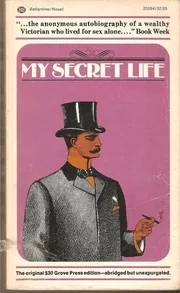
This is an adult book that suits mature readers with an interest in history or the literature of sexuality.
418 pages, about 6.5 to 10 hours.
A Victorian man's explicit, unrepentant memoir of a lifetime of appetite. 41% taste match
The story
My Secret Life is an erotic memoir attributed to a Victorian Englishman who goes by the name Walter. Presented in the first person, it begins with the narrator's earliest memories of sexual matters in childhood and follows his experiences through the decades of his adult life, up to the close of what he calls his amatory career. The work runs to roughly 418 pages in its median edition and first appeared in the form discussed here in 1966, with 64 editions in all.
The book is set in nineteenth-century Great Britain, chiefly in London and elsewhere in England, with episodes in Scotland and on the European continent. It records hundreds of encounters and sets them against the public restraint of the Victorian period. Shelved with classic literature, English erotic writing and works on sex customs, it is also read as a record of private habits and of the behavior of a man who describes himself as driven by his appetites. Readers interested in Victorian social history, the literature of sexuality, or first-person confessional writing from the period will find it fits those subjects.
My earliest recollections of things sexual are of what I think must have occurred some time between my age of five and eight years.
Characters
Walter
Setting
London and other parts of EnglandScotlandContinental EuropeLondonEngland
Period
19th Century
Themes
Classic LiteratureErotic literatureSex customsEnglish Erotic literatureSexPornographySex addictionSex addicts
- Want to read 260
- Reading now 25
- Read 13
Most people shelving it are saving it for later.
Of 298 readers who put it on a shelf, 87% want to read it, 8% are reading it now, 4% have finished it and 0% stopped before the end.
By the numbers
- The median edition runs 418 pages. Counting about 275 words a page and an adult reading pace of 250 words a minute, that is about 7.7 hours of reading.
- Open Library tracks 64 editions from 33 publishers, the earliest dated 1966 and the latest 2022.
- On reader demand it ranks in the top 9% of the classic books in our catalog (8,749 of them).
- Libraries shelve it under Dewey 301.417924 and Library of Congress class PR-5990.00000000.
 BookWard’s take
A Victorian man's explicit, unrepentant memoir of a lifetime of appetite
My Secret Life is a first-person erotic memoir attributed to a Victorian Englishman who calls himself Walter. It begins in early childhood and follows his sexual history through the decades, set against a public culture of repression. The sexual content is as explicit and constant as the genre allows, and the encounters repeat by design, so it is not leaning on familiar tropes so much as building a deliberate pattern out of repetition. The reading itself is easy, since the plain prose does little to slow you down. But the length and recurring structure make the middle sag more than in most books. The writing is loose and unrestrained where I tend to prefer tight, original, restrained work, so this is an awkward match. Its real value is as a document of private Victorian habits and self-justifying confession, with a narrator whose view of himself deserves scrutiny.
Hundreds of encounters over a whole life make this a long, cumulative work, far from BookWard's preference for tight books.
Episodic encounters keep things moving, but the steady accumulation makes the momentum even rather than fast.
Its candor was unusual for its era, though the repeated pattern limits freshness for a modern reader.
The writing is plain, direct and unadorned, closer to a diary or ledger than literary prose.
There is no plot to drive it, so the narrator's character and habits carry the book.
The tone is more appetite and self-regard than optimism, leaning toward the bleak side.
Chronological and conventional in form, with no formal experiment.
Walter is not out to amuse, and the tone stays serious and matter-of-fact.
The material is frank and at times troubling, though not relentlessly grim in tone.
Feeling is largely subordinate to appetite, so the emotional register stays fairly cool.
See all 50 dialsEvery position, side by side with this book
Where it lines up
- SentimentBookWard 8 · book 7
- Authorial voiceBookWard 9 · book 8
- Story or ideasBookWard 3 · book 4
Where it pulls apart
- Familiar tropesBookWard 10 · book 3
- LengthBookWard 1 · book 7
- OpeningBookWard 10 · book 6
Hundreds of encounters over a whole life make this a long, cumulative work, far from BookWard's preference for tight books.
The childhood-memory opening is frank and arresting, though it announces its subject more than it grips with tension.
The structure leans on repetition of encounters, and the confessional-erotic mode follows well-worn conventions.
A memoir has its own internal consistency, but the narrator's self-account is selective rather than airtight.
Episodic encounters keep things moving, but the steady accumulation makes the momentum even rather than fast.
Its candor was unusual for its era, though the repeated pattern limits freshness for a modern reader.
Walter is vivid in his appetites, but the many people he encounters are mostly sketched in passing.
It closes with the end of his self-described amatory career, a natural stopping point rather than a dramatic resolution.
Walter is more self-justifying than sentimental, though he does not hold feeling at a restrained distance.
The explicitness is the point of the book, but its candor is documentary rather than darkness engineered for effect.
It is a personal record, not scholarship, though it carries real value as a source on Victorian sexual customs.
The unapologetic first-person confessional voice is strongly its own, even if it is not likable.
The book is built on accumulated experience, with little argument beyond what the narrator's life implies.
Walter tends to narrate and explain his motives and encounters directly instead of letting scenes speak.
The repetitive episodic structure makes it hard to sustain interest across more than four hundred pages.
The writing is plain, direct and unadorned, closer to a diary or ledger than literary prose.
There is no plot to drive it, so the narrator's character and habits carry the book.
The tone is more appetite and self-regard than optimism, leaning toward the bleak side.
Chronological and conventional in form, with no formal experiment.
Walter is not out to amuse, and the tone stays serious and matter-of-fact.
The prose is easy to read, though the material and length ask for stamina.
It is told entirely from Walter's single perspective.
The memoir moves forward from childhood through adult life in a linear way.
It is a grounded account of real-world encounters in Victorian Britain.
Hundreds of encounters mean a very large, mostly transient cast of partners and acquaintances.
Though it spans a lifetime, the focus stays on one man's private life rather than epic events.
Walter records actions and encounters but also his motives and reflections, so it is balanced.
Reported conversations appear in many encounters, though narration carries most of the book.
Desire dominates, but romance in the sense of lasting attachment is minor.
Victorian London and the provinces will feel unfamiliar to most readers today, as will its hidden social world.
It is firmly set in the nineteenth century and reads as a period document.
Its value as a historical and confessional record endures, though its manner is tied to its period.
Walter tells his own story and shapes it to flatter his appetites, so his account invites suspicion.
The book offers no moral verdict, leaving readers to judge the narrator and his conduct.
Encounters and settings are described in considerable, often explicit detail.
It reads as a personal narrative rather than analysis.
It is intensely personal, told by the man who lived it.
It stands alone as a single, long memoir.
Episodes accumulate without plot reversals, so surprise is rare.
The explicit content and the narrator's attitudes challenge many modern readers.
The material is frank and at times troubling, though not relentlessly grim in tone.
Feeling is largely subordinate to appetite, so the emotional register stays fairly cool.
Any humor is incidental and dry rather than broad.
Violence is not a central feature, though some encounters may carry coercive edges.
Explicit sexual content is the whole substance of the book.
Politics sits in the background, with class and social custom more present than ideology.
The Victorian English is readable, with some period vocabulary but no dense dialect.
Walter freely states his tastes, judgments and justifications, so the narration is strongly opinionated.
It looks back over a lifetime as recollection and record.
The worldview is self-interested and unsentimental rather than idealistic.
Review written by BookWard, dial version 1, November 2026.
Who is My Secret Life right for?
This is an adult book that suits mature readers with an interest in history or the literature of sexuality. It contains explicit sexual content throughout, including recollections beginning in childhood, which some readers will find disturbing.
The prose is easy to read, though the material and length ask for stamina.
The material is frank and at times troubling, though not relentlessly grim in tone.
Feeling is largely subordinate to appetite, so the emotional register stays fairly cool.
Violence is not a central feature, though some encounters may carry coercive edges.
Book CompanionMy Secret Life: ideas, characters, themes
A man known only as Walter records a lifetime of sexual experience, exposing a private side of Victorian life that contrasts with its public restraint.
- A confession from childhood. The memoir begins with the narrator's earliest sexual recollections, placing them between the ages of five and eight.
- A lifetime, in order. It follows his experiences through the decades up to the close of what he calls his amatory career.
- Hundreds of encounters. The book is built from an accumulation of episodes rather than a single driving plot.
- Britain and beyond. The setting is chiefly London and elsewhere in England, with episodes in Scotland and on the European continent.
- Private versus public. The record is set against the Victorian era's reputation for repression.
Characters
Walter
Narrator
The pseudonymous Victorian Englishman who tells his own story and describes himself as driven by his appetites.
Themes
The private habits that lay behind a publicly restrained era.
Desire as a driving force in the narrator's life and choices.
The first-person record as self-account and self-justification.
The gap between public morality and private behavior.
Discussion questions
- How far should we trust a narrator who is recording his own life and describing himself as driven by his appetites?
- What does the book reveal about the gap between Victorian public restraint and private behavior?
- Does the repetition of encounters build meaning, or does it flatten the experience of reading?
- How should a modern reader weigh the book's historical value against its content?
- What difference does it make that the author is known only as Walter?
Personalize your Book Companion
This is the general edition. In BookWard, the Companion is written for you: your reading profile, your notes, and spoiler-safe to the page you are on.
Buy, listen or borrow My Secret Life
Each link opens a search for this book on that store, in a new tab.
Read on a device
Borrow
Reviews and community
If you liked My Secret Life
A profiler's firsthand tour through the minds of killers
Mercury and MeJim HuttonA partner's close-up of Freddie Mercury's private final years
JunkyWilliam S. BurroughsA flat, unflinching ledger of addiction from Burroughs's debut
Tropic of CancerHenry MillerA raw, voice-driven Paris of hunger, talk and appetite
Sources: Open Library.
Track My Secret Life and find your next favorite
Add it to your shelf, rate what you have read, and BookWard will recommend what fits you.
Free to start. No credit card needed.