Suits mature teens and adults who enjoy fast, large-scale science fiction adventure.
672 pages, about 10.5 to 15.5 hours.
Darrow's revolution reaches its breaking point in Red Rising's third book. 48% taste match
The story
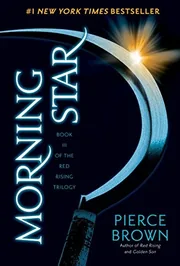
Morning Star is a science fiction novel by American author Pierce Brown, first published in 2016. It is the third book in the Red Rising Trilogy, part of the wider Red Rising saga, and runs to roughly 672 pages in its median edition. The story sits within a dystopian setting of space colonies, where a rigid class system keeps power in the hands of a ruling elite and the question of resisting that government drives the plot.
The central figure is Darrow, who began life as a Red miner on Mars and was later remade into a Gold in order to work against the ruling class from within. Having escaped capture, he returns to his campaign against the Sovereign of the Society, gathering the resources and allies he needs to confront the forces arrayed against him. After years spent among the Golds, he moves toward open revolution, in a fight that continues the conflict established in the earlier volumes of the series.
Themes
Resistance to GovernmentSpace coloniesNew York Times bestsellerDystopias
- Want to read 159
- Reading now 6
- Read 90
Readers are split between finishing it and saving it for later.
Of 255 readers who put it on a shelf, 62% want to read it, 2% are reading it now, 35% have finished it and 0% stopped before the end.
By the numbers
- The median edition runs 672 pages. Counting about 275 words a page and an adult reading pace of 250 words a minute, that is about 12 hours of reading.
- Open Library tracks 20 editions from 13 publishers, the earliest dated 2016 and the latest 2024, across 3 languages.
- On reader demand it ranks in the top 3% of the recent books in our catalog (6,647 of them).
- Libraries shelve it under Dewey 813.6 and Library of Congress class PS-3602.00000000.R7226 M67 2016.
 BookWard’s take
Darrow's revolution reaches its breaking point in Red Rising's third book
Morning Star is the third Red Rising book, and the one where Darrow moves from infiltration to open revolution against the Sovereign. It is long, at roughly 672 pages, and it earns that length better than most thrillers of its size: the pace stays high and the middle never really sags, which suits a reader who prizes momentum. The opening grabs fast, and the characters carry real weight because Darrow and his allies have three books of history behind them. Where it parts ways with my own leanings is in its sentiment and its familiar shapes. This is operatic and emotional, built on a chosen-one rebel arc, so it is a more openly heart-on-sleeve read than I usually warm to. Start with book one, because this is no place to enter.
At roughly 672 pages it is a big, sprawling volume, well past BookWard's preference for tight books.
Darrow's open revolution keeps events moving at speed, matching BookWard's taste for fast, propulsive reading.
The class-caste space-colony setting has its own identity, but the revolution storyline is well-worn ground against BookWard's high bar.
Direct, muscular, occasionally lyrical language sits in the middle, close to BookWard's slightly plain lean.
The revolution's forward drive leads, while Darrow's personal stakes ride alongside, tilting more toward plot than BookWard does.
Rebellion and loyalty carry a thread of hope, though the war keeps the tone hard-edged, near BookWard's hopeful lean.
A straightforward revolutionary narrative with a conventional arc, roughly on par with BookWard's modest structural taste.
The tone is serious and martial, with only brief dry moments, well short of BookWard's lighter lean.
War, loss and cruelty run through it, darker than BookWard's middle position.
Loyalty, grief and sacrifice are played at full volume, more intense than BookWard's measured lean.
See all 50 dialsEvery position, side by side with this book
Where it lines up
- Sagging middleBookWard 8 · book 8
- PaceBookWard 8 · book 9
- Character depthBookWard 8 · book 7
Where it pulls apart
- LengthBookWard 1 · book 9
- Familiar tropesBookWard 10 · book 4
- Internal logicBookWard 10 · book 6
At roughly 672 pages it is a big, sprawling volume, well past BookWard's preference for tight books.
It resumes straight from Darrow's escape and campaign, pulling a returning reader in immediately, close to BookWard's taste for instant hooks.
A lowborn hero rising against tyrants leans on familiar rebel-epic shapes, short of the trope-avoidance BookWard values.
The revolution plays out with strategic cause and effect, though the larger machinery asks for some generosity compared with BookWard's airtight ideal.
Darrow's open revolution keeps events moving at speed, matching BookWard's taste for fast, propulsive reading.
The class-caste space-colony setting has its own identity, but the revolution storyline is well-worn ground against BookWard's high bar.
Darrow carries the history of two earlier books, giving his choices weight, in line with BookWard's liking for drawn characters.
As the closing volume of the trilogy it aims to resolve the central conflict, near BookWard's appetite for fully resolved endings.
Grand, heart-forward storytelling about loss and cause sits more sentimental than BookWard's restrained preference.
Brutal turns come from the stakes of war and tend to serve the story, though the book is more blunt than restrained.
Not applicable to a work of fiction.
Brown's first-person style has a recognizable punch, which BookWard rates well, if not wholly singular.
This is firmly story-led, driven by revolution and conflict rather than argument, which suits BookWard's leaning toward story.
Series lore is woven into action and conflict rather than lectured, though a third volume explains some background, near BookWard's scene-first taste.
Constant escalation keeps a long book from drifting, matching BookWard's taste for a sustained middle.
Direct, muscular, occasionally lyrical language sits in the middle, close to BookWard's slightly plain lean.
The revolution's forward drive leads, while Darrow's personal stakes ride alongside, tilting more toward plot than BookWard does.
Rebellion and loyalty carry a thread of hope, though the war keeps the tone hard-edged, near BookWard's hopeful lean.
A straightforward revolutionary narrative with a conventional arc, roughly on par with BookWard's modest structural taste.
The tone is serious and martial, with only brief dry moments, well short of BookWard's lighter lean.
Fast and clear on the page, though it rewards knowing the earlier books, more demanding than BookWard's easy-leaning taste.
Told largely through Darrow's own eyes, well short of BookWard's appetite for many viewpoints.
The campaign unfolds forward as one continuous conflict, plainly linear next to BookWard's taste for shifting time.
A caste-ruled future of space colonies and high tech sits far from grounded reality, past BookWard's middle.
A revolution gathers many allies and enemies across factions, a large cast above BookWard's more modest preference.
Open revolution against a ruling Sovereign across space colonies is epic in scope, beyond BookWard's middle ground.
Battles, strategy and confrontation dominate over reflection, tilting toward outer action more than BookWard does.
Plotting, speeches and tense exchanges give it a fair weight of talk, close to BookWard's liking for dialogue.
Love and loss drive Darrow's motives, but revolution stays central, matching BookWard's lighter romance dial.
A caste society across Mars and space colonies is thoroughly unfamiliar, well past BookWard's already unfamiliar-leaning taste.
A far-future setting sits well away from the present day, unlike BookWard's present-leaning lean.
Its themes of oppression and rebellion endure, though the book is rooted in its genre moment, a little under BookWard's lean.
Darrow narrates in a mostly straight voice, steady rather than unreliable, below BookWard's unreliable lean.
Heroes and tyrants are drawn fairly plainly even as war forces hard choices, clearer than BookWard's ambiguity.
Colorful action and a richly invented society give it substantial detail, above BookWard's middle lean.
Not applicable to a work of fiction.
Not applicable to a work of fiction.
It is the third book of the Red Rising Trilogy and part of a wider saga, as series-bound as a book can be.
Betrayals and reversals arrive steadily across the revolution, in line with BookWard's taste for plenty of surprises.
A fast adventure with hard themes that stays accessible, a little less challenging than BookWard's lean.
War, loss and cruelty run through it, darker than BookWard's middle position.
Loyalty, grief and sacrifice are played at full volume, more intense than BookWard's measured lean.
Humor is sparse and tends toward the dry and wry, a little under BookWard's middle.
Open war means plenty of bloodshed on the page, well above BookWard's middle.
The book is more about war than intimacy, leaving it below BookWard's middle.
Resistance to a tyrannical government is the engine of the plot, putting politics well ahead of BookWard's middle.
Invented slang and ranks add some texture but the language stays largely plain, close to BookWard's middle.
Darrow's committed first-person stance colors everything, edging past BookWard's slightly opinionated lean.
Rebuilding the future is the driving goal of the revolution, close to BookWard's forward-looking lean.
Darrow fights for the future his wife believed in, an idealistic core a little above BookWard's lean.
Review written by BookWard, dial version 1, November 2026.
Who is Morning Star right for?
Suits mature teens and adults who enjoy fast, large-scale science fiction adventure. It contains war, graphic violence and intense themes of oppression and loss.
Fast and clear on the page, though it rewards knowing the earlier books, more demanding than BookWard's easy-leaning taste.
War, loss and cruelty run through it, darker than BookWard's middle position.
Loyalty, grief and sacrifice are played at full volume, more intense than BookWard's measured lean.
Open war means plenty of bloodshed on the page, well above BookWard's middle.
Book CompanionMorning Star: ideas, characters, themes
A remade rebel who infiltrated a ruling caste now turns open revolution against the tyrant at its head.
- The third of three. Morning Star closes the Red Rising Trilogy, continuing the conflict set up in the earlier volumes.
- Infiltration ends. After years hiding among the Golds, Darrow moves from secrecy to declared rebellion.
- Escape and regroup. The story picks up as Darrow escapes capture and resumes his campaign against the Sovereign.
- Allies and resources. He gathers the allies and resources needed to take on the forces of the Society.
- A caste-ruled future. The setting is a dystopian space-colony society where a ruling elite holds the power.
Characters
Darrow
Protagonist
A Red miner from Mars remade into a Gold to bring down the ruling class from within.
The Sovereign
Antagonist
The tyrannical ruler of the Society, against whom Darrow wages his campaign.
Themes
What it takes to stand against a government that holds all the power.
How a rigid hierarchy decides who rises and who is kept down.
How grief for a lost loved one can turn into a lasting cause.
Living among your enemies and what it does to who you are.
The bonds and trust required to turn a rebellion into a movement.
Discussion questions
- Does Darrow's long infiltration justify the methods he uses in open revolution?
- How does the Society's rigid class system shape the choices characters make?
- What does the book suggest about the cost of leading a revolution?
- How does loss shape Darrow's sense of purpose compared with earlier in the series?
- Is the fight against the Sovereign portrayed as simply good against evil, or something more complicated?
Personalize your Book Companion
This is the general edition. In BookWard, the Companion is written for you: your reading profile, your notes, and spoiler-safe to the page you are on.
Buy, listen or borrow Morning Star
Each link opens a search for this book on that store, in a new tab.
Read on a device
Borrow
Reviews and community
If you liked Morning Star
A fast, brutal sci-fi revenge story that hooks from page one
Queen of ShadowsSarah J. MaasA big, fast fantasy return built on vengeance and loyalty
NightfallShannon MessengerA sixth Lost Cities volume that raises the stakes sharply
The Hero of AgesBrandon SandersonA trilogy-closer where the enemy is entropy itself
Sources: Open Library.
Track Morning Star and find your next favorite
Add it to your shelf, rate what you have read, and BookWard will recommend what fits you.
Free to start. No credit card needed.