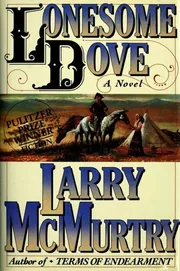
Lonesome Dove
by Larry McMurtry · 1971
Best suited to mature teens and adults who enjoy long, immersive novels.
945 pages, about 15 to 22 hours.
A vast Western that earns every one of its 945 pages. 56% taste match
The story
Lonesome Dove is a historical Western novel by Larry McMurtry, set in the American West of the 1870s. It follows a cattle drive from the Texas town of Lonesome Dove north to Montana, with stretches of the journey crossing places such as the Platte River, Ogallala, and the Yellowstone River. The book runs to roughly 945 pages in its median edition and has appeared in 26 editions.
At its center are Augustus McCrae and Woodrow F. Call, two former Texas Rangers who have been partners and friends for years. Gus is the more romantic of the pair and good with women, while Call is driven, exacting, and used to being in charge. Around them are the members of the outfit and others they meet along the way, including Pea Eye Parker, Joshua Deets, Newt Dobbs, Jake Spoon, Dishwater Boggett, Bolivar, Po Campo, Lorena Wood, Blue Duck, and July Johnson. The story takes in cowboys, settlers, outlaws, and the relationships between men and women. It won the 1986 Pulitzer Prize for Fiction and was adapted as a television miniseries in 1989.
When augustus came out on the porch the blue pigs were eating a rattlesnake-not a very big one.
Characters
Woodrow F. CallAugustus McCraePea Eye ParkerJoshua DeetsNewt DobbsJake Spoon
Setting
West United StatesWest (U.S.)TexasLonesome DoveFort Smith
Period
1870s
Themes
western cattle drivescowboysMan-woman relationshipsHistorical - GeneralTexas RangersCattle drivesWestern storiesRoman américain
- Want to read 491
- Reading now 23
- Read 62
Most people shelving it are saving it for later.
Of 576 readers who put it on a shelf, 85% want to read it, 4% are reading it now, 11% have finished it and 0% stopped before the end.
By the numbers
- The median edition runs 945 pages. Counting about 275 words a page and an adult reading pace of 250 words a minute, that is about 17 hours of reading.
- Open Library tracks 26 editions from 18 publishers, the earliest dated 1985 and the latest 2016, across 3 languages.
- On reader demand it ranks in the top 2% of the classic books in our catalog (8,749 of them).
- Libraries shelve it under Dewey 813.54 and Library of Congress class PS-3563.00000000.A319 L6 1986x.
 BookWard’s take
A vast Western that earns every one of its 945 pages
Lonesome Dove opens on a porch, with pigs eating a rattlesnake, and it never really lets go. It is very long, yet the long trail from Texas to Montana is sustained throughout rather than sagging, which BookWard prizes. Its strength is character depth: Gus and Call are drawn so fully that the plot feels like a consequence of who they are. Where BookWard prefers brevity, this book runs against the grain at length, and its familiar frontier setting means originality comes from execution rather than novelty. Pace is steady rather than rushed, the ending is resolved, and the violence and cruelty are weighed with real moral seriousness rather than used for effect. A Pulitzer winner that holds its scale without losing intimacy.
At 945 pages it is among the longest books you will pick up, the opposite of BookWard's love of tight, short reads.
The drive moves at the speed of cattle and horses, unhurried, which sits slower than BookWard's usual taste.
The setting is familiar, but the people and their friendship feel specific rather than borrowed.
The prose is plain and direct, with moments of beauty, rather than ornate.
What happens grows out of who these people are and what they want.
There is warmth and dark humor, but loss and hard endings weigh more than comfort.
A conventional journey narrative moving forward from start to finish.
Dry, easy humor runs through the talk, lightening an otherwise serious story.
Cruelty, death and hardship are real parts of this world.
The deep feeling builds across its length and lands hard.
See all 50 dialsEvery position, side by side with this book
Where it lines up
- Authorial voiceBookWard 9 · book 9
- ExpositionBookWard 2 · book 2
- Sagging middleBookWard 8 · book 8
Where it pulls apart
- LengthBookWard 1 · book 10
- Familiar tropesBookWard 10 · book 5
- OpeningBookWard 10 · book 7
At 945 pages it is among the longest books you will pick up, the opposite of BookWard's love of tight, short reads.
That opening on the porch, pigs and a rattlesnake, is vivid and easy, though the real pull builds gradually rather than seizing you at once.
Cattle drives and ex-Rangers are well-worn Western ground, though the characters push against the type.
The journey and its people hold together convincingly, with consequences that follow from character and circumstance.
The drive moves at the speed of cattle and horses, unhurried, which sits slower than BookWard's usual taste.
The setting is familiar, but the people and their friendship feel specific rather than borrowed.
Gus and Call are drawn with real depth, and the large outfit around them is given individual texture, matching BookWard's priority.
The journey reaches a definite conclusion rather than trailing off, which suits BookWard's liking for resolution.
It is warm and affecting without turning syrupy, leaning slightly toward feeling.
Cruelty and loss land because the story has built toward them, rather than being thrown in for effect.
McMurtry's storytelling is easy, humane and unmistakably his own.
This is a story first, carried by incident and people rather than argument.
Information arrives through scenes, talk and events rather than explanation.
Despite the length, the trail keeps generating fresh incident and character, so the middle holds.
The prose is plain and direct, with moments of beauty, rather than ornate.
What happens grows out of who these people are and what they want.
There is warmth and dark humor, but loss and hard endings weigh more than comfort.
A conventional journey narrative moving forward from start to finish.
Dry, easy humor runs through the talk, lightening an otherwise serious story.
The prose is accessible, though the length asks for real commitment.
The story moves among many members of the outfit and the people around them.
The story moves forward along the trail in a straightforward line.
Entirely grounded in the real, rough West of the 1870s.
A large cast of cowboys, women, outlaws and settlers fills the pages.
A journey across a continent's worth of country, yet focused on intimate relationships.
The trail supplies plenty of action, balanced by quiet, character-revealing talk.
Talk carries much of the book, with the men's banter central to its charm.
Love threads through the book, but it is one strand among many rather than the center.
The 1870s frontier will be foreign to most readers, though its conventions are widely recognized.
Set in the nineteenth century, far from the present day.
Its status as a Pulitzer winner and enduring favorite points to lasting appeal.
A straightforward, trustworthy narration tells the story plainly.
Heroes and villains exist, but even the good characters carry real flaws and failures.
Landscape, weather and trail life are rendered in generous, physical detail.
It stands well alone, but belongs to a wider Lonesome Dove series.
Events turn in unexpected ways, though mostly through consequence rather than trickery.
Gentle in voice, it still asks you to face loss, hardship and difficult truths.
Cruelty, death and hardship are real parts of this world.
The deep feeling builds across its length and lands hard.
The humor is wry and character-based rather than broad.
Violence is a real, recurring part of frontier life here, shown with weight.
Sex and prostitution are present but not the focus or explicit center.
The setting carries history, but politics is not what drives the story.
Frontier speech is colorful but easy to follow.
The narration lets events and characters speak for themselves rather than pushing a line.
It looks back, partly with elegy, on a way of life already passing.
Dreams drive the characters, but the story is clear-eyed about what they cost.
Review written by BookWard, dial version 1, November 2026.
Who is Lonesome Dove right for?
Best suited to mature teens and adults who enjoy long, immersive novels. It contains frontier violence, cruelty and sexual themes, including prostitution.
The prose is accessible, though the length asks for real commitment.
Cruelty, death and hardship are real parts of this world.
The deep feeling builds across its length and lands hard.
Violence is a real, recurring part of frontier life here, shown with weight.
Book CompanionLonesome Dove: ideas, characters, themes
A long cattle drive from Texas to Montana tests the friendship of two former Rangers and the dreams of everyone who follows them.
- The setup. Gus McCrae and Woodrow Call, former Texas Rangers and longtime partners, live in the town of Lonesome Dove.
- The drive. The story follows a cattle drive north from Texas toward Montana across rivers and open country.
- Two opposites. Gus is romantic and charming with women, while Call is driven, exacting and used to command.
- The outfit. A wide cast joins the journey, including Pea Eye Parker, Newt Dobbs, Jake Spoon and Dishwater Boggett.
- Recognition. The novel won the 1986 Pulitzer Prize for Fiction and was adapted as a miniseries in 1989.
Characters
Augustus McCrae
Former Ranger and partner
The romantic of the pair, good with women and easy in conversation.
Woodrow F. Call
Former Ranger and partner
Driven and exacting, and used to being in charge.
Newt Dobbs
Young member of the outfit
One of the younger figures traveling with the drive.
Jake Spoon
Friend and former Ranger
A figure from the old Ranger days who joins the story.
Lorena Wood
Woman at the center of several lives
A character who draws the attention and affection of many around her.
Themes
The long bond between Gus and Call, and the feelings each keeps from the other.
The hope of building a new life from the last open land.
What the members of the outfit owe each other on a dangerous road.
A frontier way of life already giving way to something else.
The ties between men and women that shape and disrupt the journey.
Discussion questions
- Why do Gus and Call stay partners despite being so different?
- What does the drive to Montana mean to each character, and how do their reasons differ?
- How does the book treat the old West: as myth, as fact, or both?
- Which member of the outfit stayed with you most, and why?
- Does the sheer length strengthen the story or test it?
Personalize your Book Companion
This is the general edition. In BookWard, the Companion is written for you: your reading profile, your notes, and spoiler-safe to the page you are on.
Buy, listen or borrow Lonesome Dove
Each link opens a search for this book on that store, in a new tab.
Read on a device
Borrow
Reviews and community
If you liked Lonesome Dove
Four generations of a Korean family in Japan, told with patience
The GodfatherMario PuzoA Mafia family saga that earns its reputation
A Fine BalanceRohinton MistryFour lives, one flat, and the Emergency pressing in
East of EdenJohn SteinbeckSteinbeck's sprawling Cain and Abel saga, built to outlast its length
Sources: Open Library.
Track Lonesome Dove and find your next favorite
Add it to your shelf, rate what you have read, and BookWard will recommend what fits you.
Free to start. No credit card needed.