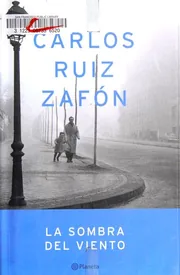
La sombra del viento
by Carlos Ruiz Zafón · 2001
Best suited to adult and older teen readers who enjoy long, atmospheric mysteries.
528 pages, about 8.5 to 12.5 hours.
A gothic Barcelona mystery where books are the real obsession. 56% taste match
The story
La sombra del viento, published in 2001, is a literary mystery by Carlos Ruiz Zafón and the first book in the Cemetery of Forgotten Books series. It runs to roughly 528 pages and has appeared in 99 editions.
The story opens in Barcelona in 1945, when a boy named Daniel Sempere is taken by his father to the Cemetery of Forgotten Books, a hidden place in the old city. There he finds a book that changes the course of his life and draws him into a web of intrigue and buried secrets. The novel moves between the last splendors of Modernism and the dark years after the war, following a trail that includes the author Julián Carax and a cast featuring Fermín Romero de Torres, Nuria Monfort, Clara Barceló and Penélope Aldaya. It blends suspense, historical fiction and comedy of manners around a tragic love story, with rare books and antiquarian booksellers at its center.
I still remember the day my father took me to the Cemetery of Forgotten Books for the first time.
Characters
Daniel SempereJulián CaraxFermín Romero de TorresNuria MonfortClara BarcelóPenélope Aldaya
Setting
BarcelonaSpainEspañaEl Cementerio de los Libros OlvidadosBarcelona (Spain)
Period
19451933-1966
Themes
Mothers and sonsVerschollenheitWidowersAutorBooksBuchYoung menFaszination
- Want to read 822
- Reading now 79
- Read 82
- Stopped 1
Most people shelving it are saving it for later.
Of 984 readers who put it on a shelf, 84% want to read it, 8% are reading it now, 8% have finished it and 0% stopped before the end.
By the numbers
- The median edition runs 528 pages. Counting about 275 words a page and an adult reading pace of 250 words a minute, that is about 9.7 hours of reading.
- Open Library tracks 99 editions from 55 publishers, the earliest dated 2001 and the latest 2021, across 12 languages.
- On reader demand it ranks in the top 1% of the modern books in our catalog (15,152 of them).
- Libraries shelve it under Dewey 863.64 and Library of Congress class PQ-6668.00000000.U49 S66 2009.
 BookWard’s take
A gothic Barcelona mystery where books are the real obsession
Zafón opens with a boy, a father and a hidden library, and the hook works at once: Daniel Sempere picks one book and it rearranges his life. I'm a sucker for an opening that grabs you right away, and this one does. Where it gets honest is the familiar material. Cursed book, buried love story, brooding city: the gothic furniture is well worn, though arranged with real flair. The large cast is drawn with generous depth, and the voice is unmistakable, rich and a little operatic, where I tend to prefer plainer prose. The internal logic holds as the nested secrets unfold, and the story stays brisk across 528 pages. It leans sentimental where I lean restrained, but it earns its pull.
At 528 pages it runs long, well beyond the tight shape BookWard prefers, though the plot keeps moving.
Intrigue keeps the chapters turning at a good clip, close to BookWard's preferred speed.
The books-about-books premise is distinctive, though it draws on a long gothic tradition.
Ornate, atmospheric sentences lean well past BookWard's mostly plain preference.
Plot and character share the load, with the mystery steering and the people giving it weight.
A tragic love story under a dark postwar city, with warmth and loyalty as counterweights.
Stories nest inside stories like Russian dolls, a more layered build than a straight line.
Fermín's banter and the comedy of manners bring real lightness to a serious story.
Postwar cruelty and a tragic love story bring real darkness without making it relentless.
Love, loss and obsession are felt strongly and played at full volume.
See all 50 dialsEvery position, side by side with this book
Where it lines up
- Authorial voiceBookWard 9 · book 9
- Story or ideasBookWard 3 · book 3
- OpeningBookWard 10 · book 9
Where it pulls apart
- LengthBookWard 1 · book 7
- Familiar tropesBookWard 10 · book 4
- SentimentBookWard 8 · book 3
At 528 pages it runs long, well beyond the tight shape BookWard prefers, though the plot keeps moving.
A boy led to a hidden Cemetery of Forgotten Books grabs the reader on the first page, exactly what BookWard rewards.
Cursed books, doomed love and a shadowy city are familiar gothic tropes, handled with flair but not avoided.
The nested mysteries interlock into a coherent trail, which suits BookWard's appetite for airtight construction.
Intrigue keeps the chapters turning at a good clip, close to BookWard's preferred speed.
The books-about-books premise is distinctive, though it draws on a long gothic tradition.
Daniel, Fermín and the Carax circle are vivid and layered, in line with BookWard's taste for drawn characters.
The mysteries are largely answered by the close, which BookWard likes in a resolved ending.
A tragic love story told with open romantic feeling sits well on the sentimental side of BookWard's restraint.
Dark revelations arrive as part of the story's logic rather than as cheap jolts.
Not applicable to a novel.
Zafón's lush, theatrical narration is instantly recognizable and strongly his own.
This is a story-led book, driven by plot and secrets rather than argument.
Backstory is often delivered through characters telling stories, so explanation comes more often than BookWard likes.
The nested structure keeps new questions arriving, so the long middle holds its tension.
Ornate, atmospheric sentences lean well past BookWard's mostly plain preference.
Plot and character share the load, with the mystery steering and the people giving it weight.
A tragic love story under a dark postwar city, with warmth and loyalty as counterweights.
Stories nest inside stories like Russian dolls, a more layered build than a straight line.
Fermín's banter and the comedy of manners bring real lightness to a serious story.
Accessible and absorbing, though the layered narratives ask for some attention.
Daniel leads, but other voices carry key parts of the story, a modest spread of perspectives.
The narrative moves between 1945 and earlier decades as the mystery is pieced together.
Grounded history with a gothic tint; the forgotten-books cemetery feels almost mythic but stays real.
A large, memorable ensemble includes Fermín, Nuria Monfort, Clara Barceló and Penélope Aldaya.
Spans decades and a whole city, yet stays close to a handful of intertwined lives.
Investigation and feeling are balanced, with plenty of both action and reflection.
Conversation is frequent and lively, especially around Fermín.
A tragic love story is central to the mystery's emotional core.
Barcelona from Modernism to the postwar years is a distinct, atmospheric setting for most readers.
Set in the 1940s and earlier, firmly in the past.
Millions of copies sold and lasting readership suggest a book that has outlived its release.
Daniel narrates from memory with reasonable candor, so the narration reads as mostly reliable.
Heroes and villains are fairly distinct, with some moral grays among the older generation.
Rich, sensory depiction of Barcelona and its shadowy streets is a defining strength.
Not applicable to a novel.
Not applicable to a novel.
First in the Cemetery of Forgotten Books series, though it reads as a complete story.
Nested secrets deliver reveal after reveal, one of the book's main pleasures.
Mostly an immersive, accessible read, with emotional weight but little reader strain.
Postwar cruelty and a tragic love story bring real darkness without making it relentless.
Love, loss and obsession are felt strongly and played at full volume.
Humor runs mid-range, mixing dry wit with Fermín's more theatrical comedy.
Wartime and postwar brutality appears at moments but is not the book's focus.
Romance is present but handled with restraint rather than explicitness.
The postwar Spanish backdrop shapes events without becoming the book's argument.
Clear, readable language, with period flavor but no heavy dialect.
The narration carries a strong, romantic point of view on books and the city.
Preoccupied with memory and the buried past rather than what comes next.
Cynicism about power sits beside real faith in love, loyalty and the worth of books.
Review written by BookWard, dial version 1, November 2026.
Who is La sombra del viento right for?
Best suited to adult and older teen readers who enjoy long, atmospheric mysteries. It includes postwar darkness, a tragic love story and some violence, handled within a literary frame.
Accessible and absorbing, though the layered narratives ask for some attention.
Postwar cruelty and a tragic love story bring real darkness without making it relentless.
Love, loss and obsession are felt strongly and played at full volume.
Wartime and postwar brutality appears at moments but is not the book's focus.
Book CompanionLa sombra del viento: ideas, characters, themes
A boy's chance discovery of a forgotten book pulls him into the buried story of its vanished author.
- The hidden library. Daniel is taken to the Cemetery of Forgotten Books in 1945 and chooses one volume to protect.
- The missing author. The book he picks leads him toward Julián Carax and the secrets surrounding his life.
- Barcelona as character. The story moves from the last splendors of Modernism to the dark years of the postwar.
- Genres in one book. Suspense, historical fiction and a comedy of manners combine around a tragic love story.
- Stories inside stories. Plots and enigmas nest like Russian dolls, rewarding careful attention.
Characters
Daniel Sempere
Young protagonist
A boy who takes a book from the Cemetery of Forgotten Books and follows where it leads.
Julián Carax
Mysterious author
The writer of the book Daniel finds, whose life becomes the mystery.
Fermín Romero de Torres
Ally and comic presence
A vivid figure in Daniel's circle who brings humor and loyalty to the search.
Nuria Monfort
Key figure in the mystery
Part of the cast tied to the secrets Daniel uncovers.
Penélope Aldaya
Central to the love story
Linked to the tragic romance at the heart of the novel.
Themes
Stories can change lives and outlast the people who wrote them.
Buried history keeps shaping the present until someone digs it up.
Fascination with a book or a person can pull someone into danger.
Love here carries loss, and its echoes travel across decades.
Daniel grows up through the quest the book sets in motion.
Discussion questions
- Why does the Cemetery of Forgotten Books make such a strong opening image?
- How does the postwar Barcelona setting shape the mystery?
- Which character's story moved you most, and why?
- How do the nested stories change the way you read the central mystery?
- Is the book's romanticism a strength or a weakness for you?
Personalize your Book Companion
This is the general edition. In BookWard, the Companion is written for you: your reading profile, your notes, and spoiler-safe to the page you are on.
Buy, listen or borrow La sombra del viento
Each link opens a search for this book on that store, in a new tab.
Read on a device
Borrow
Reviews and community
If you liked La sombra del viento
A doorstop sequel that trades Highlands romance for Paris intrigue
BuckeyePatrick RyanA small Ohio town, two families, and one buried secret
Hearts in AtlantisStephen KingStephen King's elegy for the sixties and the generation that blew it
All the Light We Cannot SeeAnthony DoerrA lyrical war novel built from short chapters and a blind girl's Paris
Sources: Open Library.
Track La sombra del viento and find your next favorite
Add it to your shelf, rate what you have read, and BookWard will recommend what fits you.
Free to start. No credit card needed.