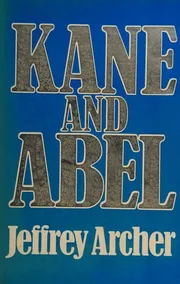
Kane & Abel
by Jeffrey Archer · 1979
Best suited to adult and older teen readers who enjoy long historical sagas.
550 pages, about 8.5 to 13 hours.
Two men, one birth date, a rivalry across continents. 47% taste match
The story
Kane & Abel is a historical saga by British author Jeffrey Archer, first published in 1979. It follows two men born on the same day, 18 April 1906, who come from opposite ends of society. William Lowell Kane belongs to the world of Boston Brahmins and private banking, with schooling at St. Paul's School and Harvard University. Abel Rosnovski is born a Polish peasant, and his story carries him through Poland, Siberia, Turkey and the Middle East before he reaches the United States and builds a career as a hotelkeeper, with the Hotel Plaza among the places in his story.
The book spans the decades of the Great Depression and World War II, tracing the paths of two capitalists and financiers whose lives run in parallel across continents. Other figures in the story include Virginia, Lucy and Richard Kane, Henry Osborne, Mathew Lester and Władek Koskiewicz. Part thriller and part family chronicle, it runs to roughly 550 pages and has appeared in 76 editions. A sequel, The Prodigal Daughter, follows Florentyna Kane.
SHE ONLY STOPPED screaming when she died.
Characters
William Lowell KaneAbel RosnovskiFlorentyna RosnovskiVirginia KaneLucy KaneRichard Kane
Setting
PolandUnited StatesSt. Paul's SchoolHarvard UniversitySiberia
Period
18 April 1906
Themes
TitanicPolesBoston BrahminshotelkeepersPeasantsCapitalists and financiersPeasantry
- Want to read 281
- Reading now 39
- Read 47
Most people shelving it are saving it for later.
Of 367 readers who put it on a shelf, 77% want to read it, 11% are reading it now, 13% have finished it and 0% stopped before the end.
By the numbers
- The median edition runs 550 pages. Counting about 275 words a page and an adult reading pace of 250 words a minute, that is about 10 hours of reading.
- Open Library tracks 76 editions from 57 publishers, the earliest dated 1979 and the latest 2022, across 9 languages.
- On reader demand it ranks in the top 1% of the modern books in our catalog (15,152 of them).
- Libraries shelve it under Dewey 823 and Library of Congress class PZ-0004.00000000.A6725 Kan 1980.
 BookWard’s take
Two men, one birth date, a rivalry across continents
Kane & Abel opens with a screaming woman and a birth on 18 April 1906, then sets two very different boys on a collision course: a Boston Brahmin banker's son and a Polish peasant who ends up in the hotel trade. The hook is where it shines. Archer starts fast and rarely lets go, and the pace stays brisk across 550 pages. It doesn't sag either, since the story keeps moving through Poland, Siberia, Turkey and the Depression. Where I part ways with it is in originality and prose: the rise-and-revenge saga is a familiar shape, told plainly. Think page-turning chronicle, not literary event.
At 550 pages across two lifetimes it is a long book, though it reads quicker than it measures, against BookWard's love of tight.
Decades and continents are crossed at a steady clip, close to BookWard's preferred speed.
The mirrored-lives premise is the draw, but the shape of a dynastic revenge saga is a familiar one.
The prose is plain and functional, built to serve the story, a little plainer than BookWard's middle ground.
Events and the clash between the two men drive the book more than inner change does.
Hardship and a bitter feud darken things, with only intermittent hope.
A conventional parallel-lives layout carries it, with little formal experiment.
It plays almost entirely straight, with little humor to lighten the saga.
Poverty, war and a long feud supply grit without relentless bleakness.
Loss, loyalty and grudge produce real feeling, though in broad strokes.
See all 50 dialsEvery position, side by side with this book
Where it lines up
- PaceBookWard 8 · book 8
- EndingBookWard 8 · book 8
- Sagging middleBookWard 8 · book 8
Where it pulls apart
- LengthBookWard 1 · book 7
- Familiar tropesBookWard 10 · book 4
- Internal logicBookWard 10 · book 6
At 550 pages across two lifetimes it is a long book, though it reads quicker than it measures, against BookWard's love of tight.
It opens on a woman's screams and a double birth on 18 April 1906, which grabs at once, just as BookWard likes.
The rags-to-riches and bitter-rivalry framework is well worn, so it leans on familiar saga tropes more than BookWard prefers.
Two lives running in parallel are plotted so they eventually meet, though the coincidences asked of the reader loosen the machinery.
Decades and continents are crossed at a steady clip, close to BookWard's preferred speed.
The mirrored-lives premise is the draw, but the shape of a dynastic revenge saga is a familiar one.
Both leads are drawn with real drive and history, yet they are shaped more by ambition and grievance than by nuance.
The long rivalry is built to resolve, and it does so decisively, in line with BookWard's taste for closure.
Family bonds and hardship are played with feeling and some melodrama, so it is warmer than BookWard's restrained ideal.
Hardship and loss serve the plot, but the darker beats are there to propel a saga rather than to unsettle.
This is fiction, so rigor does not apply.
Archer's clean, commercial storytelling is recognizable but not strikingly distinctive on the page.
This is overwhelmingly story-led, built on events and rivalry rather than on arguments.
A sweeping chronicle covering decades often explains and summarizes to move time along, more than BookWard would like.
With Poland, Siberia, Turkey and the United States to cover, the narrative keeps finding new momentum, fitting BookWard's taste.
The prose is plain and functional, built to serve the story, a little plainer than BookWard's middle ground.
Events and the clash between the two men drive the book more than inner change does.
Hardship and a bitter feud darken things, with only intermittent hope.
A conventional parallel-lives layout carries it, with little formal experiment.
It plays almost entirely straight, with little humor to lighten the saga.
It is an easy, immersive read that asks little of the reader beyond attention.
The story alternates between its two protagonists, with a supporting cast around them.
The two lives move forward in order from their shared birth date, with little time-bending.
Grounded in real history and place, with the Depression and World War II as backdrop.
Two families plus bankers, hoteliers and rivals make a sizable, if manageable, cast.
Spanning continents and decades, it has the sweep of an epic family saga.
Events, journeys and business moves dominate over introspection.
Scenes mix talk and action in about equal measure, as is usual for the genre.
Family and marriage matter, but rivalry and ambition are the central engine.
Peasant Poland, Siberia and the Middle East offer settings many readers will find new.
It is a historical saga set in the early to mid twentieth century.
It has lasted well, with its enduring bestseller status and a place in the BBC's Big Read.
A straightforward third-person narration, with no tricks on the reader.
The two men's grievances are laid out clearly enough that sympathy shifts but the stakes stay readable.
Place and period are sketched efficiently rather than lushly rendered.
A sequel, The Prodigal Daughter, follows Florentyna Kane, though this book stands well alone.
Reversals and coincidences keep arriving, a feature of the genre.
A comfortable, propulsive read that rarely pushes the reader out of their zone.
Poverty, war and a long feud supply grit without relentless bleakness.
Loss, loyalty and grudge produce real feeling, though in broad strokes.
Any humor is incidental and broad rather than dry.
War and hardship bring violence, though it is not dwelt on.
Sexual content is slight and secondary to the plot.
Wars and economic turmoil form the backdrop, but the book is not a political argument.
The language is plain and accessible throughout.
The narration lets the story speak rather than editorializing.
It looks back on a century that is now history.
Ambition and revenge dominate, though loyalty and family counterweigh the harsher tone.
Review written by BookWard, dial version 1, November 2026.
Who is Kane & Abel right for?
Best suited to adult and older teen readers who enjoy long historical sagas. It deals with war, hardship and a bitter feud, though it stays mostly on the commercial-thriller side of dark.
It is an easy, immersive read that asks little of the reader beyond attention.
Poverty, war and a long feud supply grit without relentless bleakness.
Loss, loyalty and grudge produce real feeling, though in broad strokes.
War and hardship bring violence, though it is not dwelt on.
Book CompanionKane & Abel: ideas, characters, themes
Two men born on the same day in 1906, one into Boston privilege and one into Polish peasantry, build parallel lives across continents and decades.
- A shared birthday, a divided world. Both leads are born on 18 April 1906, which frames the book as a study in how circumstance shapes fate.
- Boston banking versus Polish hardship. William Lowell Kane moves through St. Paul's School and Harvard, while Abel Rosnovski begins as a peasant.
- A long journey to America. Abel's path runs through Poland, Siberia, Turkey and the Middle East before the United States.
- Capitalism as drama. Both men become financiers and hoteliers in an America shaped by the Depression and World War II.
- Saga with thriller bones. Family chronicle and suspense blend, with the Hotel Plaza among the settings of Abel's rise.
Characters
William Lowell Kane
Boston banker
A Brahmin by birth, schooled at St. Paul's and Harvard, whose life runs in parallel with Abel's.
Abel Rosnovski
Polish immigrant and hotelier
Born a peasant, he crosses continents and builds a career in the hotel trade.
Florentyna Rosnovski
Abel's daughter
A member of the next generation, linked to the story's family legacy.
Richard Kane
Kane family member
Part of the Kane family circle around William.
Themes
How a grudge can shape two lives across decades.
The gulf between inherited status and self-made success.
What two capitalists will risk to build and protect their empires.
The path from the old world to America and what it demands.
Whether parallel lives are chance or something closer to destiny.
Discussion questions
- Does the shared birth date make the rivalry feel destined or contrived?
- Which man's journey did you find more compelling, and why?
- How does the Great Depression test each man differently?
- Does the book ask you to take a side, and did you?
- Which ideas about class and ambition still feel current?
Personalize your Book Companion
This is the general edition. In BookWard, the Companion is written for you: your reading profile, your notes, and spoiler-safe to the page you are on.
Buy, listen or borrow Kane & Abel
Each link opens a search for this book on that store, in a new tab.
Read on a device
Borrow
Reviews and community
If you liked Kane & Abel
A fast, polished legal thriller that made Grisham a household name
The PartnerJohn GrishamA faked death, a missing fortune, and a fugitive in Brazil
Angels & DemonsDan BrownA one-day Vatican chase that runs on clues and speed
Strangers in TimeDavid BaldacciTwo wartime orphans, a bookshop, and a widower with secrets
Sources: Open Library.
Track Kane & Abel and find your next favorite
Add it to your shelf, rate what you have read, and BookWard will recommend what fits you.
Free to start. No credit card needed.