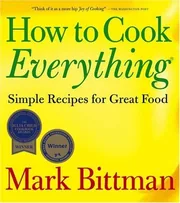
How to Cook Everything
by Mark Bittman · 1998
Suits home cooks of most ages, including teens learning basic skills, with adult supervision around knives and heat.
944 pages, about 15 to 22 hours.
A huge, practical kitchen reference for everyday home cooks. 38% taste match
What it covers
How to Cook Everything is a general cooking reference by Mark Bittman, first published in 1998. It is written for home cooks in the United States and works as a broad kitchen guide rather than a book on a single cuisine or technique. The author was a food writer for the New York Times, and the book opens with a discussion of equipment, weighing the case for a modest set of tools against the cost of a fully outfitted kitchen.
Across roughly 944 pages, the book covers everyday cooking in its many forms, including quick and easy dishes, vegetarian cooking, and menus. It stands as the first volume in a larger series that later added narrower titles on subjects such as convenience cooking and vegetarian cuisine. A companion volume, How to Cook Everything: Vegetarian, followed in 2007, and a second edition of the original appeared in October 2008 with less emphasis on professional techniques. The book has been issued in a number of editions over the years and sits in the cookbook category of nonfiction.
You can spend tens of thousands of dollars on kitchen equipment, or you can spend a couple of hundred bucks and be done with it.
Themes
CookeryCooking & FoodCookingCookbooksQuick and easy cookingVegetarian cookingMenus
- Want to read 234
- Reading now 16
- Read 15
Most people shelving it are saving it for later.
Of 265 readers who put it on a shelf, 88% want to read it, 6% are reading it now, 6% have finished it and 0% stopped before the end.
By the numbers
- The median edition runs 944 pages. Counting about 275 words a page and an adult reading pace of 250 words a minute, that is about 17 hours of reading.
- Open Library tracks 11 editions from 8 publishers, the earliest dated 1998 and the latest 2019.
- On reader demand it ranks in the top 5% of the modern books in our catalog (15,152 of them).
- Libraries shelve it under Dewey 641.5 and Library of Congress class TX-0714.00000000.B573 2008.
 BookWard’s take
A huge, practical kitchen reference for everyday home cooks
This is a reference book, built to be dipped into rather than read cover to cover. At 944 pages it is long and sprawling, though nobody is meant to feel it as a slog. The opening is an oddity: it starts with equipment, weighing a modest set of tools against a fully outfitted kitchen, which is useful but not a hook. The advice leans practical and tested rather than anecdotal, and it explains things outright, as a how-to should. It is a standalone-feeling flagship with later companions, and the voice is plain and encouraging rather than showy. If you want a dependable shelf book for ordinary cooking, it earns its space. If you want a page-turner, this isn't one.
At 944 pages it is a big book by design, which is the opposite of BookWard's tight preference, though a reference is not read straight through.
It moves at the speed of a reader browsing and cooking, steady rather than fast or slow.
It gathers well-known everyday cooking into one broad guide instead of proposing new ideas, so it sits on the familiar side.
The prose is plain and functional, written to be understood at the stove, which BookWard can live with.
There is no plot or character arc, so this dial does not apply.
The outlook is encouraging, telling home cooks that good food is within reach.
It follows a conventional reference layout of sections and recipes, a familiar form for a cookbook.
The tone is helpful and straightforward, with little aimed at humor.
The subject is gentle and domestic.
The tone is calm and instructional rather than emotionally intense.
See all 50 dialsEvery position, side by side with this book
Where it lines up
- SentimentBookWard 8 · book 8
- Story or ideasBookWard 3 · book 4
- Internal logicBookWard 10 · book 8
Where it pulls apart
- LengthBookWard 1 · book 10
- OpeningBookWard 10 · book 3
- Familiar tropesBookWard 10 · book 4
At 944 pages it is a big book by design, which is the opposite of BookWard's tight preference, though a reference is not read straight through.
It opens with a measured discussion of kitchen equipment, a sensible start but a slow one next to BookWard's love of an instant hook.
Home-cooking staples and standard techniques are the point, so it works with the familiar rather than avoiding it.
Recipes and techniques are built to be followed step by step, so the instructions hold together in the way a cook needs.
It moves at the speed of a reader browsing and cooking, steady rather than fast or slow.
It gathers well-known everyday cooking into one broad guide instead of proposing new ideas, so it sits on the familiar side.
There are no characters to draw, so this dial does not apply.
A reference has no story to resolve, so an ending does not apply.
The tone is practical and matter-of-fact, which suits BookWard's liking for restraint.
There is nothing dark or shocking to earn, so this dial does not apply.
It is a working cooking reference with a practical, tested bent, firmly more instructional than anecdotal, in line with BookWard's taste.
The writing is the clear, encouraging voice of a working food writer, helpful more than flamboyant.
It is a practical guide, not a narrative, and leans toward method over plot, though it is more how-to than big ideas.
It explains outright by necessity, telling you how to do things rather than showing scenes, the far end of this dial from BookWard.
A reference is not read as one arc, so a sagging middle does not apply.
The prose is plain and functional, written to be understood at the stove, which BookWard can live with.
There is no plot or character arc, so this dial does not apply.
The outlook is encouraging, telling home cooks that good food is within reach.
It follows a conventional reference layout of sections and recipes, a familiar form for a cookbook.
The tone is helpful and straightforward, with little aimed at humor.
It is easy to pick up and use, with no demanding reading effort required.
A single practical author voice guides the whole book.
Instructions run in the order you cook, with no shifting timeline.
Cooking is entirely grounded in the real kitchen.
There is no cast, so this dial does not apply.
The scope is the home kitchen, an intimate and personal setting.
The focus is on doing, on tools, techniques and dishes, rather than on inner thought.
A cooking reference has essentially no dialogue.
There is no romance, so this dial does not apply.
The home kitchen is about as familiar a setting as exists.
It is aimed at present-day home cooks, with a second edition in 2008 keeping it current.
Basic cooking skills last, and the book has been reissued in a number of editions over the years.
The author speaks plainly and directly, a reliable guide.
There are no moral questions at stake, so this dial does not apply.
Descriptions serve the cook rather than decorate, moderately full where a technique needs it.
It is a how-to organized by topic and recipe, with narrative a minor ingredient.
The author's own teaching voice comes through, but the book stays focused on the cook's needs.
It is the flagship volume of a larger series, with companions such as a vegetarian volume following in 2007.
A reference offers practical information, not surprises.
It aims to comfort and equip a cook, not unsettle a reader.
The subject is gentle and domestic.
The tone is calm and instructional rather than emotionally intense.
Humor is not a feature of the book, so this dial does not apply.
There is no violence on the page.
There is no sexual content.
It is a practical cooking guide with no political agenda.
The language is plain and meant for ordinary home cooks.
The author offers clear recommendations about equipment and technique, a mildly opinionated guide.
It looks ahead to the meals a reader will cook next.
It carries an optimistic belief that anyone can learn to cook well.
Review written by BookWard, dial version 1, November 2026.
Who is How to Cook Everything right for?
Suits home cooks of most ages, including teens learning basic skills, with adult supervision around knives and heat. Nothing sensitive beyond ordinary kitchen safety.
It is easy to pick up and use, with no demanding reading effort required.
The subject is gentle and domestic.
The tone is calm and instructional rather than emotionally intense.
There is no violence on the page.
Book CompanionHow to Cook Everything: ideas, characters, themes
A single, broad reference can teach an American home cook to make nearly any everyday dish without a fully outfitted kitchen.
- Start with the tools. The book opens by weighing a modest set of equipment against the cost of a fully outfitted kitchen.
- Written for home cooks. It is aimed at U.S. home cooks rather than professionals.
- Wide coverage. Across roughly 944 pages it takes in quick and easy cooking, vegetarian dishes and menus.
- A flagship volume. It is the first book in a series that later added narrower titles on convenience cooking and vegetarian cuisine.
- Revised over time. A second edition in October 2008 reduced the emphasis on professional techniques.
Themes
Making real meals at home with ordinary effort.
Doing more with a modest set of tools.
Cooking as a skill open to anyone, not only professionals.
One book covering many kinds of dishes and occasions.
Discussion questions
- Do you agree that a modest set of tools is enough, or does a fuller kitchen make you a better cook?
- How does a general reference differ from a book on a single cuisine?
- Which dishes would you reach for first in a book this broad?
- What does the reduced emphasis on professional techniques in the second edition say about its audience?
- How would you use a 944-page book differently from one you read straight through?
Personalize your Book Companion
This is the general edition. In BookWard, the Companion is written for you: your reading profile, your notes, and spoiler-safe to the page you are on.
Buy, listen or borrow How to Cook Everything
Each link opens a search for this book on that store, in a new tab.
Read on a device
Borrow
Reviews and community
If you liked How to Cook Everything
A practical system for getting your head clear and your work moving
The Pragmatic ProgrammerAndy HuntA tip-driven manual that taught a generation to code well
What Every BODY Is SayingJoe NavarroA former FBI agent's field guide to reading body language
Get Better at AnythingScott YoungA clear framework for why some learning sticks and some stalls
Sources: Open Library.
Track How to Cook Everything and find your next favorite
Add it to your shelf, rate what you have read, and BookWard will recommend what fits you.
Free to start. No credit card needed.