Best for mature teens and adults comfortable with dark fantasy and a demanding read.
512 pages, about 8 to 12 hours.
A necromancer's mind-bending puzzle box, rewarding if you stay sharp. 58% taste match
The story
Harrow the Ninth is a science fantasy novel by New Zealand author Tamsyn Muir, first published in 2020. It is the second book in The Locked Tomb series, coming after Gideon the Ninth and before Nona the Ninth. The story blends dark fantasy with space opera, drawing on necromancy, swords, witches, and imaginary wars, and it is set in the far future. Its central figures include women and lesbian characters, and the book sits within LGBTQ science fiction and fantasy.
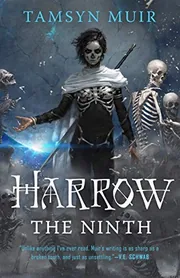
Harrowhark Nonagesimus is the last necromancer of the Ninth House. Called up by her Emperor to fight a war that cannot be won, she trains alongside a rival she despises, working to become an angel of undeath. Her health is declining, her sword leaves her sick, and her own mind is turning against her. She is shut inside the Emperor's Mithraeum with three teachers who are cold toward her, while the ghost of a murdered planet pursues her. Harrow must ask whether someone is trying to kill her, and whether the universe would be better off if they succeeded. The print edition runs to about 512 pages.
Characters
Harrowhark Nonagesimus
Themes
paranormalnecromancyWomen authorsWitchesMagicLesbiansImaginary wars and battlesSwords
- Want to read 92
- Reading now 5
- Read 52
Readers are split between finishing it and saving it for later.
Of 149 readers who put it on a shelf, 62% want to read it, 3% are reading it now, 35% have finished it and 0% stopped before the end.
By the numbers
- The median edition runs 512 pages. Counting about 275 words a page and an adult reading pace of 250 words a minute, that is about 9.4 hours of reading.
- Open Library tracks 9 editions from 7 publishers, the earliest dated 2020 and the latest 2022, across 2 languages.
- On reader demand it ranks in the top 5% of the recent books in our catalog (6,647 of them).
- Libraries shelve it under Library of Congress class PR-9639.40000000.M84H37 2020.
 BookWard’s take
A necromancer's mind-bending puzzle box, rewarding if you stay sharp
Harrow the Ninth is the second Locked Tomb book, and it is built to unsettle. Harrowhark Nonagesimus is trained for an unwinnable war while her health, her sword and her own mind turn against her. Originality is where it shines: the structure and voice are unlike most space fantasy, and the authorial voice is distinctive and unmistakable. It asks more of you than most books do, since both the reading effort and the structure run heavy, and the timeline is deliberately disorienting. That is the point, but it is not an easy hook. Its familiar tropes are bent rather than followed, and it is darker than gentle. Come in with the first book fresh and prepared to work.
At about 512 pages it runs long, well past BookWard's love of tight books, though the density keeps it from feeling padded.
It moves briskly on the surface but pauses for dense, looping sequences, a touch slower than BookWard prefers.
Its blend of gothic necromancy, space opera and fractured storytelling stands apart from nearly anything in the genre, a strong match.
The prose is stylized, playful and richly worded, noticeably more ornate than BookWard's preference.
Harrow's fracturing mind drives events as much as the war does, leaning character-driven as BookWard likes.
Hope flickers amid ash and a ruined world, but the mood stays largely grim, a little below BookWard's leaning.
Its structure is deliberately fractured and experimental, well beyond the conventional shape BookWard usually favors.
Gallows humor and sarcasm run through even the darkest scenes, matching BookWard's appetite for funny.
Murdered planets, failing health and a doomed war make it a dark read, darker than BookWard's midpoint.
Beneath the jokes, grief and desperation hit hard, more intense than BookWard's moderate lean.
See all 50 dialsEvery position, side by side with this book
Where it lines up
- Familiar tropesBookWard 10 · book 9
- OriginalityBookWard 9 · book 10
- Character depthBookWard 8 · book 9
Where it pulls apart
- LengthBookWard 1 · book 7
- OpeningBookWard 10 · book 6
- Internal logicBookWard 10 · book 8
At about 512 pages it runs long, well past BookWard's love of tight books, though the density keeps it from feeling padded.
It opens on a disorienting, voice-heavy note that grabs through strangeness rather than a clean immediate hook, a slight mismatch with BookWard.
Necromancers, swords and a far-future empire are subverted and recombined rather than played straight, which BookWard values.
Its puzzle-box design rewards close attention, with mysteries built to resolve on their own terms, matching BookWard's taste for airtight rules.
It moves briskly on the surface but pauses for dense, looping sequences, a touch slower than BookWard prefers.
Its blend of gothic necromancy, space opera and fractured storytelling stands apart from nearly anything in the genre, a strong match.
Harrow is a deeply drawn, prickly and damaged protagonist whose unraveling mind sits at the heart of the book, which BookWard enjoys.
It aims to answer its own puzzles while still leaving the larger series open, a partial fit for BookWard's love of resolution.
Feeling is present but often masked by irony and sharp wit rather than offered sweetly, close to BookWard's restraint.
Its dark turns serve the mystery and the characters' wounds rather than existing for effect, which BookWard appreciates.
This is fiction, so rigor does not apply.
Muir's voice is unmistakable, irreverent and ornate by turns, one of the book's biggest strengths and a big win for BookWard.
Plot and character carry it, though the puzzle-like construction gives ideas some weight, a bit more idea-led than BookWard's story-first lean.
Much is shown through scene and implication rather than explained, which suits BookWard, though some mysteries need patience.
The structure keeps tension going across a long book, with only minor lulls, fitting BookWard's wish for a sustained middle.
The prose is stylized, playful and richly worded, noticeably more ornate than BookWard's preference.
Harrow's fracturing mind drives events as much as the war does, leaning character-driven as BookWard likes.
Hope flickers amid ash and a ruined world, but the mood stays largely grim, a little below BookWard's leaning.
Its structure is deliberately fractured and experimental, well beyond the conventional shape BookWard usually favors.
Gallows humor and sarcasm run through even the darkest scenes, matching BookWard's appetite for funny.
It asks for close attention and rereading instincts, noticeably harder than the easy reading BookWard tends to prefer.
The focus stays tightly on Harrow, with only some shifts in perspective, slightly fewer viewpoints than BookWard's taste.
Time is deliberately scrambled and unreliable, far more shifting than BookWard's moderate leaning, which can be a hurdle.
Necromancy, ghost planets and cosmic war make it thoroughly fantastical, beyond BookWard's middle ground.
The cast is contained around a few key figures, a fairly small ensemble that suits BookWard.
The fate of the galaxy is at stake, giving it an epic backdrop, though the focus stays personal.
Much of the drama plays out inside Harrow's head, leaning inward in line with BookWard.
Banter and sharp exchanges are frequent, a moderate fit for BookWard's taste for dialogue.
Relationships matter to the story but romance is not its main engine, in line with BookWard.
Its gothic far-future setting with strange houses and a haunted Mithraeum is deeply unfamiliar, which BookWard enjoys.
It is set in the far future, so it reads far from the present day.
Its originality and voice should hold up well beyond its moment, matching BookWard's interest in lasting books.
Harrow's grip on her own story is shaky and her narration cannot be fully trusted, a strong match for BookWard.
The war, the Emperor and Harrow's choices are murky rather than neatly good or evil, matching BookWard's comfort with ambiguity.
Gothic settings and strange imagery are described lavishly, richer than BookWard's usual middle ground.
This is fiction, so nonfiction style does not apply.
This is fiction, so perspective type does not apply.
It is the second book in The Locked Tomb series and depends on the first, unlike BookWard's usual standalone lean.
Reveals and reversals drive the experience, giving it far more surprises than BookWard's already high taste.
It is demanding and unsettling rather than comforting, a good fit for BookWard's preference for challenge.
Murdered planets, failing health and a doomed war make it a dark read, darker than BookWard's midpoint.
Beneath the jokes, grief and desperation hit hard, more intense than BookWard's moderate lean.
The humor is bold and absurd as often as dry, a bit broader than BookWard's balance.
Combat and necromantic gore are regular features, heavier than BookWard's midpoint.
Sexual content is light, well below BookWard's midpoint.
Empire and power frame the plot but are not argued directly, below BookWard's midpoint.
The slang-heavy, in-world idiom takes some effort, a touch denser than BookWard's midpoint.
The narration is sharp and opinionated, slightly more so than BookWard prefers.
The story stares back at past choices while pressing toward an uncertain future, sitting roughly in the middle against BookWard's forward lean.
Characters swing between cynicism and stubborn devotion, close to BookWard's slightly idealistic leaning.
Review written by BookWard, dial version 1, November 2026.
Who is Harrow the Ninth right for?
Best for mature teens and adults comfortable with dark fantasy and a demanding read. It contains war, death and gruesome necromantic imagery.
It asks for close attention and rereading instincts, noticeably harder than the easy reading BookWard tends to prefer.
Murdered planets, failing health and a doomed war make it a dark read, darker than BookWard's midpoint.
Beneath the jokes, grief and desperation hit hard, more intense than BookWard's moderate lean.
Combat and necromantic gore are regular features, heavier than BookWard's midpoint.
Book CompanionHarrow the Ninth: ideas, characters, themes
Harrowhark Nonagesimus, last necromancer of the Ninth House, is drafted into an unwinnable war while her health and her own mind start to fail her.
- A sequel that rewards the first book. It continues the story from Gideon the Ninth, so the opening volume sets up what matters here.
- A war that cannot be won. Harrow is drafted by her Emperor to fight a conflict framed as unwinnable, and her training toward becoming an angel of undeath drives the plot.
- A rival she detests. Harrow trains side by side with a hated rival, which keeps tension and friction constant.
- Confined to the Mithraeum. She is sealed in the Emperor's gothic Mithraeum with three unfriendly teachers, creating a tight, claustrophobic setting.
- A mind turning against her. Her failing health and unstable thoughts raise the central question of whether someone is trying to kill her.
Characters
Harrowhark Nonagesimus
Protagonist
The last necromancer of the Ninth House, drafted by the Emperor to fight an unwinnable war while her health and mind fail.
Themes
What happens when you cannot trust your own mind or memory.
The cost of serving a power that demands everything.
How enmity shapes two people forced to work together.
Death, undeath and what a life is worth.
Staying alive against an enemy that may be inside her.
Discussion questions
- How does the book make you question what is real, and did that frustrate or thrill you?
- Why does Harrow trust or distrust the people training her?
- What does the pressure of an unwinnable war do to a person's choices?
- How does the humor change the way the darker moments land?
- Does the sequel work better if you have just finished the first book?
Personalize your Book Companion
This is the general edition. In BookWard, the Companion is written for you: your reading profile, your notes, and spoiler-safe to the page you are on.
Buy, listen or borrow Harrow the Ninth
Each link opens a search for this book on that store, in a new tab.
Read on a device
Borrow
Reviews and community
If you liked Harrow the Ninth
A rock-star vampire tells his own story, grandly and unapologetically
HyperionDan SimmonsA Canterbury Tales in space, with a monster waiting at the end
The Drawing of the ThreeStephen KingDoorways on a beach, and a gunslinger who needs allies
The Raven ScholarAntonia HodgsonA murder mystery inside a succession contest, narrated with a wink
Sources: Open Library.
Track Harrow the Ninth and find your next favorite
Add it to your shelf, rate what you have read, and BookWard will recommend what fits you.
Free to start. No credit card needed.