Best suited to adult and older teen readers comfortable with dense, shifting science fiction.
481 pages, about 7.5 to 11 hours.
A Canterbury Tales in space, with a monster waiting at the end. 50% taste match
The story
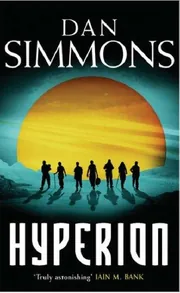
Hyperion is a science fiction novel by American author Dan Simmons, first published in 1989. It is the first book of his Hyperion Cantos series and won the Hugo Award for best novel. The story is set in the 29th century, when the Hegemony of Man spans hundreds of planets linked by farcaster portals. The Hegemony keeps an uneasy alliance with the TechnoCore, a civilisation of artificial intelligences, while it is at odds with the Ousters, modified humans who live in space stations between the stars.
The action centres on Hyperion, an Outback world beyond the farcaster network, where the Time Tombs stand and are said to move backwards through time under the watch of a creature called the Shrike. As an Ouster invasion approaches, a group of pilgrims makes a final journey to the Tombs. Each of them tells how they came to be chosen. The book is built from these separate tales and several timelines, in a structure modelled on Geoffrey Chaucer's The Canterbury Tales. The pilgrims hope to petition the Shrike, which is said to grant a wish to one of them. The story continues in The Fall of Hyperion, published in 1990.
The Consul awoke with the peculiar headache, dry throat, and sense of having forgotten a thousand dreams which only periods in cryogenic fugue could bring.
Period
2732
Themes
Ciencia-ficcio n.Long Now Manual for CivilizationExtraterrestrial beingsPilgrims and pilgrimagesInterplanetary voyagesDramaFuture lifeLife on other planets
- Want to read 502
- Reading now 24
- Read 222
Most people shelving it are saving it for later.
Of 748 readers who put it on a shelf, 67% want to read it, 3% are reading it now, 30% have finished it and 0% stopped before the end.
By the numbers
- The median edition runs 481 pages. Counting about 275 words a page and an adult reading pace of 250 words a minute, that is about 8.8 hours of reading.
- Open Library tracks 26 editions from 21 publishers, the earliest dated 1989 and the latest 2023, across 7 languages.
- On reader demand it ranks in the top 1% of the modern books in our catalog (15,152 of them).
- Libraries shelve it under Dewey 813.54 and Library of Congress class PS-3569.00000000.I47292.
 BookWard’s take
A Canterbury Tales in space, with a monster waiting at the end
Hyperion borrows its frame from Chaucer: seven pilgrims, one destination, and a creature called the Shrike guarding the Time Tombs. Each pilgrim tells how they came to be chosen, so the book is really a set of linked stories, and that is where it earns its keep. The structure is far more elaborate than most novels attempt, with many narrators and shifting times. The originality is real: the farcaster Hegemony, the TechnoCore and the Time Tombs feel built rather than borrowed. The prose is richer than most science fiction, and the pace between tales is uneven, so it asks more of the reader than a straight adventure does. The ending is a pause, not a close, because the story continues in The Fall of Hyperion.
At 481 pages it is long for a book that stops mid-story, which sits looser than BookWard's taste for tight, short reads.
Momentum shifts from tale to tale, quick in some and slow in others, a touch below BookWard's preferred drive.
The farcaster web, the TechnoCore and the Shrike are inventive, and the framing device is used with fresh purpose.
The prose is rich and allusive, clearly more ornate than BookWard's plainer middle ground.
The pilgrimage gives it a spine, but the personal histories do most of the work, tilting it slightly to character.
The mood is grim, with war looming and the pilgrims carrying heavy burdens, darker than BookWard's mildly hopeful lean.
A frame narrative built from separate tales and several timelines is far more experimental than BookWard's usual taste.
The humor is sparse and the tone is mostly grave, which sits on the serious side of BookWard's lean.
War, loss and the Shrike's menace give it a dark core, somewhat above BookWard's midpoint.
Several tales land with real force, so the emotion runs fairly intense.
See all 50 dialsEvery position, side by side with this book
Where it lines up
- OriginalityBookWard 9 · book 9
- Character depthBookWard 8 · book 8
- Authorial voiceBookWard 9 · book 8
Where it pulls apart
- LengthBookWard 1 · book 6
- Internal logicBookWard 10 · book 6
- EndingBookWard 8 · book 2
At 481 pages it is long for a book that stops mid-story, which sits looser than BookWard's taste for tight, short reads.
It opens on a cryogenic waking and a pilgrimage already under way, which pulls you forward, though the real grip comes tale by tale.
A Chaucer-style frame in a far-future setting gives it unfamiliar footing, which suits BookWard's dislike of leaning on stock tropes.
The Hegemony, farcasters and time dilation form a coherent setup, though the Time Tombs running backwards stay deliberately mysterious.
Momentum shifts from tale to tale, quick in some and slow in others, a touch below BookWard's preferred drive.
The farcaster web, the TechnoCore and the Shrike are inventive, and the framing device is used with fresh purpose.
Each pilgrim gets a full tale of their own history, which gives real depth, in line with what BookWard values.
It breaks off at a threshold and hands the resolution to a sequel, well short of BookWard's liking for full resolution.
Some tales lean on grief and loss with real feeling, a little warmer than BookWard's restrained taste.
The darkness is tied to the pilgrims' stories and the Shrike's menace rather than thrown in for effect.
Simmons writes with a confident, literary hand and shifts register convincingly between each pilgrim's tale.
The stories carry the book, but the ideas behind the Hegemony and the Core give it weight, so it balances the two.
Much is revealed through the pilgrims' own telling, mostly in scene, though some worldbuilding is laid out directly.
The tales vary in strength, so energy dips in places, though the pilgrimage frame keeps it moving overall.
The prose is rich and allusive, clearly more ornate than BookWard's plainer middle ground.
The pilgrimage gives it a spine, but the personal histories do most of the work, tilting it slightly to character.
The mood is grim, with war looming and the pilgrims carrying heavy burdens, darker than BookWard's mildly hopeful lean.
A frame narrative built from separate tales and several timelines is far more experimental than BookWard's usual taste.
The humor is sparse and the tone is mostly grave, which sits on the serious side of BookWard's lean.
The shifting tales, voices and invented terms ask for patience, noticeably more effort than an easy read.
The story is told through many pilgrims' accounts, a strong match for BookWard's liking for many voices.
Multiple timelines and time dilation across the Outback planets make the chronology shift constantly.
Far-future technology, AIs and a creature that moves through time place it firmly in the fantastical.
A group of pilgrims plus the wider Hegemony, TechnoCore and Ousters give it a moderate-to-large cast.
The Hegemony spans hundreds of planets and a war is about to land, an epic backdrop for personal stories.
The tales mix interior history with outer threat, leaning slightly more toward the characters' inner lives.
Conversation among the pilgrims drives the frame, though the long tales are mostly narrative.
Love appears within some pilgrims' histories but is not the book's engine.
The 29th-century Hegemony and the Outback planet Hyperion are about as unfamiliar as a setting can be.
It is set in the 29th century, so far removed from the present day.
Its Hugo-winning status and Chaucerian frame suggest ideas that outlast the moment of its 1989 publication.
The pilgrims tell their own stories as they chose to, but nothing marks them as deceptive in an obvious way.
The pilgrims carry hard choices and the Hegemony is no simple hero, so the moral picture is murky.
Settings and technology are drawn in full colour, richer than BookWard's usual middle ground.
It is the first book of the Hyperion Cantos and continues in The Fall of Hyperion.
Each tale reveals more about the pilgrims and the Shrike, so reveals come steadily.
It asks for attention and tolerance for open questions rather than offering comfort.
War, loss and the Shrike's menace give it a dark core, somewhat above BookWard's midpoint.
Several tales land with real force, so the emotion runs fairly intense.
What humor exists is understated and dry rather than broad.
The Shrike and the coming war bring real violence, though it is not the book's whole point.
Sexual content is present but secondary to the stories being told.
The Hegemony, the Ousters and the TechnoCore give power and conflict a clear place in the plot.
Invented terms and dense worldbuilding add some difficulty, but the language is not truly dialect.
Narration varies by pilgrim, so the book is not heavily editorializing as a whole.
It looks ahead to a future civilisation, though it carries the past with it through the pilgrims' histories.
The mood leans cynical about institutions and power, with only glimmers of idealism.
Review written by BookWard, dial version 1, November 2026.
Who is Hyperion right for?
Best suited to adult and older teen readers comfortable with dense, shifting science fiction. It contains war, violence and loss, and some mature themes.
The shifting tales, voices and invented terms ask for patience, noticeably more effort than an easy read.
War, loss and the Shrike's menace give it a dark core, somewhat above BookWard's midpoint.
Several tales land with real force, so the emotion runs fairly intense.
The Shrike and the coming war bring real violence, though it is not the book's whole point.
Book CompanionHyperion: ideas, characters, themes
A group of pilgrims, each carrying their own story, travels to the Time Tombs of Hyperion to face the Shrike as war approaches.
- The frame. A pilgrimage to the Time Tombs holds the book together, echoing the structure of The Canterbury Tales.
- The tales. Each pilgrim tells how they came to be chosen, so every section reads like its own story.
- The setting. The Hegemony of Man links hundreds of planets with farcaster portals, while the Outback planets sit outside that network.
- The threats. The Ousters threaten invasion and the Shrike guards the Time Tombs, which move backwards through time.
- The continuation. The story carries on in The Fall of Hyperion, published in 1990.
Characters
The Consul
One of the pilgrims
The book opens as he wakes from cryogenic fugue, which sets the pilgrimage in motion.
The Shrike
Guardian of the Time Tombs
A legendary metallic creature said to grant a wish to one pilgrim.
Themes
A journey toward something that might change a life, and the cost of going.
How people explain who they are by telling the tale of how they got here.
Dilation, cryogenic sleep and tombs moving backwards bend what time means to these lives.
The pull between human institutions and the artificial minds of the TechnoCore.
What people will give up for a wish or a belief.
Discussion questions
- Why might the author frame the book as a pilgrimage with separate tales?
- Which pilgrim's story stayed with you most, and why?
- How does the uneasy alliance with the TechnoCore shape the world?
- What does the Shrike represent, and does it frighten or fascinate you?
- Did you mind that the book ends without a full resolution?
Personalize your Book Companion
This is the general edition. In BookWard, the Companion is written for you: your reading profile, your notes, and spoiler-safe to the page you are on.
Buy, listen or borrow Hyperion
Each link opens a search for this book on that store, in a new tab.
Read on a device
Borrow
Reviews and community
If you liked Hyperion
VanderMeer returns to Area X with a stranger, sharper, multi-part novel
WickedGregory MaguireOz retold as a political biography of its witch
The Vampire LestatAnne RiceA rock-star vampire tells his own story, grandly and unapologetically
Exit PartyEmily St. John MandelA party, a vanished host, and an America that has come apart
Sources: Open Library.
Track Hyperion and find your next favorite
Add it to your shelf, rate what you have read, and BookWard will recommend what fits you.
Free to start. No credit card needed.