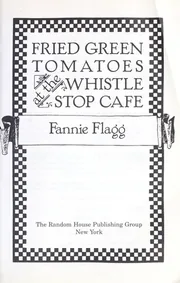
Fried Green Tomatoes at the Whistle Stop Cafe
by Fannie Flagg · 1987
It suits adult readers and older teens who enjoy character-driven, humorous Southern fiction.
403 pages, about 6.5 to 9.5 hours.
A warm Alabama story told across two time periods. 51% taste match
The story
Fannie Flagg's novel, first published in 1987, is a work of domestic fiction set in Alabama that moves between two time periods. In the present, Evelyn Couch, a middle-aged housewife, begins visiting Ninny Threadgoode, an elderly woman living in a nursing home. Week after week, Ninny talks about her younger years in the small town of Whistle Stop, and the two women grow close as the visits continue.
Ninny's recollections center on Idgie Threadgoode, her sister-in-law, and Idgie's friend Ruth Jamison, who ran the Whistle Stop Cafe together in the 1930s. The cafe served coffee and barbecue, and the story follows the people around it, including a murder. The book looks at female friendship, family, aging, and love between women, and it also takes up race relations and the harm racism does to both Black and white people. Evelyn's friendship with Ninny gives her a chance at a new direction in her own life, while Ninny's stories keep the people of Whistle Stop remembered. The novel was adapted into the 1991 film Fried Green Tomatoes, and the book has appeared in 27 editions.
The Whistle Stop Cafe opened up last week, right next door to me at the post office, and owners Idgie Threadgoode and Ruth Jamison said business has been good ever since.
Setting
AlabamaFriendship
Themes
Race relationsReminiscing in old ageFemale friendshipRomance norte americanoLesbiansWomenLove storiesRestaurants
- Want to read 190
- Reading now 9
- Read 42
Most people shelving it are saving it for later.
Of 241 readers who put it on a shelf, 79% want to read it, 4% are reading it now, 17% have finished it and 0% stopped before the end.
By the numbers
- The median edition runs 403 pages. Counting about 275 words a page and an adult reading pace of 250 words a minute, that is about 7.4 hours of reading.
- Open Library tracks 27 editions from 19 publishers, the earliest dated 1987 and the latest 2024, across 7 languages.
- On reader demand it ranks in the top 3% of the modern books in our catalog (15,152 of them).
- Libraries shelve it under Dewey 813.54 and Library of Congress class PS-3556.00000000.L26 F7 1992.
 BookWard’s take
A warm Alabama story told across two time periods
Fannie Flagg builds this around a simple frame: Evelyn Couch, stuck in middle age, visits Ninny Threadgoode in a nursing home and hears about the Whistle Stop Cafe. The structure is where it earns its shape, since the present-day visits keep opening onto the 1930s and a wider circle of townspeople. It leans on the familiar comforts of domestic fiction, and it is sentimental in a way that will feel cozy to some readers and soft to others. It is also a gentler read than one with a taste for hard-edged restraint might want. What it offers instead is a voice: a talkative, folksy storyteller who makes a 403-page book feel companionable. Race, aging and love between women all get real room. Come for the voice and the cafe, not for tight construction.
At 403 pages it runs long for a small-town story, well away from the tight length BookWard prefers.
Ninny's stories wander at a front-porch pace, steadier than BookWard's faster taste.
The two-era storytelling frame and the cafe setting have their own character, though the ingredients are familiar.
The language is plain and conversational, with homespun color rather than ornament, close to BookWard's level.
Evelyn's change and the friendships matter more than any single plot mechanism, which suits BookWard.
Evelyn gets a new direction and the people of Whistle Stop are kept alive, so it leans hopeful, as BookWard does.
Weaving two eras together is a step beyond straight chronology, though it stays easy to follow.
The folksy storytelling brings plenty of laughter alongside the heavier material, close to BookWard's taste.
Murder and racism sit inside a warm story, so it goes darker than a cozy read suggests, close to BookWard.
The friendships and the passing of time carry real feeling, matching BookWard's emotional register.
See all 50 dialsEvery position, side by side with this book
Where it lines up
- Authorial voiceBookWard 9 · book 9
- Story or ideasBookWard 3 · book 3
- Character depthBookWard 8 · book 7
Where it pulls apart
- Familiar tropesBookWard 10 · book 3
- LengthBookWard 1 · book 6
- OpeningBookWard 10 · book 6
At 403 pages it runs long for a small-town story, well away from the tight length BookWard prefers.
The nursing-home frame draws you in gently rather than grabbing you, a softer opening than BookWard likes.
Cozy small-town warmth and a cafe full of eccentrics are well-worn comforts, short of the trope-avoiding BookWard prefers.
Its two timelines connect cleanly, and the story hangs together without strain, though it values charm over precision.
Ninny's stories wander at a front-porch pace, steadier than BookWard's faster taste.
The two-era storytelling frame and the cafe setting have their own character, though the ingredients are familiar.
Evelyn, Ninny, Idgie and Ruth are drawn with warmth and quirks, close to the depth BookWard values.
The present-day and past threads are meant to come together, which suits BookWard's liking for resolution.
It is openly affectionate and heartfelt, which sits on the sentimental side of BookWard's restrained taste.
A murder sits inside the cafe's story, and it belongs to the plot rather than serving as shock for its own sake.
This is a novel, so the rigor dial does not apply.
Flagg's folksy, talkative storyteller voice is the book's signature, matching BookWard's love of distinctive voices.
This is a story-led book, driven by people and incidents rather than argument, in line with BookWard.
Ninny tells much of the past aloud, so some of it is explained rather than dramatized, a little more than BookWard prefers.
A story told in loose visits and recollections can meander in places, less sustained than BookWard likes.
The language is plain and conversational, with homespun color rather than ornament, close to BookWard's level.
Evelyn's change and the friendships matter more than any single plot mechanism, which suits BookWard.
Evelyn gets a new direction and the people of Whistle Stop are kept alive, so it leans hopeful, as BookWard does.
Weaving two eras together is a step beyond straight chronology, though it stays easy to follow.
The folksy storytelling brings plenty of laughter alongside the heavier material, close to BookWard's taste.
It reads easily and invites you to settle in, which is no obstacle for BookWard.
The present-day visits and the Whistle Stop townspeople give it many angles, in step with BookWard.
It moves between the present and the 1930s, a shifting timeline much like BookWard's taste.
The story is grounded Alabama life with no fantastical elements, more real-world than BookWard's middle position.
Whistle Stop is full of townspeople around the cafe, making for a wide cast, wider than BookWard's usual.
It stays inside one small town and a handful of lives, so it is intimate, close to BookWard's range.
It balances what happens in the cafe with what the women feel about their lives, close to BookWard.
Much of the story comes through talk, with Ninny's telling and the townspeople's banter, in step with BookWard.
Love, including love between women, runs through the book, though friendship and community share the center with it.
A 1930s Alabama railroad town is a distinct place, though the setting is easy to settle into.
Most of the story is set in the 1930s, with a framing present, so it looks mainly to the past, unlike BookWard.
Its themes of friendship, aging and community, and its 1991 film adaptation, point to lasting appeal, as BookWard values.
Ninny tells her story warmly and openly, with no sign of a narrator hiding the truth, so it is reliable, unlike BookWard's taste.
It takes clear moral positions, especially on racism, which is more direct than BookWard's liking for ambiguity.
Cafe food, small-town texture and period detail give it rich description, beyond BookWard's middle.
This is a novel, so the nonfiction style dial does not apply.
This is a novel, so the personal-perspective dial does not apply.
It reads as a self-contained story, like BookWard's usual standalone.
Past events unfold through revelation and a murder, but it favors storytelling over big reversals, a bit short of BookWard.
It is comforting overall, even as it takes on racism, so it leans away from BookWard's challenging taste.
Murder and racism sit inside a warm story, so it goes darker than a cozy read suggests, close to BookWard.
The friendships and the passing of time carry real feeling, matching BookWard's emotional register.
The humor is folksy and good-natured, closer to broad than dry, a touch broader than BookWard.
A murder and the racism of the era appear on the page, but the book is not graphic, below BookWard's level.
The love between women is present but not written as explicit content, well below BookWard.
Racism and its effect on Black and white people are central themes, so it is outspoken, near BookWard's level.
Southern speech colors the voice, but it reads easily, so the language difficulty is modest, like BookWard.
The storyteller's warm, chatty voice carries opinions throughout, in step with BookWard.
Ninny's memories drive the book, so it looks back more than forward, unlike BookWard's forward lean.
It believes in friendship and decency and treats cruelty as harmful, so it is idealistic, matching BookWard.
Review written by BookWard, dial version 1, November 2026.
Who is Fried Green Tomatoes at the Whistle Stop Cafe right for?
It suits adult readers and older teens who enjoy character-driven, humorous Southern fiction. It deals with racism, a murder and love between women, so it may call for a conversation with younger readers.
It reads easily and invites you to settle in, which is no obstacle for BookWard.
Murder and racism sit inside a warm story, so it goes darker than a cozy read suggests, close to BookWard.
The friendships and the passing of time carry real feeling, matching BookWard's emotional register.
A murder and the racism of the era appear on the page, but the book is not graphic, below BookWard's level.
Book CompanionFried Green Tomatoes at the Whistle Stop Cafe: ideas, characters, themes
Telling stories keeps people alive, and listening to them can change the life of the person who listens.
- The two-time frame. Evelyn's present-day visits to Ninny open onto the 1930s, so the past and present keep shaping each other.
- The cafe at the center. The Whistle Stop Cafe, run by Idgie and Ruth, serves coffee and barbecue and draws in the people around it.
- Friendship between women. Female friendship, in the present and the past, runs from the first page to the last.
- Race and its harm. The book looks at race relations and the harm racism does to both Black and white people.
- A murder in the past. The cafe's story includes a murder, which adds a darker thread to Ninny's recollections.
Characters
Evelyn Couch
A middle-aged housewife in the present day
She visits Ninny each week and finds a chance at a new direction in her life.
Ninny Threadgoode
An elderly woman in a nursing home
She tells stories of her younger years in Whistle Stop, Alabama.
Idgie Threadgoode
Ninny's sister-in-law
A tomboy who ran the cafe in the 1930s with her friend Ruth.
Ruth Jamison
Idgie's friend and cafe partner
She helps run the Whistle Stop Cafe with Idgie.
Themes
The bonds between women, in the present and the past, are what carry the book.
Ninny's old age and Evelyn's slump in middle age show how later life can still change.
Stories keep the people of Whistle Stop from being forgotten.
The book shows how prejudice damages Black and white people alike.
Affection and partnership between women sit at the heart of the cafe's story.
The cafe pulls a small town together around food, talk and shared lives.
Discussion questions
- Why does Flagg frame the cafe's story as something one woman tells to another?
- How does Evelyn change as she listens to Ninny?
- What does the Whistle Stop Cafe stand for in its town?
- How does the book handle race relations, and does it do so well?
- What does the murder add to a story that is otherwise warm?
Personalize your Book Companion
This is the general edition. In BookWard, the Companion is written for you: your reading profile, your notes, and spoiler-safe to the page you are on.
Buy, listen or borrow Fried Green Tomatoes at the Whistle Stop Cafe
Each link opens a search for this book on that store, in a new tab.
Read on a device
Borrow
Reviews and community
If you liked Fried Green Tomatoes at the Whistle Stop Cafe
Five women, one boardinghouse, and Washington's Red Scare closing in
BuckeyePatrick RyanA small Ohio town, two families, and one buried secret
Mina vännerFredrik BackmanA lonely teenager chases the story behind a famous painting
The HelpKathryn StockettThree Mississippi women, 1962, and one risky project
Sources: Open Library.
Track Fried Green Tomatoes at the Whistle Stop Cafe and find your next favorite
Add it to your shelf, rate what you have read, and BookWard will recommend what fits you.
Free to start. No credit card needed.