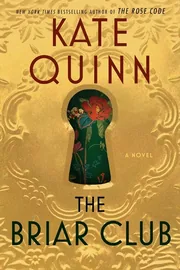
The Briar Club
by Kate Quinn · 2024
Suits adult readers and older teens who enjoy historical fiction about friendship.
432 pages, about 7 to 10 hours.
Five women, one boardinghouse, and Washington's Red Scare closing in. 58% taste match
The story
The Briar Club is a novel by Kate Quinn, first published in 2024, and it falls within literary and general fiction. The story opens in Washington, DC, in 1950, at Briarwood House, an all-female boardinghouse in the heart of the capital. The building is worn down, and its residents mostly keep their distance from one another.
That changes when Grace March, a widow, takes the attic room. Her weekly dinner parties and window-brewed sun tea draw the other residents together. Among them are Fliss, an Englishwoman who presents herself as a perfect wife and mother; Nora, a policeman's daughter who becomes involved with a gangster; Beatrice, a baseball player whose career ended when the women's baseball league closed; and Arlene, who commits herself to McCarthy's Red Scare. Grace has a secret of her own, and when an act of violence divides the house, the women must decide who their true enemy is. The book runs about 432 pages and has appeared in eight editions.
By the numbers
- The median edition runs 432 pages. Counting about 275 words a page and an adult reading pace of 250 words a minute, that is about 7.9 hours of reading.
- Open Library tracks 8 editions from 2 publishers, the earliest dated 2024 and the latest 2025.
- On reader demand it ranks in the top 30% of the recent releases books in our catalog (1,627 of them).
- Libraries shelve it under Dewey 813.6 and Library of Congress class PS-3617.00000000.U578B7 2024.
 BookWard’s take
Five women, one boardinghouse, and Washington's Red Scare closing in
Kate Quinn sets this in Briarwood House, an all-female boardinghouse in 1950 Washington, DC, where a widow's attic dinner parties pull five very different women together. It is a character-driven book with plenty of voices: Fliss, Nora, Beatrice and Arlene each carry their own thread, so the viewpoint stays wide even though the cast itself is modest. The setting is vivid and specific, a particular corner of postwar America rendered with care. Whether the book feels fresh is the open question, since a found-family boardinghouse and a widow with a secret are well-worn ground, and it may lean on familiar tropes more than some readers would like. The pace should move briskly across 432 pages, and the violence at the centre suggests the book at least tries to earn its shocks. A good fit for readers who want warmth with some bite.
At 432 pages it is full-length rather than tight, which sits further from BookWard's love of brevity.
Several intertwined storylines keep things moving at a steady clip rather than a slow crawl.
The 1950 DC setting and Red Scare backdrop add freshness, but the core structure is well-trodden.
Accessible, readable prose rather than ornate stylings.
The women and their friendships drive events more than a plot machine does.
Found family and healing rituals give the book a hopeful core despite its darker turns.
A shared-house ensemble is a conventional frame, not an experimental one.
The premise reads as warm and serious, with humor in the margins at most.
Violence, the Red Scare and a shadowy gangster add some darkness to an otherwise warm story.
Wounded, secretive women and a house in crisis make for strong feeling.
See all 50 dialsEvery position, side by side with this book
Where it lines up
- EndingBookWard 8 · book 8
- Story or ideasBookWard 3 · book 3
- PaceBookWard 8 · book 7
Where it pulls apart
- Familiar tropesBookWard 10 · book 4
- LengthBookWard 1 · book 6
- OpeningBookWard 10 · book 7
At 432 pages it is full-length rather than tight, which sits further from BookWard's love of brevity.
The boardinghouse and a widow's arrival give it an inviting start, though it builds through character rather than a jolt.
A found-family boardinghouse and a widow with a secret are familiar setups, which BookWard would mark down.
A plot built on secrets and a central act of violence needs tight cause and effect, and this kind of story usually delivers it.
Several intertwined storylines keep things moving at a steady clip rather than a slow crawl.
The 1950 DC setting and Red Scare backdrop add freshness, but the core structure is well-trodden.
Five distinct women, each with a private wound, put character at the centre of the book.
The question of who the true enemy is points toward a resolved answer rather than a drifting close.
Healing dinners and sun tea lean warm, so the book likely tips toward feeling more than restraint.
An act of violence tears the house apart, and the setup suggests it is woven into the story rather than gratuitous.
This is a novel, so the rigor dial does not apply.
A polished, commercial historical-fiction voice that is confident without being strongly idiosyncratic.
This is firmly story-led, driven by the women's lives and what happens in the house.
Historical fiction like this mostly shows period detail through scene, with some explaining of the era.
Interwoven plotlines usually keep the middle moving, though a long page count leaves some room to slacken.
Accessible, readable prose rather than ornate stylings.
The women and their friendships drive events more than a plot machine does.
Found family and healing rituals give the book a hopeful core despite its darker turns.
A shared-house ensemble is a conventional frame, not an experimental one.
The premise reads as warm and serious, with humor in the margins at most.
A commercial historical novel is easy to read and does not ask much of the reader.
Fliss, Nora, Beatrice and Arlene each anchor their own strand, so the book moves among many perspectives.
This is grounded historical fiction with no fantastical element.
Five main women plus the people around them make a mid-sized ensemble.
One boardinghouse and its residents keep it intimate, even with national politics in the background.
Secrets and friendships balance inner lives against events like the violence and the gangster subplot.
A house full of talkative women and shared dinners points to a dialogue-rich book.
Nora's entanglement gives romance a place, but friendship is the main bond.
1950s Washington is a specific and less everyday setting, though not exotic.
Set in 1950, it looks back at a past era rather than the present.
Its themes of friendship and fear travel, though the setting ties it to a period.
Arlene's Red Scare zeal and the question of the true enemy introduce real moral tension.
The boardinghouse and the era invite detailed period texture.
This is a novel, so the nonfiction-style dial does not apply.
This is a novel, so the perspective dial does not apply.
It reads as a standalone novel.
Grace's secret and the shocking violence suggest several turns along the way.
It offers emotional weight but stays within the comfortable range of popular historical fiction.
Violence, the Red Scare and a shadowy gangster add some darkness to an otherwise warm story.
Wounded, secretive women and a house in crisis make for strong feeling.
Any humor is likely dry and gentle, not broad.
McCarthy's Red Scare is a live thread through Arlene, putting politics fairly high.
Language stays plain and period-flavored rather than dense.
The narration tells the story from within the women's lives without much editorializing.
It looks back at the postwar years, though its themes echo today.
Friendship and healing push it toward the idealistic side despite the fear around it.
Review written by BookWard, dial version 1, November 2026.
Who is The Briar Club right for?
Suits adult readers and older teens who enjoy historical fiction about friendship. It includes an act of violence, a gangster subplot and Red Scare tensions that some readers may find heavy.
A commercial historical novel is easy to read and does not ask much of the reader.
Violence, the Red Scare and a shadowy gangster add some darkness to an otherwise warm story.
Wounded, secretive women and a house in crisis make for strong feeling.
Book CompanionThe Briar Club: ideas, characters, themes
In 1950 Washington, a widow's weekly dinners turn a houseful of guarded women into friends, until violence forces them to decide who the real enemy is.
- A boardinghouse in 1950 DC. Briarwood House is an all-female, down-at-the-heels residence in the heart of the capital, where residents keep to themselves.
- Grace's arrival. The widow Grace March moves into the attic room and draws her neighbors together through weekly dinner parties and sun tea.
- Four neighbors, four struggles. Fliss, Nora, Beatrice and Arlene each face their own pressures, from a polished marriage to a gangster entanglement to a lost baseball career.
- The Red Scare backdrop. Arlene throws herself into McCarthy's anti-communist crusade, bringing the era's suspicion into the house.
- Grace's secret and the violence. Grace hides something of her own, and a shocking act of violence tears the house apart.
Characters
Grace March
The widow in the attic
A lovely, mysterious newcomer whose dinners bring the residents together while she hides a terrible secret.
Fliss
Resident
A poised English beauty whose perfect wife-and-mother surface covers deep inner wounds.
Nora
Resident
A policeman's daughter who becomes entangled with a shadowy gangster.
Beatrice
Resident
A frustrated baseball star whose career ended with the women's league after WWII.
Arlene
Resident
A poisonous, gung-ho woman who has committed herself to the Red Scare.
Themes
Strangers become a support network through shared meals and trust.
Nearly every resident hides something behind a respectable front.
The Red Scare turns neighbors into potential enemies.
Women adjust to lost wartime roles and limited postwar options.
The book asks whether danger comes from outside or from within the house.
Discussion questions
- Why does Grace's hospitality change the house so much?
- How do the women's public faces differ from what they hide?
- What does Arlene's Red Scare zeal say about fear and belonging?
- How does the postwar setting shape the choices these women have?
- Who do you think the true enemy is, and why?
Personalize your Book Companion
This is the general edition. In BookWard, the Companion is written for you: your reading profile, your notes, and spoiler-safe to the page you are on.
Buy, listen or borrow The Briar Club
Each link opens a search for this book on that store, in a new tab.
Read on a device
Borrow
Reviews and community
If you liked The Briar Club
Two wartime orphans, a bookshop, and a widower with secrets
BuckeyePatrick RyanA small Ohio town, two families, and one buried secret
The Secret Book SocietyMadeline MartinA cozy 1895 book club with a murder rumor attached
The WomenKristin HannahA Vietnam nurse's war, and the homecoming that nearly breaks her
Sources: Open Library.
Track The Briar Club and find your next favorite
Add it to your shelf, rate what you have read, and BookWard will recommend what fits you.
Free to start. No credit card needed.