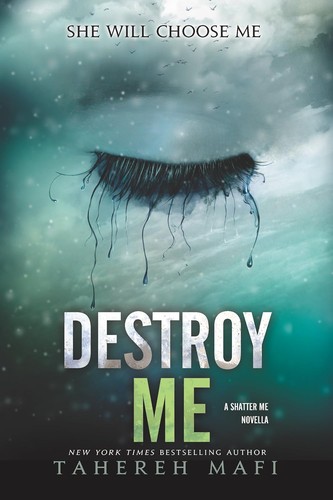
Destroy Me
by Tahereh Mafi
★ Top 25 book of 2012 · #12 on Best Books of 2012
Juliette fled The Reestablishment by shooting Warner, but he survives and is still fixated on her. While he works to keep his soldiers in line and hunt down the traitors who helped her, his father arrives with very different plans for Juliette.
Best for: Readers who have finished Shatter Me and want Warner's perspective
Destroy Me is #12 on BookWard's Best Books of 2012, out of 59 2012 books that cleared our data bar.
What Destroy Me is about
This story follows Shatter Me and picks up after Juliette's escape from The Reestablishment. Warner is recovering from a near-fatal wound at the base, keeping his soldiers in line and stamping out any talk of rebellion in the sector. He is still obsessed with Juliette and wants her back, and he plans to deal with Adam and Kenji, the two traitors who helped her get away. Then his father, the Supreme Commander of The Reestablishment, arrives to fix his son's mistakes, with very different plans for Juliette. Warner cannot let those plans happen. Intense and brooding, it explores obsession, power and the pull between a father and son. It suits readers of the first book who want to know what Warner is really like.
Destroy Me on the Best Books of 2012
Destroy Me came out in 2012. Of the 59 books first published in 2012 that met BookWard's data bar, it ranks #12 on our Best Books of 2012 list.
Why it made the list: 1,090 readers have shelved it on Open Library; readers rate it 4.1 out of 5 (24 ratings); 55 are reading it right now. The list ranks each year’s books on how many readers have picked them up, how highly readers rate them, and how many are reading them right now.
Nearby on the 2012 list
- En Man Som Heter Ove Fredrik Backman, #10
- Breaking the Habit of Being Yourself Joe Dispenza, #11
- Bared to You Sylvia Day, #13
- Aristotle and Dante Discover the Secrets of the Universe Benjamin Alire Sáenz, #14
See all Best Books of 2012 Best books by year
More years: Best Books of 2011 Best Books of 2013.
The numbers behind it
- Readers: 984 want to read it, 55 are reading it now and 51 have read it, according to Open Library.
- Ratings: 4.1 out of 5 from 24 Open Library ratings.
| Signal | This book (0 to 100) | Weight |
|---|---|---|
| Reach | 86 | 55% |
| Reader love | 44 | 25% |
| Being read right now | 86 | 20% |
Questions about Destroy Me
When was Destroy Me published?
Destroy Me by Tahereh Mafi was first published in 2012.
Was Destroy Me one of the best books of 2012?
Destroy Me is #12 on BookWard's Best Books of 2012, out of 59 2012 books that cleared our data bar. 1,090 readers have shelved it on Open Library; readers rate it 4.1 out of 5 (24 ratings); 55 are reading it right now.
Why is Destroy Me on the Best Books of 2012 list?
1,090 readers have shelved it on Open Library; readers rate it 4.1 out of 5 (24 ratings); 55 are reading it right now.
More of the best books of 2012
- Wonder R. J. Palacio, #1
- The Fault in Our Stars John Green, #2
- The Selection (the Selection #1) Kiera Cass, #3
- Drama Raina Telgemeier, #4
- Throne of Glass Sarah J. Maas, #5
- The Power of Habit Charles Duhigg, #6
See the full Best Books of 2012, the Top 100, or new books on Rising.
How we know
This page uses public data: Open Library reader counts and ratings, and Wikipedia page views for recent years. The description is paraphrased from real source text. Rankings reflect reading interest, not quality or sales, and can be affected by data gaps. Lists update monthly.
Suits older teens and adults who already know Shatter Me and enjoy intense, stylized dystopian romance.
Depends on the edition you pick.
A short companion novella from Warner's obsessive point of view. 55% taste match
 BookWard’s take
A short companion novella from Warner's obsessive point of view
Destroy Me is a companion novella to Shatter Me, and it is built around one man: Warner, recovering from a gunshot and set on getting Juliette back. That makes it a character-driven, narrow piece rather than a plot machine. It is short, and it moves briskly because the whole thing runs on a single obsession and a looming threat from his father. The voice is the draw: heightened, fragmentary and intense, which will delight fans and wear on anyone who dislikes ornate prose. Familiar tropes are present, since the dystopian regime and the brooding antagonist are well-worn ground, so there is little here that feels new. Read it only after Shatter Me, because it is a series piece, not a way in.
A novella that stays short and contained, which suits BookWard's love of tight books.
A short span built around one obsession and one approaching threat keeps it moving at a good clip.
Its value is a fresh angle on a known character, not a new premise.
Lyrical, fragmentary and ornate, which sits above BookWard's mid-range taste but is part of its identity.
It is driven by one man's fixation far more than by external plot.
Obsession, injury and a looming parent leave it mostly bleak.
Its fragmented, interior style is slightly unconventional for a novella.
This is an intense, serious book with little room for comedy.
A ruthless regime and a wounded, fixated protagonist give it a dark edge.
Intensity of feeling is the whole texture of the book.
See all 50 dialsEvery position, side by side with this book
Where it lines up
- LengthBookWard 1 · book 1
- Authorial voiceBookWard 9 · book 9
- Story or ideasBookWard 3 · book 3
Where it pulls apart
- Familiar tropesBookWard 10 · book 4
- Internal logicBookWard 10 · book 6
- OpeningBookWard 10 · book 7
A novella that stays short and contained, which suits BookWard's love of tight books.
It opens on Warner wounded and fixated on Juliette, so the pull starts immediately.
A dystopian regime and a brooding antagonist are familiar territory, which sits below BookWard's taste for avoiding tropes.
The setup follows cleanly from the first book, though it leans on feeling more than tight mechanics.
A short span built around one obsession and one approaching threat keeps it moving at a good clip.
Its value is a fresh angle on a known character, not a new premise.
The whole book exists to open up Warner's interior, which is where it earns its place.
As a bridge to the series, it resolves its own thread while pointing onward.
Intense, yearning feeling runs through it, so it leans emotional rather than restrained.
The danger comes from the regime and Warner's father, and the darkness serves the character.
This is fiction, so rigor does not apply.
Mafi's fragmented, heightened style is unmistakable and the strongest reason to read it.
It is story and character first, with little interest in arguing an idea.
It leans on Warner's own telling of events, so more is explained than staged in scene.
Its short length leaves little room for a middle to sag.
Lyrical, fragmentary and ornate, which sits above BookWard's mid-range taste but is part of its identity.
It is driven by one man's fixation far more than by external plot.
Obsession, injury and a looming parent leave it mostly bleak.
Its fragmented, interior style is slightly unconventional for a novella.
This is an intense, serious book with little room for comedy.
Short and readable, though the stylized prose asks some attention.
It stays in a single head throughout.
It follows events forward after the first book, in a largely linear way.
A dystopian world with people who have unusual powers sits well above the everyday.
A small circle revolves around Warner, Juliette and the figures pursuing them.
It stays close and personal despite the regime looming behind it.
Almost all of the action is inside Warner's head.
Thought and narration carry it more than conversation.
Warner's fixation on Juliette is the engine, though it is obsession more than courtship.
A dystopian regime world is unfamiliar, though readers of the first book will know it.
A near-future dystopia reads as contemporary in feel.
Its appeal is tied to fans of the series and its moment in YA dystopia.
A fixated, self-justifying narrator gives his view of things a skew worth questioning.
Warner is a morally tangled figure and the book does not settle on easy answers.
Heightened imagery and sensory detail are central to its style.
This is fiction, so the nonfiction dial does not apply.
This is fiction, so the nonfiction dial does not apply.
It is explicitly a companion to Shatter Me and meant to be read inside the series.
It plays out more as character study than a puzzle of reversals.
Obsession and control make it uneasy, though not difficult to follow.
A ruthless regime and a wounded, fixated protagonist give it a dark edge.
Intensity of feeling is the whole texture of the book.
There is little humor, and what there is stays dry.
A gunshot recovery and a threatening regime bring violence, mostly in the background.
The tension is romantic and charged but not graphic.
A controlling regime is the backdrop, though it stays in the background.
The language is plain in vocabulary but stylized in rhythm.
The narration is deeply subjective and strongly opinionated.
It looks ahead to what Warner will do next while carrying the weight of what came before.
Control and obsession tilt it cynical, with only faint hope.
Review written by BookWard, dial version 1, November 2026.
Who is Destroy Me right for?
Suits older teens and adults who already know Shatter Me and enjoy intense, stylized dystopian romance. It involves a violent regime, a shooting and an obsessive protagonist.
Short and readable, though the stylized prose asks some attention.
A ruthless regime and a wounded, fixated protagonist give it a dark edge.
Intensity of feeling is the whole texture of the book.
A gunshot recovery and a threatening regime bring violence, mostly in the background.
Book CompanionDestroy Me: ideas, characters, themes
A short look inside Warner's head as he recovers from a near-fatal wound and plots to retrieve Juliette.
- Warner's recovery. The book opens with Warner healing from the gunshot Juliette gave him.
- The search for Juliette. His first priority is to find her and bring her back.
- Hunting the traitors. He also intends to deal with Adam and Kenji, who helped her escape.
- Keeping order. He must keep his soldiers in check and suppress any mention of a rebellion in the sector.
- The Supreme Commander arrives. Warner's father shows up to correct his son's mistakes, with different plans for Juliette.
Characters
Warner
Narrator and focus
Recovering from a wound and still fixated on Juliette.
Juliette
The one he wants back
She escaped the Reestablishment and shot Warner.
Adam
Traitor in Warner's eyes
One of the two who helped Juliette escape.
Kenji
Traitor in Warner's eyes
The other who helped her get away.
The Supreme Commander
Warner's father
Leader of the Reestablishment, with his own plans for Juliette.
Themes
How fixation shapes what a person chooses to do.
A regime and a family both try to dominate through power.
A father's expectations press down on his son.
Who counts as a traitor depends on whose side you take.
Discussion questions
- How does hearing events from Warner change how you see the first book?
- Is Warner's focus on Juliette love, obsession or something else?
- What does the Supreme Commander's arrival reveal about Warner?
- Why tell this story as a short novella instead of a full novel?
- Does a sympathetic narrator excuse his actions?
Personalize your Book Companion
This is the general edition. In BookWard, the Companion is written for you: your reading profile, your notes, and spoiler-safe to the page you are on.
Buy, listen or borrow Destroy Me
Each link opens a search for this book on that store, in a new tab.
Read on a device
Borrow
Reviews and community
If you liked Destroy Me
A girl with a lethal touch, told in scribbled-out lines
The Cruel PrinceHolly BlackA sharp, scheming faerie court story with a mortal girl at its center
TitheHolly BlackSuburban faerie dark fantasy with a punk edge and real teeth
Defy Me (Shatter Me)Tahereh MafiA dystopian romance that keeps the Shatter Me engine running
Find your own best books
Add what you have read, rate it, and BookWard will recommend what to read next.
Free to start. No credit card needed.