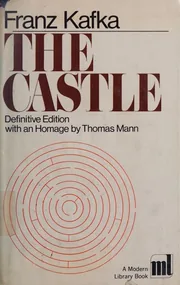
Das Schloß
by Franz Kafka · 1922
Best suited to mature teens and adults ready for abstract, slow-moving fiction.
384 pages, about 6 to 9 hours.
A surveyor who cannot reach the Castle, and cannot leave. 47% taste match
The story
Das Schloß is a novel by Franz Kafka, the Austrian author whose work belongs to German-language literature. It follows a man known only as K., who comes to a village late one evening and is identified as a Land Surveyor. The authorities who govern the village are said to reside in a castle on the hill above it, and K. wants to be admitted there. He is neither accepted by the villagers nor able to go home, and his efforts to reach the Castle take place in a maze of officialdom.
Kafka began writing the book in 1922 and left it unfinished. It is the last of his three major novels. The story deals with bureaucracy and authority, and it is often read as an allegory. Readers meet K. in situations that set certainty against doubt, hope against fear, and reason against nonsense. A standard of the classic literature shelf, the book runs to roughly 384 pages in a typical edition and has appeared in a great many editions.
IT WAS late in the evening when K. arrived.
Themes
BureaucracyCastlesCriticism and interpretationClassic LiteratureGerman literatureClassicsClassicNew York Times reviewed
- Want to read 553
- Reading now 37
- Read 49
Most people shelving it are saving it for later.
Of 639 readers who put it on a shelf, 87% want to read it, 6% are reading it now, 8% have finished it and 0% stopped before the end.
By the numbers
- The median edition runs 384 pages. Counting about 275 words a page and an adult reading pace of 250 words a minute, that is about 7.0 hours of reading.
- Open Library tracks 166 editions from 102 publishers, the earliest dated 1926 and the latest 2021, across 11 languages.
- On reader demand it ranks in the top 2% of the classic books in our catalog (8,749 of them).
- Libraries shelve it under Dewey 830 and Library of Congress class PT-2621.00000000.A26 S3 1983.
 BookWard’s take
A surveyor who cannot reach the Castle, and cannot leave
Das Schloß grabs you quickly, and its logic is deliberately maddening. K. arrives in a village, is named a Land Surveyor, and wants only to be admitted to the Castle above it. It may be a tricky fit for some readers. The book runs on a nightmare logic of its own, strict in its way but never airtight. Where it earns its place is in its originality and its voice, since few novels read like this one. The ending is the other sticking point, because Kafka left the book unfinished. It is demanding and driven by ideas more than plot, so it rewards patience over speed. If you like your puzzles solved, this one refuses.
At about 384 pages it is mid-length, longer than BookWard's taste for tight books, and it feels its size.
Progress is slow by design, with K.'s efforts circling rather than advancing, well below BookWard's preference.
Few books before or since resemble it, and that singular invention is exactly what BookWard rewards.
The prose is plain and exact on the surface, which keeps it nearer the plain end.
K.'s predicament and the machinery around him carry it roughly equally, so it sits near the middle.
Hope keeps flickering and failing, and the overall mood is closer to bleak than hopeful.
The form is a fairly conventional continuous narrative, with its strangeness in content rather than layout.
There is dry absurd comedy in the bureaucracy, but the tone stays mostly serious.
The darkness is existential and bureaucratic rather than graphic, so it sits mid-scale.
Feeling runs under a controlled surface, moderate in force.
See all 50 dialsEvery position, side by side with this book
Where it lines up
- Familiar tropesBookWard 10 · book 10
- Shock for effectBookWard 9 · book 9
- OriginalityBookWard 9 · book 10
Where it pulls apart
- Internal logicBookWard 10 · book 3
- EndingBookWard 8 · book 1
- LengthBookWard 1 · book 5
At about 384 pages it is mid-length, longer than BookWard's taste for tight books, and it feels its size.
A stranger arriving late at a village and wanting into the Castle sets the problem quickly, though the book then slows.
Nothing here follows a standard template; the bureaucratic maze is Kafka's own, which BookWard prizes.
The village runs on a dream logic of contradictory rules, consistent in feeling but never airtight, which strains BookWard's taste.
Progress is slow by design, with K.'s efforts circling rather than advancing, well below BookWard's preference.
Few books before or since resemble it, and that singular invention is exactly what BookWard rewards.
K. is drawn through his stubborn pursuit more than through a rounded inner life, a little under BookWard's liking.
Kafka left it unfinished, so it offers no resolution, the opposite of what BookWard looks for.
There is no softness or easy comfort anywhere, which suits BookWard's liking for restraint.
Its darkness comes from the grinding absurdity of the situation rather than from shock for effect, which BookWard respects.
This is fiction, so the nonfiction rigor dial does not apply.
Kafka's flat, precise, unmistakable voice is the book's greatest strength and a clear match for BookWard.
It is driven by its ideas about authority and belonging more than by plot events, leaning toward the idea side.
Much is conveyed through scenes and conversations, though characters do talk through the rules at length.
The middle repeats its frustrations, and the circling can feel slack to a reader wanting momentum.
The prose is plain and exact on the surface, which keeps it nearer the plain end.
K.'s predicament and the machinery around him carry it roughly equally, so it sits near the middle.
Hope keeps flickering and failing, and the overall mood is closer to bleak than hopeful.
The form is a fairly conventional continuous narrative, with its strangeness in content rather than layout.
There is dry absurd comedy in the bureaucracy, but the tone stays mostly serious.
It asks for patience and interpretation, and it is harder going than BookWard's preference.
The story stays with K. throughout, so it is a single-viewpoint book.
Events unfold in a straight line from K.'s arrival onward.
The setting is realistic on its face but runs on dreamlike rules, leaning slightly fantastical.
A good number of villagers and officials pass through, making the cast moderately large.
The action is confined to one village and one man's struggle, which keeps it intimate.
It balances K.'s thoughts with his dealings with others, sitting near the middle.
Much of the book is conversation between K. and the villagers, so dialogue is heavy.
Romantic entanglements exist but are not the center of the book.
The village and its Castle form an unfamiliar, self-contained world unlike ordinary life.
It was written in the early twentieth century, firmly in the past.
Its portrait of bureaucracy and exclusion keeps feeling current a century on, a strong fit with BookWard.
The narration reports K.'s experience plainly and reads as reliable.
Right and wrong are hard to pin down, and no authority or figure offers a clear answer.
Settings are sketched economically rather than richly described.
It is a standalone novel.
It offers few reveals, since its drama is the repeated frustration of K.'s aims.
The book unsettles and frustrates rather than comforts.
The darkness is existential and bureaucratic rather than graphic, so it sits mid-scale.
Feeling runs under a controlled surface, moderate in force.
Any humor is dry and deadpan rather than broad.
There is very little physical violence on the page.
Sexual content is slight and handled indirectly.
Its subject is power and bureaucracy, though not tied to a specific party or cause.
The language is plain in style, but the logic of the talk can be dense.
The narration stays neutral and lets the situation speak for itself.
The mood is stuck and circular, with no sense of a better future ahead.
K.'s hopes are repeatedly frustrated, and the book is cynical about institutions.
Review written by BookWard, dial version 1, November 2026.
Who is Das Schloß right for?
Best suited to mature teens and adults ready for abstract, slow-moving fiction. It has little graphic content, but its mood of frustration and exclusion can feel heavy.
It asks for patience and interpretation, and it is harder going than BookWard's preference.
The darkness is existential and bureaucratic rather than graphic, so it sits mid-scale.
Feeling runs under a controlled surface, moderate in force.
There is very little physical violence on the page.
Book CompanionDas Schloß: ideas, characters, themes
A man who wants only to do his job finds the authority over him unreachable and unexplainable.
- The arrival. K. comes to a village late one evening and is identified as a Land Surveyor.
- The Castle above. The village is governed by authorities said to reside in a castle on the hill.
- Neither in nor out. K. is not accepted by the villagers, yet he cannot go home.
- The maze of officialdom. His attempts to reach the Castle run through a labyrinth of officials and procedures.
- Unfinished by design of fate. Kafka began it in 1922 and never completed it, making it the last of his three major novels.
Characters
K.
Protagonist
A man known only by an initial, identified as a Land Surveyor, who seeks admission to the Castle.
Themes
Systems of authority that operate by rules no ordinary person can fully grasp.
The struggle to be accepted by a community that holds you at a distance.
The way the book keeps pitting what K. believes against what he can verify.
A world that mixes rational procedure with absurd results.
K.'s steady pursuit alongside his constant dread of failure.
Discussion questions
- Why might Kafka have left K.'s goal permanently out of reach?
- Is the Castle a place, an institution, or an idea?
- How does K.'s status as an outsider shape what he is told?
- Does the unfinished state weaken the book or add to it?
- What makes the bureaucracy feel both ridiculous and frightening?
Personalize your Book Companion
This is the general edition. In BookWard, the Companion is written for you: your reading profile, your notes, and spoiler-safe to the page you are on.
Buy, listen or borrow Das Schloß
Each link opens a search for this book on that store, in a new tab.
Read on a device
Borrow
Reviews and community
If you liked Das Schloß
A strange Kent tideline, and an object that won't hold still
The King in YellowRobert W. ChambersA slim 1895 horror collection built around a play that ruins its readers
Bartleby, the ScrivenerHerman MelvilleFive words, a lawyer's unease, and a office that cannot cope
Down and Out in Paris and LondonGeorge OrwellOrwell's first book, and a clear-eyed look at poverty
Sources: Open Library.
Track Das Schloß and find your next favorite
Add it to your shelf, rate what you have read, and BookWard will recommend what fits you.
Free to start. No credit card needed.