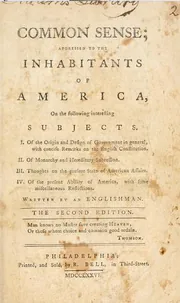
Common Sense
by Thomas Paine, Thomas Paine · 1776
Suits older teens and adults, and works well in classrooms studying the American Revolution.
61 pages, about 1 to 1.5 hours.
A short, fiery pamphlet that argued a continent toward independence. 54% taste match
What it covers
Common Sense is a political pamphlet by Thomas Paine, first published in 1776. Written in 1775 and 1776, it runs to 47 pages and argues for independence from Great Britain, addressing people in the Thirteen Colonies. Paine sets out moral and political reasoning aimed at ordinary colonists, urging them to support an egalitarian form of government and to take up the cause of separation. It appeared anonymously on January 10, 1776, as the American Revolution was beginning.
The text belongs to the literature of political science and radicalism, and it takes up questions about monarchy and the nature of government. It sits within the era of the American Revolution, from 1775 to 1783, and the wider revolutionary age of the late eighteenth century, which also reached France. Paine's pamphlet is often placed alongside the political writing of figures such as Edmund Burke. Quaker history and the Philadelphia Yearly Meeting of the Society of Friends also appear among its related subjects. Since its first printing it has gone through well over a hundred editions, and it is regularly included in collections of classic works of history and politics.
Setting
United StatesGreat BritainFrancemei guoÉtats-Unis
Period
1775-1783Revolution, 1775-178318th century
Themes
Political sciencePolitics and governmentMonarchyEarly works to 1800Society of FriendsHistoryRadicalismPhilosophy
- Want to read 217
- Reading now 18
- Read 28
Most people shelving it are saving it for later.
Of 263 readers who put it on a shelf, 83% want to read it, 7% are reading it now, 11% have finished it and 0% stopped before the end.
By the numbers
- The median edition runs 61 pages. Counting about 275 words a page and an adult reading pace of 250 words a minute, that is about 65 minutes of reading.
- Open Library tracks 171 editions from 82 publishers, the earliest dated 1776 and the latest 2020, across 5 languages.
- On reader demand it ranks in the top 6% of the classic books in our catalog (8,749 of them).
- Libraries shelve it under Dewey 320.011 and Library of Congress class E--0211.00000000.P1455 1920z.
 BookWard’s take
A short, fiery pamphlet that argued a continent toward independence
Common Sense is a political argument in under fifty pages, written for ordinary colonists rather than scholars. That aim shapes everything BookWard cares about here. The hook is immediate, because Paine takes on monarchy and the case for separation almost at once. The pace is brisk, and the middle never sags, since each section pushes the same case forward. Rigor is a more mixed story: it is a polemic, not a survey, so persuasion outranks balance, and the exposition is explained outright, which is exactly what a pamphlet should do. The voice is distinctive and plain-spoken, with prose built to be understood by anyone. It is idea-led, with no characters to speak of. If you want to see how a short text can move a nation, start here.
At 47 to 61 pages depending on edition, it is about as short as a landmark book gets, which BookWard loves.
Short sections and a single driving aim keep it moving quickly, close to BookWard's preferred speed.
Pitching radical egalitarian ideas to ordinary colonists in plain language was a fresh move in its time.
The prose is clear and direct, built for common readers, not ornamental.
It looks forward with confidence to a new kind of government, a hopeful note in a charged moment.
It follows a conventional pamphlet structure, moving from the nature of government to the case for separation.
This is a serious, urgent argument with little room for jokes.
The subject is conflict and rebellion, but the tone is argumentative rather than grim.
The urgency is real and the rhetoric stirring, though reasoned rather than raw.
See all 50 dialsEvery position, side by side with this book
Where it lines up
- LengthBookWard 1 · book 1
- PaceBookWard 8 · book 8
- EndingBookWard 8 · book 8
Where it pulls apart
- Story or ideasBookWard 3 · book 10
- ExpositionBookWard 2 · book 9
- Familiar tropesBookWard 10 · book 7
At 47 to 61 pages depending on edition, it is about as short as a landmark book gets, which BookWard loves.
Paine goes straight at government and monarchy, so the argument starts fast, which suits BookWard's taste for immediate openings.
Its republican arguments were bold for 1776, though they now feel familiar after centuries of imitation and echo.
The case builds step by step toward independence, though as a polemic it argues one side rather than testing both.
Short sections and a single driving aim keep it moving quickly, close to BookWard's preferred speed.
Pitching radical egalitarian ideas to ordinary colonists in plain language was a fresh move in its time.
It is an argument, not a story, so there are no characters to draw and the dial does not apply.
It closes on a clear call to action, fully resolved in purpose, which fits BookWard's taste for finished endings.
Paine appeals to feeling openly in places, but the argument stays firmly in charge of the emotion.
The provocation is earned, because attacking monarchy in 1776 was the whole point, not a stunt.
It marshals moral and political reasoning but is a persuasive pamphlet, not a documented study, so BookWard finds it less rigorous than ideal.
Paine's blunt, confident, plain-spoken style is unmistakable, and BookWard prizes that kind of voice.
It is entirely an argument, with ideas leading from the first page to the last.
Paine explains his reasoning outright, which is what a pamphlet for ordinary readers needs.
At this length there is no room for a slump, and every section serves the case.
The prose is clear and direct, built for common readers, not ornamental.
It looks forward with confidence to a new kind of government, a hopeful note in a charged moment.
It follows a conventional pamphlet structure, moving from the nature of government to the case for separation.
This is a serious, urgent argument with little room for jokes.
The language is plain, though 18th-century phrasing and period references take a little adjusting to.
A single, committed authorial viewpoint carries the whole text.
The argument unfolds in a straight line from first principle to conclusion.
It deals entirely in real politics and real events.
It addresses an audience and a king, with no real cast at all.
It is a small pamphlet about the founding of a nation, so the stakes are enormous.
It concerns public action and political change far more than private reflection.
As an essay it contains essentially no dialogue.
Romance has no place in a political pamphlet.
Colonial America in revolution is unfamiliar ground for most modern readers.
It dates from 1776, firmly in the past.
Its arguments about government and consent still get read and quoted well beyond its moment.
Paine speaks in his own forthright voice, with nothing hidden or unreliable.
The moral stance is plainly stated, with Paine leaving no doubt where he stands.
It argues rather than describes, so scene-setting is minimal.
It reads as sustained argument rather than storytelling, leaning analytical, with some vivid rhetoric.
Paine writes as a committed advocate, not a detached observer, so it is more personal than neutral.
It stands alone as a single pamphlet.
An argument has few surprises beyond the force of its claims.
It challenged readers to rethink loyalty and government, which BookWard values.
The subject is conflict and rebellion, but the tone is argumentative rather than grim.
The urgency is real and the rhetoric stirring, though reasoned rather than raw.
It discusses war and conflict as a prospect but does not dwell on violence.
There is no sexual content.
Politics is the entire subject, front and center from start to finish.
The language is plain, with only some archaic 18th-century phrasing.
Paine's views are the whole point, stated forcefully and without neutrality.
It looks ahead toward a new nation and a new form of government.
It argues for a more equal order, an idealistic vision for its time.
Review written by BookWard, dial version 1, November 2026.
Who is Common Sense right for?
Suits older teens and adults, and works well in classrooms studying the American Revolution. It contains no explicit content, though its 18th-century phrasing can take some getting used to.
The language is plain, though 18th-century phrasing and period references take a little adjusting to.
The subject is conflict and rebellion, but the tone is argumentative rather than grim.
The urgency is real and the rhetoric stirring, though reasoned rather than raw.
It discusses war and conflict as a prospect but does not dwell on violence.
Book CompanionCommon Sense: ideas, characters, themes
Paine argues that monarchy is a poor basis for government and that the American colonies should declare independence from Great Britain.
- Written for ordinary people. Paine aimed his reasoning at common colonists, using clear, persuasive prose rather than learned language.
- A case against monarchy. The pamphlet takes up the nature of government and challenges the legitimacy of monarchy.
- The case for separation. It urges colonists to support independence and take up the cause of breaking from Britain.
- An egalitarian vision. Paine pushes for a more egalitarian form of government in place of inherited rule.
- Perfect timing. It appeared anonymously on January 10, 1776, as the American Revolution was beginning, and became an immediate sensation.
Themes
The argument for the colonies breaking from Great Britain.
The questioning of hereditary rule and its legitimacy.
A system meant to serve ordinary people rather than rulers.
How clear, direct writing can move a public to act.
The wider revolutionary age in which the pamphlet took shape.
Discussion questions
- Why might plain language have been so effective for Paine's audience?
- How does the pamphlet make its case against monarchy?
- Does a one-sided argument weaken or strengthen its persuasive force?
- Which of Paine's ideas still shape political debate today?
- How does reading it now differ from reading it in 1776?
Personalize your Book Companion
This is the general edition. In BookWard, the Companion is written for you: your reading profile, your notes, and spoiler-safe to the page you are on.
Buy, listen or borrow Common Sense
Each link opens a search for this book on that store, in a new tab.
Read on a device
Borrow
Reviews and community
If you liked Common Sense
A fierce, compact pamphlet that still sets the terms of argument
La conquête du painPeter KropotkinKropotkin's case for feeding everyone through voluntary cooperation, argued without apology
Die Entwicklung des Sozialismus von der Utopie zur WissenschaftFriedrich EngelsEngels's short, argumentative primer on how socialism claimed to become a science
A Vindication of Rights of WomanMary WollstonecraftWollstonecraft's 1792 argument for women's education and independence, still bracing today
Sources: Open Library.
Track Common Sense and find your next favorite
Add it to your shelf, rate what you have read, and BookWard will recommend what fits you.
Free to start. No credit card needed.