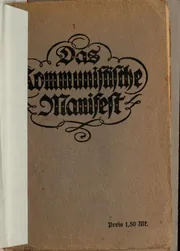
Manifest der Kommunistischen Partei
by Karl Marx, Friedrich Engels · 1848
Suits mature teenagers and adults interested in politics, history or economics.
89 pages, about 1.5 to 2 hours.
A fierce, compact pamphlet that still sets the terms of argument. 50% taste match
What it covers
Manifest der Kommunistischen Partei is a short political pamphlet first published in 1848, with Karl Marx named as its author. It was written for the Communist League, an organization active in the 19th century, and sets out the aims and purpose of that group. Most editions run to roughly 89 pages, so it reads as a compact work of political writing rather than a long treatise.
The text is a primary source in the history of communism, socialism, and Marxism. It examines capitalism, the proletariat, and social conflict, presenting class struggle as the driving force of history and expecting it to lead toward communism across the world. It also touches on questions of social justice and the social contract that belong to political science. The pamphlet appeared in the period of the February Revolution of 1848, with Germany and France as the countries most closely tied to it. It has been reissued in hundreds of editions and is regularly classed among the classics of political literature, and its opening line, which declares that the history of all existing societies is the history of class struggles, frames everything that follows.
The history of all hitherto existing societies is the history of class struggles.
Setting
GermanyFrance
Period
February Revolution, 184819th century
Themes
CommunismSourcesCapitalismSocialismSocial conflictMarxismHistoryLong Now Manual for Civilization
- Want to read 864
- Reading now 40
- Read 127
Most people shelving it are saving it for later.
Of 1031 readers who put it on a shelf, 84% want to read it, 4% are reading it now, 12% have finished it and 0% stopped before the end.
By the numbers
- The median edition runs 89 pages. Counting about 275 words a page and an adult reading pace of 250 words a minute, that is about 1.6 hours of reading.
- Open Library tracks 459 editions from 276 publishers, the earliest dated 1848 and the latest 2022, across 23 languages.
- On reader demand it ranks in the top 1% of the classic books in our catalog (8,749 of them).
- Libraries shelve it under Dewey 335.422 and Library of Congress class HX-0276.00000000.M3 1930.
 BookWard’s take
A fierce, compact pamphlet that still sets the terms of argument
At 89 pages, this is about as tight as political writing gets, and it opens with one of the most famous lines in print, so it grabs you at once. It is driven by ideas rather than story, and the argument is stated outright instead of dramatized. The pace is brisk, with no sagging middle, because each section pushes the case forward. The voice is unmistakable: confident, combative, built for the rallying cry. Where I part ways with it is in outlook and moral clarity. It is certain it is right, and it expects history to bend toward a single outcome. Read it as a primary source and an argument, not a balanced survey.
At 89 pages it is about as short as a landmark text gets, which suits BookWard's taste for the tight.
Short sections and a driving argument keep it moving, which matches BookWard's preference for pace.
It codified a new way of reading history through class struggle, a fresh framework for its time that BookWard prizes.
The language is rhetorical and vivid, with memorable images, leaning more ornate than plain.
There is no plot or character arc; the book is driven entirely by argument, so it is far from character-led.
It looks toward a future worth fighting for, a hopeful turn that sits comfortably with BookWard.
It follows a conventional pamphlet layout, with sections moving from history to program to call to action.
It is stern and serious, with only the occasional sardonic edge.
It deals with exploitation and conflict, but in an argumentative tone rather than a grim one.
It is driven by conviction and moral urgency, with passion conveyed through rhetoric.
See all 50 dialsEvery position, side by side with this book
Where it lines up
- LengthBookWard 1 · book 1
- OpeningBookWard 10 · book 10
- PaceBookWard 8 · book 8
Where it pulls apart
- ExpositionBookWard 2 · book 10
- Character depthBookWard 8 · book 1
- Story or ideasBookWard 3 · book 10
At 89 pages it is about as short as a landmark text gets, which suits BookWard's taste for the tight.
Its opening declaration about a spectre haunting Europe grabs the reader immediately, exactly the kind of start BookWard rewards.
Its arguments and phrases have become so familiar that they now read as stock political language, though they were fresh in 1848.
It builds a clear chain of reasoning from history to class to revolution, though it asserts its premises more than it tests them.
Short sections and a driving argument keep it moving, which matches BookWard's preference for pace.
It codified a new way of reading history through class struggle, a fresh framework for its time that BookWard prizes.
It has no individual characters; classes stand in for people, so character depth does not really apply.
It closes with a direct call to action, a firm and resolved finish in line with BookWard's taste.
The tone is combative and rhetorical, with some rousing flourishes, but little softness or sentimentality.
Its provocations are tied to its argument rather than used for effect, which BookWard respects.
It marshals history and economics in support of its case, but as a manifesto it persuades more than it proves.
The prose is forceful, urgent and unmistakable, a distinctive voice built to rouse readers.
This is an argument from start to finish, far more idea-led than BookWard's story-leaning taste.
It explains its claims outright rather than showing them in scene, the opposite of what BookWard prefers.
At this length and with this momentum, there is no middle to sag; the argument stays sustained.
The language is rhetorical and vivid, with memorable images, leaning more ornate than plain.
There is no plot or character arc; the book is driven entirely by argument, so it is far from character-led.
It looks toward a future worth fighting for, a hopeful turn that sits comfortably with BookWard.
It follows a conventional pamphlet layout, with sections moving from history to program to call to action.
It is stern and serious, with only the occasional sardonic edge.
Short, but dense with historical and economic references, so it asks for some effort and background.
A single collective voice makes the case; opposing views appear only to be answered.
The argument moves from past to present to a predicted future in a broadly linear sweep.
It is entirely about real societies, economies and history.
It names classes and movements rather than people, so the cast is effectively tiny.
It claims to explain the whole of human history and a world-wide future, as epic as scope gets.
It concerns social forces and action in the world, not inner life.
As a pamphlet it contains essentially no dialogue.
Romance plays no part in the text.
The industrial Europe of 1848 is distant from most readers, though its themes feel recognizable.
It comes from the 19th century, rooted in the revolutions of 1848.
Its arguments and slogans have stayed in debate for generations and remain widely cited.
The authorial voice is open and direct, with no hidden agenda about whose view this is.
It sees the world in sharp moral terms, with oppressors and oppressed and little room for ambiguity.
It is not a descriptive book; imagery serves the argument and scenery is not its concern.
It reasons analytically through history and economics rather than telling a narrative.
It is written as a collective political statement, with the authors' personal lives kept out of view.
It stands alone as a single pamphlet.
There is little surprise in structure, since the argument announces its aims and follows them.
It confronts readers with a radical critique of the economic order, which many will find provocative.
It deals with exploitation and conflict, but in an argumentative tone rather than a grim one.
It is driven by conviction and moral urgency, with passion conveyed through rhetoric.
The wit, where it appears, is sharp and sarcastic rather than broad.
It speaks of revolution and conflict in the abstract, with no violence depicted on the page.
There is no sexual content.
It is a political document from first line to last, as front and center as politics gets.
The language is plain in syntax but loaded with period terms and references.
It is unashamedly partisan, arguing a position on every page.
It is oriented toward a future it hopes to bring about, while analyzing the past to get there.
It believes a more just society is possible and worth struggle, an idealism at its core.
Review written by BookWard, dial version 1, November 2026.
Who is Manifest der Kommunistischen Partei right for?
Suits mature teenagers and adults interested in politics, history or economics. It contains no explicit content, but its subject is contested, and its arguments are best read alongside other views.
Short, but dense with historical and economic references, so it asks for some effort and background.
It deals with exploitation and conflict, but in an argumentative tone rather than a grim one.
It is driven by conviction and moral urgency, with passion conveyed through rhetoric.
It speaks of revolution and conflict in the abstract, with no violence depicted on the page.
Book CompanionManifest der Kommunistischen Partei: ideas, characters, themes
The history of society is the history of class struggle, and the working class is destined to overturn the order that exploits it.
- History as class conflict. The pamphlet frames all past society as a contest between oppressor and oppressed classes.
- Capitalism's reach. It portrays capitalism as a force that reshapes the whole world and every relationship in it.
- The proletariat. The working class is presented as the group with the power and the interest to change the system.
- A program for the Communist League. It sets out the aims of the organization that commissioned it and how it differs from other movements.
- A call to unite. It ends with a direct appeal to workers everywhere to act together.
Themes
The conflict between groups defined by their place in the economy.
The economic system the text analyzes and criticizes.
The aim of a fairer distribution of power and wealth.
Sweeping change in the structure of society, which the text expects.
Common cause among workers across borders.
Discussion questions
- Which of the pamphlet's claims about capitalism still describe the world today, and which do not?
- How does the book's confident, rallying voice shape the way you weigh its arguments?
- What does it mean to treat history as a single driving force, and what might that leave out?
- Why has this short text been reissued and debated for so long?
- How should a reader separate the pamphlet's ideas from the later movements and governments carried out in its name?
Personalize your Book Companion
This is the general edition. In BookWard, the Companion is written for you: your reading profile, your notes, and spoiler-safe to the page you are on.
Buy, listen or borrow Manifest der Kommunistischen Partei
Each link opens a search for this book on that store, in a new tab.
Read on a device
Borrow
Reviews and community
If you liked Manifest der Kommunistischen Partei
A short, fiery pamphlet that argued a continent toward independence
Die Entwicklung des Sozialismus von der Utopie zur WissenschaftFriedrich EngelsEngels's short, argumentative primer on how socialism claimed to become a science
La conquête du painPeter KropotkinKropotkin's case for feeding everyone through voluntary cooperation, argued without apology
State and RevolutionVladimir Il’ich LeninLenin's short, fierce argument that the state serves one class
Sources: Open Library.
Track Manifest der Kommunistischen Partei and find your next favorite
Add it to your shelf, rate what you have read, and BookWard will recommend what fits you.
Free to start. No credit card needed.