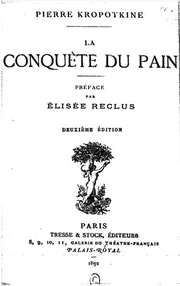
La conquête du pain
by Peter Kropotkin · 1892
It suits mature teenagers and adults interested in political and economic thought.
221 pages, about 3.5 to 5 hours.
Kropotkin's case for feeding everyone through voluntary cooperation, argued without apology. 41% taste match
What it covers
La conquête du pain is a work of political writing by Peter Kropotkin, a Russian anarchist and communist thinker. He composed it in French, and it reached readers in 1892. Its chapters began as pieces printed in the anarchist periodical Le Révolté before being gathered into a book in Paris. Élisée Reclus, who lived from 1830 to 1905, contributed the preface and proposed its title. Portions were later printed in Freedom, a London journal that Kropotkin helped found, between 1892 and 1894.
The book examines the economic arrangements of feudalism and capitalism and sets out Kropotkin's argument that they sustain want and scarcity. In their place he describes a decentralized economy built on mutual aid and voluntary cooperation, and he contends that such cooperation is already visible in both natural evolution and human society. It sits within the history of anarchist and communist thought and is shelved among works of history and politics. The title has also appeared in Russian as Khleb i volja, meaning Bread and Freedom, and it is sometimes called The Bread Book. It has been issued in many editions, with a typical length of around 221 pages.
به شیوا و نارنج هزاردانهٔ آفتاب ر. الف
Setting
Russia
Period
1892
Themes
HistoryCommunismAnarchismAnarchism and anarchistsAnarchistsCommunism and ecologyPolitical scienceCommunism, history
- Want to read 136
- Reading now 6
- Read 22
Most people shelving it are saving it for later.
Of 164 readers who put it on a shelf, 83% want to read it, 4% are reading it now, 13% have finished it and 0% stopped before the end.
By the numbers
- The median edition runs 221 pages. Counting about 275 words a page and an adult reading pace of 250 words a minute, that is about 4.1 hours of reading.
- Open Library tracks 151 editions from 78 publishers, the earliest dated 1892 and the latest 2024, across 10 languages.
- On reader demand it ranks in the top 8% of the classic books in our catalog (8,749 of them).
- Libraries shelve it under Dewey 335.83 and Library of Congress class HX-0915.00000000 K713 1972.
 BookWard’s take
Kropotkin's case for feeding everyone through voluntary cooperation, argued without apology
This is an argument book, and it gets to arguing right away: the opening pages go after feudalism and capitalism and explain why Kropotkin thinks both keep people poor. He never pretends to neutrality, and he doesn't want you to. It is almost pure idea rather than story, a long chain of claims about mutual aid and decentralized economies. Its staying power is real, given how often later movements have returned to it. Politics is front and center on every page. On rigor the picture is mixed: the reasoning holds together on its own terms, but the case leans on conviction and sweeping assertion more than on measured evidence. Read it as a foundational text, not a neutral survey.
At 221 pages it is compact for a work this ambitious, which suits BookWard's liking for tight books.
It moves briskly from one economic topic to the next, with little lingering.
A decentralized economy built on mutual aid was a bold proposal in 1892 and remains a distinct one.
The prose is plain and forceful, built to persuade, not to decorate.
It rests on the belief that cooperation can abolish scarcity, which is an openly hopeful premise.
It follows a conventional order, moving from diagnosis to proposal.
It is wholly serious in purpose and tone.
It dwells on poverty and scarcity but stays focused on remedy, not despair.
The moral urgency is felt without turning the book into melodrama.
See all 50 dialsEvery position, side by side with this book
Where it lines up
- OriginalityBookWard 9 · book 8
- Authorial voiceBookWard 9 · book 8
- LengthBookWard 1 · book 3
Where it pulls apart
- Story or ideasBookWard 3 · book 10
- ExpositionBookWard 2 · book 9
- Familiar tropesBookWard 10 · book 6
At 221 pages it is compact for a work this ambitious, which suits BookWard's liking for tight books.
It starts straight in on the defects of existing economic systems, though the opening is a thesis, not a scene.
Its premises are well worn in anarchist thought, though the framing of bread as the central question is distinctive.
Each step follows from Kropotkin's premises, but the premises themselves are asserted more than demonstrated.
It moves briskly from one economic topic to the next, with little lingering.
A decentralized economy built on mutual aid was a bold proposal in 1892 and remains a distinct one.
There are no characters to draw; it is argument from start to finish.
It closes on its program and does not tie up questions it opens about how such a society would run.
The tone is earnest and moral, warmer than BookWard's taste for restraint, though never maudlin.
It does not trade on shock; its force comes from the argument.
The reasoning is organized and serious, but it relies on conviction and assertion more than measured evidence.
Kropotkin's confident, polemical voice is unmistakable and carries the book.
This is an idea book through and through, with no story to speak of, which fits BookWard's taste.
He explains his case outright, which is the opposite of showing it in scene.
The argument stays on one engine throughout, with few dips in energy.
The prose is plain and forceful, built to persuade, not to decorate.
It rests on the belief that cooperation can abolish scarcity, which is an openly hopeful premise.
It follows a conventional order, moving from diagnosis to proposal.
It is wholly serious in purpose and tone.
The ideas are clear, but economic argument across many chapters takes sustained attention.
One voice argues one case throughout.
It proceeds in a straightforward line from critique to remedy.
It is wholly grounded in economic and social reality, though its vision is bold.
It concerns whole societies and economies, far from the intimate.
It is concerned with social arrangements and action, not inner life.
There is no dialogue; it is direct address and argument.
It describes economic systems most readers know in outline, though its proposed alternative is unfamiliar.
Written in 1892, it belongs to the past, though its questions still speak to the present.
Its arguments keep resurfacing in later political movements, which speaks to lasting reach.
The author speaks plainly in his own voice, with no unreliability.
Kropotkin is certain about right and wrong, leaving little room for ambiguity.
It is spare on scene-setting and concentrates on argument.
It is analytical reasoning, not narrative storytelling.
It argues in general terms and keeps Kropotkin himself mostly offstage.
It stands as a single self-contained work.
An argument offers few surprises, and this one proceeds predictably in structure.
It asks readers to question basic assumptions about property, work, and need.
It dwells on poverty and scarcity but stays focused on remedy, not despair.
The moral urgency is felt without turning the book into melodrama.
It discusses social conflict in the abstract, with little violence on the page.
There is essentially none.
Politics is the whole subject, argued without disguise.
The language is direct and readable, with some period phrasing.
It is relentlessly opinionated, making a case and never staying neutral.
It looks forward to a society it wants built.
It is a deeply idealistic vision of cooperative abundance.
Review written by BookWard, dial version 1, November 2026.
Who is La conquête du pain right for?
It suits mature teenagers and adults interested in political and economic thought. The content is argument, not graphic, though its politics are openly partisan.
The ideas are clear, but economic argument across many chapters takes sustained attention.
It dwells on poverty and scarcity but stays focused on remedy, not despair.
The moral urgency is felt without turning the book into melodrama.
It discusses social conflict in the abstract, with little violence on the page.
Book CompanionLa conquête du pain: ideas, characters, themes
Kropotkin argues that feudalism and capitalism sustain poverty and scarcity, and that a decentralized economy built on mutual aid and voluntary cooperation could replace them.
- A critique of existing systems. He sets out what he sees as the defects of feudalism and capitalism and why they maintain want.
- Scarcity as a made condition. He holds that these systems thrive on and perpetuate poverty and scarcity.
- Mutual aid as the alternative. He proposes an economy resting on voluntary cooperation instead of coercion.
- Decentralization. His proposed system spreads economic organization out in place of concentrating it.
- Cooperation already exists. He asserts that tendencies toward this kind of organization are visible in both evolution and human society.
Themes
Whether want is natural or produced by the way economies are organized.
Cooperation freely chosen as the basis of social and economic life.
Spreading economic decisions across communities instead of concentrating them.
The link between meeting basic needs and being free, echoed in the Russian title Bread and Freedom.
Discussion questions
- Is scarcity a natural condition or a product of how economies are organized?
- How persuasive is Kropotkin's claim that cooperative tendencies already exist in society?
- What would a decentralized economy based on voluntary cooperation need in order to work?
- How does reading an 1892 argument change the way its claims land today?
- Does a committed, one-sided case make a book more useful or less useful as an introduction to its subject?
Personalize your Book Companion
This is the general edition. In BookWard, the Companion is written for you: your reading profile, your notes, and spoiler-safe to the page you are on.
Buy, listen or borrow La conquête du pain
Each link opens a search for this book on that store, in a new tab.
Read on a device
Borrow
Reviews and community
If you liked La conquête du pain
A short, fiery pamphlet that argued a continent toward independence
A Vindication of Rights of WomanMary WollstonecraftWollstonecraft's 1792 argument for women's education and independence, still bracing today
State and RevolutionVladimir Il’ich LeninLenin's short, fierce argument that the state serves one class
Die Entwicklung des Sozialismus von der Utopie zur WissenschaftFriedrich EngelsEngels's short, argumentative primer on how socialism claimed to become a science
Sources: Open Library.
Track La conquête du pain and find your next favorite
Add it to your shelf, rate what you have read, and BookWard will recommend what fits you.
Free to start. No credit card needed.