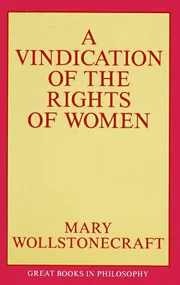
A Vindication of Rights of Woman
by Mary Wollstonecraft · 1792
Best suited to older teens and adults, particularly those interested in history, politics or philosophy.
258 pages, about 4 to 6 hours.
Wollstonecraft's 1792 argument for women's education and independence, still bracing today. 48% taste match
What it covers
A Vindication of the Rights of Woman is an essay by Mary Wollstonecraft (1759-1797), first published in 1792. It belongs to history and politics, and it is counted among the pioneering works of feminist philosophy. Wollstonecraft was a British philosopher and advocate for women's rights, and she wrote at a time when demands for the rights of men were reshaping politics in America and France.
The essay turns that same reasoning toward women in Great Britain. It takes up the education of girls and boys, the place of women in society, and the moral and political questions that follow from how women were regarded in the eighteenth century. Wollstonecraft argues against the prevailing picture of women as decorative and docile, and she presents principles for their independence, including equal schooling and the end of prejudice. The book opens by calling for a return to first principles in the search for simple truths.
It has appeared in a large number of editions, with a typical printing running to roughly 258 pages. The book suits readers interested in the early history of feminism, the political thought of the late eighteenth century, and the long-running debate over women's education and rights.
IN the present state of society it appears necessary to go back to first principles in search of the most simple truths, and to dispute with some prevailing prejudice every inch of ground.
Setting
Great Britain
Period
19th century18th century
Themes
Women's rightsWomen, education, great britainFeminismWomenEducationHistorySocial conditionsWomen's right
- Want to read 212
- Reading now 14
- Read 15
Most people shelving it are saving it for later.
Of 241 readers who put it on a shelf, 88% want to read it, 6% are reading it now, 6% have finished it and 0% stopped before the end.
By the numbers
- The median edition runs 258 pages. Counting about 275 words a page and an adult reading pace of 250 words a minute, that is about 4.7 hours of reading.
- Open Library tracks 309 editions from 92 publishers, the earliest dated 1792 and the latest 2022.
- On reader demand it ranks in the top 7% of the classic books in our catalog (8,749 of them).
- Libraries shelve it under Dewey 330 and Library of Congress class HQ-1596.00000000.W6 1793.
 BookWard’s take
Wollstonecraft's 1792 argument for women's education and independence, still bracing today
This is a foundational argument, written in 1792, that turns the logic of the rights of man onto women. It is driven far more by ideas than by narrative, and the voice is unmistakable: passionate, forthright, openly angry at the prevailing picture of women as decorative and docile. The thinking was genuinely original for its moment, though the pace is slower than a modern polemic, with long eighteenth-century sentences and a demand for patience from the reader. The reasoning is strong, built on education and first principles rather than anecdote, though it is argument rather than data. The politics are front and center throughout. It rewards readers who want to see where modern feminist thought began.
At 258 pages it is mid-length, longer than a pamphlet but never sprawling; BookWard prefers tighter, though the argument earns its room.
Long period sentences and sustained argument move at a deliberate eighteenth-century tempo, slower than BookWard usually likes.
For 1792 the move was strikingly new: applying the language of rights to women and attacking decorative femininity head on.
The prose is formal and period-bound, with long balanced sentences, more ornate than plain but not florid.
There is no plot or cast to drive it; it is neither plot-driven nor character-driven, so this does not apply.
Despite anger at injustice, its core is optimistic: it insists women can be educated and free.
A conventional essay structure of chapters building an argument, with nothing experimental in form.
It is serious and earnest in purpose, with little room for jokes.
It deals with prejudice and subjugation, but without graphic or disturbing material.
Anger and conviction run through it, giving it real intensity without melodrama.
See all 50 dialsEvery position, side by side with this book
Where it lines up
- OriginalityBookWard 9 · book 9
- Shock for effectBookWard 9 · book 9
- Authorial voiceBookWard 9 · book 9
Where it pulls apart
- Story or ideasBookWard 3 · book 10
- ExpositionBookWard 2 · book 9
- LengthBookWard 1 · book 5
At 258 pages it is mid-length, longer than a pamphlet but never sprawling; BookWard prefers tighter, though the argument earns its room.
It opens by calling for a return to first principles, a measured start rather than an instant grab, which sits a little slow for BookWard.
Its arguments became the template for later feminism, so they read as foundations rather than tired tropes, which BookWard values.
Wollstonecraft builds a reasoned case from principles about education and virtue, with each claim leaning on the last, which BookWard rewards.
Long period sentences and sustained argument move at a deliberate eighteenth-century tempo, slower than BookWard usually likes.
For 1792 the move was strikingly new: applying the language of rights to women and attacking decorative femininity head on.
It is an essay with no characters to draw, so this dial does not apply.
The essay closes on its argument rather than a story, resolving its case for equal education and independence with conviction.
Wollstonecraft argues against sensibility as a female ideal, though her appeals can run warm and impassioned.
The provocation is the argument itself; it is earned by reasoning, not gratuitous shock, and it drew outrage precisely for that reason.
It argues systematically from first principles about education, though as 1792 philosophy it relies on reasoning more than evidence.
Passionate, forthright and unmistakably hers, the voice is the book's driving force and the opposite of generic.
This is entirely idea-led: a sustained argument about women's rights, education and prejudice with no plot to carry it.
Ideas are stated and argued outright, since an essay explains its case rather than dramatizing it, far from BookWard's show-in-scene taste.
The argument mostly holds together across its chapters, though a long essay of this age can circle its points.
The prose is formal and period-bound, with long balanced sentences, more ornate than plain but not florid.
There is no plot or cast to drive it; it is neither plot-driven nor character-driven, so this does not apply.
Despite anger at injustice, its core is optimistic: it insists women can be educated and free.
A conventional essay structure of chapters building an argument, with nothing experimental in form.
It is serious and earnest in purpose, with little room for jokes.
Eighteenth-century syntax and a dense argument ask real attention, more than BookWard's usual middle ground.
A single authorial voice argues one case throughout.
It proceeds as a linear argument with no shifting chronology.
It is entirely grounded in the real social conditions of its day.
As an essay it has no cast to speak of.
It addresses the condition of women across society, a wide theme, though through close argument rather than spectacle.
It is more about reasoning and social critique than inner confession or physical action, leaning toward thought.
As an essay it contains essentially no dialogue.
Romance appears only as a subject of critique, never as plot or focus.
The late eighteenth century is distant from most readers, though the questions it raises remain familiar.
Written in 1792, it comes from the past, though its subject still speaks to the present.
The central questions about education and equality have stayed relevant, so it has lasted well beyond its moment.
The author argues in her own voice with no narrator device, so there is no unreliability to speak of.
Wollstonecraft takes clear moral positions and does not hide behind ambiguity.
It is argument rather than scenery, with little descriptive texture.
It is analytical argument, not narrative nonfiction, and works through reasoning, not anecdote.
The stance is passionate and engaged, closer to personal conviction than detached analysis.
It stands alone as a single work.
A sustained argument offers few surprises beyond the force of its claims.
It challenged the assumptions of its age and still pushes against comfortable views of education and gender.
It deals with prejudice and subjugation, but without graphic or disturbing material.
Anger and conviction run through it, giving it real intensity without melodrama.
Where it is witty at all, the edge is dry and sharp rather than broad.
It is an essay of argument and contains no violence on the page.
It discusses the status of women but has no sexual content.
Politics is its core subject: women's rights, education and social reform, stated openly.
Period vocabulary and long sentences can feel dense, though the language is standard English, not dialect.
The narration is thoroughly opinionated; arguing a case is the whole point.
It looks ahead, laying out principles for women's emancipation yet to come.
It is strongly idealistic, believing reason and education can reshape society.
Review written by BookWard, dial version 1, November 2026.
Who is A Vindication of Rights of Woman right for?
Best suited to older teens and adults, particularly those interested in history, politics or philosophy. The language is dense and period-bound, and it discusses prejudice and the subordination of women, with nothing graphic.
Eighteenth-century syntax and a dense argument ask real attention, more than BookWard's usual middle ground.
It deals with prejudice and subjugation, but without graphic or disturbing material.
Anger and conviction run through it, giving it real intensity without melodrama.
It is an essay of argument and contains no violence on the page.
Book CompanionA Vindication of Rights of Woman: ideas, characters, themes
Women should be educated as rational equals rather than shaped into decorative, docile companions, and society as a whole benefits when they are.
- Rights beyond men. Wollstonecraft takes the language of rights then reshaping America and France and applies it to women.
- Against decorative femininity. She attacks the prevailing picture of women as docile and ornamental rather than rational.
- Equal education. A central principle is that girls and boys should receive the same schooling.
- Ending prejudice. She argues that the prejudices shaping women's lives are made, not natural, and can be dismantled.
- Defined by work, not partners. Women should be able to take their place through their own profession rather than through marriage alone.
Themes
How schooling shapes character and capability, and why girls deserve the same as boys.
The idea that rational beings are owed rights regardless of sex.
Women's freedom to live and work on their own terms.
Inherited assumptions about women that society treats as nature.
The link between a person's moral life and the freedom to reason.
Discussion questions
- Which of Wollstonecraft's arguments still feel fresh today, and which feel dated?
- Why might her call for equal education have provoked outrage as well as admiration in 1792?
- How does applying the language of the rights of man to women change the argument?
- Does she persuade more through reason or through passion?
- What would an equal education look like in practice, and how close have we come to it?
Personalize your Book Companion
This is the general edition. In BookWard, the Companion is written for you: your reading profile, your notes, and spoiler-safe to the page you are on.
Buy, listen or borrow A Vindication of Rights of Woman
Each link opens a search for this book on that store, in a new tab.
Read on a device
Borrow
Reviews and community
If you liked A Vindication of Rights of Woman
Kropotkin's case for feeding everyone through voluntary cooperation, argued without apology
On LibertyJohn Stuart MillA short, rigorous case for the freedom to differ
State and RevolutionVladimir Il’ich LeninLenin's short, fierce argument that the state serves one class
The Federalist, or, The New ConstitutionAlexander HamiltonRigorous, argument-led case for the Constitution, demanding but still essential
Sources: Open Library.
Track A Vindication of Rights of Woman and find your next favorite
Add it to your shelf, rate what you have read, and BookWard will recommend what fits you.
Free to start. No credit card needed.