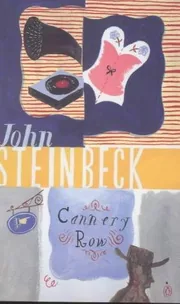
Cannery Row
by John Steinbeck · 1945
It suits teens and adults, and it often appears on school reading lists.
188 pages, about 3 to 4.5 hours.
A short, warm portrait of Monterey's outsiders, built from episodes. 62% taste match
The story
John Steinbeck's Cannery Row, first published in 1945, is a work of American fiction that portrays community life among society's outsiders. Its setting is the waterfront district of Monterey, California, where sardine canneries crowd a single street during the Great Depression. The book follows a handful of residents of that neighborhood, among them Lee Chong, who keeps the grocery, Doc, a marine biologist, and Mack, who looks after a loose band of down-and-out men.
The street was a real place in Monterey, on Ocean View Avenue, and locals had used the name Cannery Row informally since World War I. In 1958 the city made the name official as a tribute to the author. Steinbeck came back to these people and this world nine years after the novel appeared, in Sweet Thursday. Cannery Row has also been adapted for other media, with a film released in 1982 and a stage production mounted in 1995. It has appeared in 96 editions and is also collected in volumes alongside The Grapes of Wrath, The Moon Is Down, East of Eden and Of Mice and Men.
Setting
Monterey (Calif.)Cannery Row (Monterey, Calif.)MontereyCaliforniaCannery Row
Themes
Community lifeMarine biologistsSocial MarginalityVida en comunidadNovelaNOVELAS ESTADOUNIDENSES
- Want to read 215
- Reading now 12
- Read 62
Most people shelving it are saving it for later.
Of 289 readers who put it on a shelf, 74% want to read it, 4% are reading it now, 21% have finished it and 0% stopped before the end.
By the numbers
- The median edition runs 188 pages. Counting about 275 words a page and an adult reading pace of 250 words a minute, that is about 3.4 hours of reading.
- Open Library tracks 96 editions from 65 publishers, the earliest dated 1945 and the latest 2022, across 13 languages.
- On reader demand it ranks in the top 4% of the classic books in our catalog (8,749 of them).
- Libraries shelve it under Dewey 819 and Library of Congress class PS-3537.00000000.T3234 C3 1947.
 BookWard’s take
A short, warm portrait of Monterey's outsiders, built from episodes
At 188 pages, Cannery Row is exactly the length a book like this should be. It is a run of vignettes about a waterfront street, and it cares far more about who lives there than about what happens next. The characters are its real strength: Doc, Mack and Lee Chong are drawn with affection and a light touch. Steinbeck's voice is unmistakable, wry and tender in equal measure, and the sentiment stays more restrained than the subject might invite. The structure is loose, so the pull of the book comes from character first and plot second, and the opening is a gentle invitation more than a grab. If you want a compact, humane book about a community on the margins, this is it.
At 188 pages it is compact and unpadded, which suits BookWard's liking for tight books.
Episodes move along at an easy, unhurried clip, brisk enough to keep you going without rushing.
A community portrait made of interlinked sketches was an unusual shape for a novel of its time.
The prose is clear and lyrical without being showy, with moments of real beauty.
The book runs on its people and their relationships far more than on any tight plot.
It finds dignity and warmth among society's outsiders, even in hard times.
A string of linked vignettes about a neighborhood is looser than a conventional plot-driven novel.
Its humor is gentle and constant, with the scheming and misadventures of its misfits.
See all 50 dialsEvery position, side by side with this book
Where it lines up
- Character depthBookWard 8 · book 8
- Shock for effectBookWard 9 · book 9
- Authorial voiceBookWard 9 · book 9
Where it pulls apart
- OpeningBookWard 10 · book 6
- Familiar tropesBookWard 10 · book 7
- Internal logicBookWard 10 · book 7
At 188 pages it is compact and unpadded, which suits BookWard's liking for tight books.
It opens by setting a place and its people rather than a crisis, a gentle pull more than an instant grab.
It avoids stock plotting by building around a street full of lovable misfits instead of a formula.
The street's small world holds together, with people behaving in ways that fit who they are.
Episodes move along at an easy, unhurried clip, brisk enough to keep you going without rushing.
A community portrait made of interlinked sketches was an unusual shape for a novel of its time.
Doc, Mack and Lee Chong feel like real, flawed people, drawn with warmth and specificity.
It closes on a satisfying note for its cast, though it is not built around one big resolution.
It is affectionate toward its people, but Steinbeck's dry humor keeps it from turning syrupy.
It does not lean on shock; any hardship comes from the lives of the characters, not for effect.
This is fiction, so the rigor dial does not apply.
Steinbeck's wry, tender narration is instantly recognizable and gives the book its character.
It is mostly story and people, with its ideas about community carried lightly beneath the episodes.
The narrator does explain the street and its people directly, though the book mostly shows them in action.
Short, self-contained episodes keep it moving, though the looseness means some stretches matter less.
The prose is clear and lyrical without being showy, with moments of real beauty.
The book runs on its people and their relationships far more than on any tight plot.
It finds dignity and warmth among society's outsiders, even in hard times.
A string of linked vignettes about a neighborhood is looser than a conventional plot-driven novel.
Its humor is gentle and constant, with the scheming and misadventures of its misfits.
It reads easily and is often assigned in school, with nothing here that asks a lot of the reader.
The narration drifts across many residents of the Row rather than staying with one person.
The story moves forward in a straightforward way without time jumps.
It is grounded realism set in a real Monterey neighborhood.
A street's worth of residents gives it a sizable ensemble, though a few anchor the book.
The whole story lives on one street, which keeps it small and personal.
It mixes what the characters do with a sense of what they feel, without leaning hard either way.
Conversation carries a good share of the book's charm and character.
Romance is a minor thread; community and friendship matter far more.
Depression-era Monterey cannery life may be unfamiliar to many readers, though the people feel recognizable.
It is set in the Great Depression and was published in 1945, so it looks to the past.
Its affection for outsiders and community keeps it fresh decades on.
The narrator is a trustworthy, openly warm guide to the street.
Steinbeck is clearly on the side of his misfits, so its sympathies are easy to read.
The street, the waterfront and the setting are painted in vivid, loving detail.
Review written by BookWard, dial version 1, November 2026.
Who is Cannery Row right for?
It suits teens and adults, and it often appears on school reading lists. It deals with poverty and some adult situations, but handles them gently.
It reads easily and is often assigned in school, with nothing here that asks a lot of the reader.
Book CompanionCannery Row: ideas, characters, themes
A waterfront street of society's outsiders in Depression-era Monterey becomes a small, human world held together by friendship and mutual generosity.
- A real place. Cannery Row was an actual street in Monterey, and locals used the name informally from World War I.
- A story of a community. The book follows a handful of residents rather than a single hero.
- Three anchors. Lee Chong the grocer, Doc the marine biologist and Mack with his band of down-and-out men tie the street together.
- A tribute in the name. In 1958 the street was officially renamed Cannery Row in honor of Steinbeck.
- Afterlife. Steinbeck returned to these people in Sweet Thursday, and the book was adapted for film in 1982 and the stage in 1995.
Characters
Doc
Marine biologist
A thoughtful scientist who is a respected presence on the Row.
Mack
Leader of a group of down-and-out men
The head of a loose band of derelict friends who drift through the neighborhood.
Lee Chong
Local grocer
The shopkeeper whose store is a hub of the street's life.
Themes
How a group of very different people form a world of mutual dependence.
The dignity and worth of people living at the edges of society.
How hard times shape ordinary choices and relationships.
The loyalty and small kindnesses that hold the Row together.
How a single street can carry the character of a whole way of life.
Discussion questions
- Why might Steinbeck build the book from episodes about a whole street instead of one central plot?
- What does the book suggest about who deserves respect in a community?
- How does Doc differ from the other residents, and why does he matter to them?
- How does the Depression setting shape the characters' choices?
- What makes a place like the Row feel worth remembering?
Personalize your Book Companion
This is the general edition. In BookWard, the Companion is written for you: your reading profile, your notes, and spoiler-safe to the page you are on.
Buy, listen or borrow Cannery Row
Each link opens a search for this book on that store, in a new tab.
Read on a device
Borrow
Reviews and community
If you liked Cannery Row
A mock-Arthurian comedy of poverty on a Monterey hillside
Harriet the SpyLouise FitzhughA sharp, unsentimental school story that still bites
Anne of Green GablesLucy Maud MontgomeryA chatty orphan girl, a mistaken arrival, and a farm that changes
All Creatures Great and Small (All Creatures Great and Small #1-2)James HerriotA country vet's Yorkshire rounds, funny and tender in turns
Sources: Open Library.
Track Cannery Row and find your next favorite
Add it to your shelf, rate what you have read, and BookWard will recommend what fits you.
Free to start. No credit card needed.