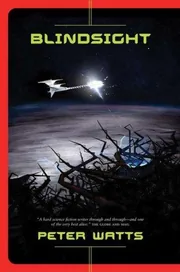
Blindsight
by Peter Watts, Peter Watts · 2006
This suits mature readers comfortable with dense science and unsettling ideas.
384 pages, about 6 to 9 hours.
Hard first contact that puts consciousness itself under the knife. 57% taste match
The story
Blindsight is a hard science fiction novel by Canadian author Peter Watts, first issued in 2006 and running to about 384 pages. It belongs to the space opera strand of the genre and deals with first contact between humanity and an alien presence, with attention to neurology, consciousness, and the problem of communicating across a gulf of understanding.
The setting is the year 2082. Fleets of strange objects have burned up over Earth, and soon afterward a faint signal is detected near the outer solar system, coming from a comet beyond Neptune. A crew is assembled to travel out and make contact. Its members include a linguist whose mind has been divided into several separate personalities, and a biologist so heavily fitted with machinery that his senses no longer resemble those of an ordinary person. The crew travels in artificial hibernation, and vampires also figure among the book's subjects. The novel also takes up identity, free will, artificial intelligence, evolution, and game theory. It was nominated for the Hugo, John W. Campbell Memorial, and Locus awards, and won the Seiun Award in Japanese translation.
It didn't start out here.
Period
208221st century
Themes
VampiresArtifical HibernationHuman-alien encountersLife on other planetsNeurologyLinguists
- Want to read 179
- Reading now 7
- Read 93
Readers are split between finishing it and saving it for later.
Of 279 readers who put it on a shelf, 64% want to read it, 3% are reading it now, 33% have finished it and 0% stopped before the end.
By the numbers
- The median edition runs 384 pages. Counting about 275 words a page and an adult reading pace of 250 words a minute, that is about 7.0 hours of reading.
- Open Library tracks 20 editions from 9 publishers, the earliest dated 2006 and the latest 2021, across 2 languages.
- On reader demand it ranks in the top 2% of the modern books in our catalog (15,152 of them).
- Libraries shelve it under Dewey 813.6 and Library of Congress class PR-9199.30000000.W386 B58 2006.
 BookWard’s take
Hard first contact that puts consciousness itself under the knife
Blindsight is a 2006 hard science fiction novel about a strange crew sent past Neptune to meet something that has not asked to be met. It is built around ideas more than story, yet it never feels thin on character: the crew is a linguist with a divided mind, a biologist wired into machinery, and a vampire in command. The internal logic is tight, with neurology and game theory doing real work, and the opening drops you straight into a world still reeling from the burning sky. The prose is dense and the exposition heavy, and I would have preferred more of it shown in scene. Expect a book that wants to unsettle you, not comfort you.
At 384 pages it is compact for its ambition, close to BookWard's preference for tight books.
The mission moves forward, but long stretches of explanation and theory slow it below BookWard's brisk preference.
A divided-mind linguist, a machine-fitted biologist and a resurrected predator as captain make this feel like nothing else on the shelf.
The prose is dense and technical, richer than BookWard's middle-of-the-road taste.
This is a book about minds and ideas more than people changing, tilting toward the plot side of BookWard's blend.
It stares into a bleak view of what intelligence may be worth, well below BookWard's cautiously hopeful tilt.
The telling is mostly straightforward, with some unusual framing around its narrator.
Its outlook is grim and often disturbing, darker than BookWard's middle-of-the-road comfort.
The register is cool and analytical, less intense than BookWard's moderate setting.
See all 50 dialsEvery position, side by side with this book
Where it lines up
- Rigor (nonfiction)BookWard 9 · book 9
- Authorial voiceBookWard 9 · book 9
- Familiar tropesBookWard 10 · book 9
Where it pulls apart
- Story or ideasBookWard 3 · book 9
- ExpositionBookWard 2 · book 8
- EndingBookWard 8 · book 4
At 384 pages it is compact for its ambition, close to BookWard's preference for tight books.
A sky of burning objects and a signal beyond Neptune set the stakes early, though the density slows the first pages.
First contact is familiar territory, but the crew and the questions it asks avoid the usual genre furniture, which BookWard prizes.
The neurology and game theory are worked through carefully, giving the premise a rigor BookWard values highly.
The mission moves forward, but long stretches of explanation and theory slow it below BookWard's brisk preference.
A divided-mind linguist, a machine-fitted biologist and a resurrected predator as captain make this feel like nothing else on the shelf.
The crew are vivid and strange, but they serve the ideas more than they invite closeness.
It resolves its central questions in a way that leaves unease behind, a bit more open than BookWard likes.
It is cold and clinical by design, and BookWard welcomes that restraint.
The darkness grows out of its questions about mind and survival rather than being applied for effect.
Its science-heavy premise is argued with unusual care, matching the high bar BookWard sets.
Peter Watts writes with a cold, precise and unmistakable voice that BookWard rates highly.
The ideas about consciousness lead and the plot follows, well toward the idea-led end where BookWard leans story-led.
Concepts are often explained outright, which runs against BookWard's liking for scene over explanation.
The mission keeps tightening, though the theory-heavy stretches test momentum.
The prose is dense and technical, richer than BookWard's middle-of-the-road taste.
This is a book about minds and ideas more than people changing, tilting toward the plot side of BookWard's blend.
It stares into a bleak view of what intelligence may be worth, well below BookWard's cautiously hopeful tilt.
The telling is mostly straightforward, with some unusual framing around its narrator.
It asks a lot of the reader, with dense concepts and a steep learning curve, above BookWard's moderate comfort.
The story stays close to a single perspective, narrower than BookWard's taste for many voices.
Events mostly unfold in order as the mission progresses.
Hard science keeps it anchored, though aliens and a resurrected hominid push into the speculative.
A handful of crew members carry the book, a bit smaller than BookWard's middle setting.
A planet under watch and a journey to the edge of the solar system give it real breadth.
It dwells in minds and perception, deep on the inner side where BookWard sits balanced.
Conversation carries a fair share of the ideas without dominating the page.
Romance plays no meaningful part in this mission.
A 2082 solar system and an alien presence make for a thoroughly unfamiliar setting.
It is set in a future well beyond the present day, not the contemporary world BookWard slightly favors.
Its questions about consciousness and intelligence should outlast the moment of its 2006 publication.
The narration is filtered through a deliberately skewed viewpoint that BookWard enjoys keeping at arm's length.
No tidy right and wrong here, with ethics left murky in ways BookWard finds rewarding.
It conjures its strange ship and alien surroundings with some richness, matching BookWard's moderate leaning.
It reads as a standalone novel.
Revelations about the crew and the alien arrive in measured amounts, roughly in line with BookWard's taste for surprise.
It is built to unsettle, well above BookWard's already challenge-leaning stance.
Its outlook is grim and often disturbing, darker than BookWard's middle-of-the-road comfort.
The register is cool and analytical, less intense than BookWard's moderate setting.
What humor exists is sparse and dry, below BookWard's center.
It touches on power and control but stays out of the political foreground.
Technical terms and dense concepts make the reading denser than BookWard's average.
The narration carries a strong and pointed stance, a little beyond BookWard's mild lean.
This is a book that looks ahead to what minds may become, matching BookWard's forward tilt.
It is among the least idealistic books you could pick, far from BookWard's gentle optimism.
Review written by BookWard, dial version 1, November 2026.
Who is Blindsight right for?
This suits mature readers comfortable with dense science and unsettling ideas. It contains dark themes and some bodily menace.
It asks a lot of the reader, with dense concepts and a steep learning curve, above BookWard's moderate comfort.
Its outlook is grim and often disturbing, darker than BookWard's middle-of-the-road comfort.
The register is cool and analytical, less intense than BookWard's moderate setting.
Book CompanionBlindsight: ideas, characters, themes
A crew of deliberately altered humans travels to meet an alien presence, and the encounter tests what consciousness and intelligence actually are.
- The signal. A faint transmission is detected from a comet beyond Neptune, setting the mission in motion.
- Fleets over Earth. Strange objects burn up in the atmosphere, and the world waits in silence.
- An altered crew. The team includes a linguist with a divided mind and a biologist heavily fitted with machinery.
- Travel in hibernation. The long voyage is made in artificial hibernation, shaping the isolation of the mission.
- Contact as a problem. The central challenge is how to communicate across a gulf that may be unbridgeable.
Characters
The linguist
Crew member
A linguist whose mind is partitioned into several separate personalities.
The biologist
Crew member
A biologist so thoroughly fitted with machinery that his senses differ from ordinary ones.
The vampire
Commander
An extinct hominid predator recalled through recombinant genetics to lead the crew.
Themes
What awareness is, and whether it is necessary or even useful.
What remains of a self when minds and bodies are altered.
Whether choices are truly chosen or produced by the brain.
How machine intelligence compares with human thought.
The difficulty of understanding a mind unlike our own.
Discussion questions
- Why might the author send such heavily altered people to meet the alien?
- Does intelligence require consciousness, or can it do without?
- How does the isolation of the voyage shape the crew?
- What does the book suggest about the limits of communication?
- Who seems most alien, the crew or the thing they are sent to find?
Personalize your Book Companion
This is the general edition. In BookWard, the Companion is written for you: your reading profile, your notes, and spoiler-safe to the page you are on.
Buy, listen or borrow Blindsight
Each link opens a search for this book on that store, in a new tab.
Read on a device
Borrow
Reviews and community
If you liked Blindsight
Beowulf's monster narrates, and the philosophy bites harder than the claws
Zur Genealogie der MoralFriedrich NietzscheNietzsche's compact, combative history of where our morals came from
Oryx and CrakeMargaret AtwoodA lone survivor, a ruined world, and the engineering behind it
NeuromancerWilliam GibsonGibson's dense, electric heist that invented how we picture cyberspace
Sources: Open Library.
Track Blindsight and find your next favorite
Add it to your shelf, rate what you have read, and BookWard will recommend what fits you.
Free to start. No credit card needed.