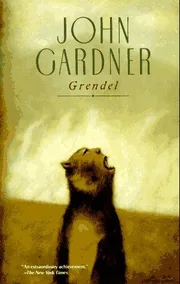
Suits mature teens and adults who enjoy literary retellings, and it is often read in school settings.
174 pages, about 3 to 4 hours.
Beowulf's monster narrates, and the philosophy bites harder than the claws. 58% taste match
The story
Grendel is a fantasy novel by the American writer John Gardner, first published in 1971. It reworks material from Beowulf, the Old English epic poem, and places its focus on the creature that the older work treats as an enemy. Grendel is the central figure here and the one whose view shapes the telling. The story is set in a medieval Scandinavian world drawn from Anglo-Saxon heroic tradition, with its warriors, kings, and monsters, and a dragon also appears among the book's subjects.
The novel works as an adaptation of an ancient story into modern fiction. Its concerns include how a person might find meaning in the world, what myth and literature can do for those who hear them, and how good and evil are to be understood. Grendel is presented as an antihero who learns about human beings while the conflict familiar from the epic unfolds around him. The book runs to roughly 174 pages in its typical edition, and about 35 editions have appeared. It suits readers drawn to retellings of Beowulf, to monster stories told from the monster's side, and to fiction rooted in medieval legend.
The old ram stands looking down over rockslides, stupidly triumphant.
Characters
Grendel
Setting
Scandinavia
Themes
BeowulfMonstersAdaptationsEpic poetry, English (Old)HeroesDragonsMedieval CivilizationCivilization, Anglo-Saxon
- Want to read 130
- Reading now 4
- Read 24
Most people shelving it are saving it for later.
Of 158 readers who put it on a shelf, 82% want to read it, 3% are reading it now, 15% have finished it and 0% stopped before the end.
By the numbers
- The median edition runs 174 pages. Counting about 275 words a page and an adult reading pace of 250 words a minute, that is about 3.2 hours of reading.
- Open Library tracks 35 editions from 19 publishers, the earliest dated 1971 and the latest 2009, across 2 languages.
- On reader demand it ranks in the top 8% of the classic books in our catalog (8,749 of them).
- Libraries shelve it under Dewey 813.54 and Library of Congress class PS-3557.00000000.A712 Gr3.
 BookWard’s take
Beowulf's monster narrates, and the philosophy bites harder than the claws
Gardner hands the telling of Beowulf to the creature the old poem treats as an enemy, and the book's sharpest trick is how much it argues while it tells. At 174 pages it stays tight, and the opening line, with its old ram standing stupidly triumphant, sets a distinctive voice at once. That voice is the draw, and it is unmistakable from the first page. Few retellings commit this fully to the monster's view, which gives the book real originality. It is also far more driven by ideas than I usually like, so this is a genuine gap between the book and my own tastes. Grendel is an antihero who learns about humans while the conflict of the epic unfolds around him, and the questions of meaning, myth and good and evil are what power the story. Expect a short book that makes you think more than it makes you turn pages.
At about 174 pages it is short and compact, which sits squarely with BookWard's taste for tight books.
The book is brief and moves, but it lingers on reflection, so it reads slower than BookWard's quick preference.
Few retellings commit so fully to the monster's perspective, and BookWard values that nerve highly.
The language is shaped and stylized, richer than plain but not ornate for its own sake, a bit richer than BookWard's usual.
The book follows Grendel's inner development more than a chain of events, close to BookWard's character-driven lean.
Its outlook is largely bleak, wrestling with meaninglessness, which is darker than BookWard's mildly hopeful tilt.
The monster narrating an ancient story gives it a distinctive shape, a little more adventurous than convention.
There is a dry, mordant edge to the narration, but it stays mostly serious, below BookWard's lightly funny lean.
It deals in monsters, violence and bleak questions, a little darker than BookWard's middle.
Feeling runs beneath the intellect without overwhelming it, close to BookWard's moderate setting.
See all 50 dialsEvery position, side by side with this book
Where it lines up
- LengthBookWard 1 · book 1
- OriginalityBookWard 9 · book 9
- Character depthBookWard 8 · book 8
Where it pulls apart
- Story or ideasBookWard 3 · book 8
- Internal logicBookWard 10 · book 7
- ExpositionBookWard 2 · book 6
At about 174 pages it is short and compact, which sits squarely with BookWard's taste for tight books.
The first sentence, about an old ram stupidly triumphant, sets an odd, confident voice at once, close to BookWard's love of fast openings.
Telling the epic from the monster's side upends the usual hero-and-beast framing, which BookWard rewards.
The monster's worldview hangs together as it works through what it learns, though philosophy matters more than plot mechanics.
The book is brief and moves, but it lingers on reflection, so it reads slower than BookWard's quick preference.
Few retellings commit so fully to the monster's perspective, and BookWard values that nerve highly.
Grendel is drawn from the inside as he learns about people, which is the depth BookWard looks for.
It rounds off the epic's central conflict, though its larger questions stay open, a little looser than BookWard prefers.
The monster's view is unsentimental and wry, avoiding easy pathos, which BookWard appreciates.
Its darkness serves the book's argument about good and evil rather than existing for effect, which earns BookWard's trust.
The monster's narration is the book's signature, strongly distinctive, and BookWard rates that very highly.
Meaning, myth and good and evil drive the book more than events, a notable pull away from BookWard's story-led lean.
Ideas are often voiced directly by the narrator, more explained than BookWard's preference for showing in scene.
At this length there is little room to drift, though reflective stretches can slow the middle slightly.
The language is shaped and stylized, richer than plain but not ornate for its own sake, a bit richer than BookWard's usual.
The book follows Grendel's inner development more than a chain of events, close to BookWard's character-driven lean.
Its outlook is largely bleak, wrestling with meaninglessness, which is darker than BookWard's mildly hopeful tilt.
The monster narrating an ancient story gives it a distinctive shape, a little more adventurous than convention.
There is a dry, mordant edge to the narration, but it stays mostly serious, below BookWard's lightly funny lean.
The philosophical weight asks for attention, though the short length keeps it approachable, a bit more demanding than BookWard's usual.
Everything is filtered through Grendel alone, a single viewpoint where BookWard leans toward many.
The story follows Grendel's life in a largely forward sweep, more linear than BookWard's mild shifting lean.
Monsters and a dragon populate a mythic Scandinavian world, firmly fantastical and above BookWard's middle.
The focus stays on Grendel with a handful of others around him, a small cast like BookWard's lean.
Though drawn from an epic, the telling stays close to one creature's mind, roughly in line with BookWard's middle.
Grendel's thoughts and reflections dominate over action, which tilts further inward than BookWard's mild preference.
Romance is not a concern of the book, well below BookWard's middling lean.
A medieval Anglo-Saxon Scandinavian world of warriors, kings and monsters is far from daily life, which BookWard enjoys.
It is rooted in the legendary medieval past, well behind BookWard's present-leaning taste.
A reworking of an ancient epic that still draws readers decades on carries real staying power, strongly in BookWard's favor.
Grendel's account is self-serving and colored by his own view, so the telling is not neutral and sits above BookWard's lean.
Good and evil are held up for questioning rather than settled, more ambiguous than BookWard's usual.
The mythic setting is drawn with some richness, a touch above BookWard's middle.
It stands alone as a single book, matching BookWard's standalone lean.
The story follows a known epic, so surprises are few, below BookWard's lean toward them.
The book pushes readers to question heroes, myth and meaning, more challenging than comforting, in line with BookWard.
It deals in monsters, violence and bleak questions, a little darker than BookWard's middle.
Feeling runs beneath the intellect without overwhelming it, close to BookWard's moderate setting.
Whatever humor appears is dry and sardonic rather than broad, below BookWard's middle.
A monster at war with men means real violence on the page, a bit above BookWard's middle.
Sexual content is not a focus of the book, below BookWard's middle.
Kings and power appear but politics is not the central thrust, slightly under BookWard's middle.
The language is stylized but readable, a touch below BookWard's middling dense-language setting.
The narrator has strong opinions and states them freely, more opinionated than BookWard's moderate lean.
The book reworks an ancient story and looks backward, well below BookWard's forward-leaning tilt.
The monster's outlook is cynical about meaning and heroism, well below BookWard's idealistic lean.
Review written by BookWard, dial version 1, November 2026.
Who is Grendel right for?
Suits mature teens and adults who enjoy literary retellings, and it is often read in school settings. It contains violence and bleak reflection on meaning, so sensitive readers may want to know before starting.
The philosophical weight asks for attention, though the short length keeps it approachable, a bit more demanding than BookWard's usual.
It deals in monsters, violence and bleak questions, a little darker than BookWard's middle.
Feeling runs beneath the intellect without overwhelming it, close to BookWard's moderate setting.
A monster at war with men means real violence on the page, a bit above BookWard's middle.
Book CompanionGrendel: ideas, characters, themes
Gardner retells part of Beowulf through the monster Grendel, using his view to question meaning, myth and the nature of good and evil.
- The monster speaks. The epic's enemy becomes the narrator, so the familiar conflict is seen from the side the old poem leaves silent.
- Learning about humans. Grendel studies people while the conflict unfolds around him, and what he sees shapes how he understands the world.
- An antihero, not a villain. The book presents Grendel as an antihero, inviting readers to feel his reasoning without excusing what he does.
- Myth and literature. Stories and songs carry power over those who hear them, and the book weighs what that power does to belief.
- A short, dense retelling. At about 174 pages, it packs philosophical questions into a compact modern fantasy built on an ancient epic.
Characters
Grendel
Narrator and antihero
The monster from Beowulf, who tells his own side of the story and slowly learns about human beings.
Themes
How a person makes sense of a world that offers no obvious purpose.
The way stories and songs shape what people believe and how they act.
Whether these are fixed qualities or labels shaped by who is telling the story.
How the same events change when told from the side of the one called the enemy.
What it means to be called a hero, and what that title costs those on the other side.
Discussion questions
- How does hearing the story from Grendel change the way you see the heroes of the epic?
- Is Grendel a villain, a victim, or something that resists both words?
- What role do stories and songs play in shaping what people believe?
- Does the book offer any answer to the question of meaning, or only the question?
- Why might a retelling choose the monster's voice instead of the hero's?
Personalize your Book Companion
This is the general edition. In BookWard, the Companion is written for you: your reading profile, your notes, and spoiler-safe to the page you are on.
Buy, listen or borrow Grendel
Each link opens a search for this book on that store, in a new tab.
Read on a device
Borrow
Reviews and community
If you liked Grendel
A ninety-six-page novel that turns on its own narrator
The End of EverythingM. John HarrisonA strange Kent tideline, and an object that won't hold still
Memórias póstumas de Brás CubasMachado de AssisA dead man narrates his own life with savage wit
The HoundingXenobe PurvisA village turns on four odd sisters, told through five voices
Sources: Open Library.
Track Grendel and find your next favorite
Add it to your shelf, rate what you have read, and BookWard will recommend what fits you.
Free to start. No credit card needed.