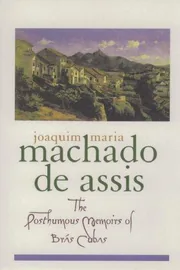
Memórias póstumas de Brás Cubas
by Machado de Assis · 1881
Best for mature teens and adults who enjoy classic literature and satirical wit.
242 pages, about 4 to 5.5 hours.
A dead man narrates his own life with savage wit. 63% taste match
The story
Memórias póstumas de Brás Cubas is a novel by Machado de Assis, first issued in book form in 1881 after appearing in installments in the Revista Brasileira during 1880. It belongs to Brazilian fiction and takes the form of an autobiography, with a narrator who speaks from beyond the grave. The story opens by asking whether these memoirs can even be called a novel.
The setting is Rio de Janeiro and the Brazil of its day, with attention to social life and customs and to the aristocracy and its class world. The author follows a loose, free form, drawing on Laurence Sterne's Tristram Shandy, and departs from the linear style of writers such as Flaubert and Zola. Its tone is ironic and pessimistic, and its arrival marked a change in the author's own style. The book is widely regarded as the work that began Realism in Brazil, though it keeps elements particular to Machado de Assis. It runs to roughly 242 pages and has appeared in 149 editions.
Estas Memórias póstumas de Brás Cubas serão um romance?
Setting
Latin AmericaBrazilRio de Janeiro
Themes
Romance brasileiroSocial life and customsDeadRomance literatureAutobiographyGhost storiesAristocracy (Social class)Classics
- Want to read 186
- Reading now 13
- Read 30
Most people shelving it are saving it for later.
Of 229 readers who put it on a shelf, 81% want to read it, 6% are reading it now, 13% have finished it and 0% stopped before the end.
By the numbers
- The median edition runs 242 pages. Counting about 275 words a page and an adult reading pace of 250 words a minute, that is about 4.4 hours of reading.
- Open Library tracks 149 editions from 70 publishers, the earliest dated 1881 and the latest 2022, across 7 languages.
- On reader demand it ranks in the top 6% of the classic books in our catalog (8,749 of them).
- Libraries shelve it under Dewey 869.3 and Library of Congress class PQ-9697.00000000.M18 M513 2020eb.
 BookWard’s take
A dead man narrates his own life with savage wit
Machado de Assis opens by asking whether these memoirs are even a novel, and that nerve carries the whole book. Brás Cubas speaks from beyond the grave, and the narration is where the book lives: its voice is distinctive, opinionated and sharply ironic, nothing like the generic. On originality it sits near the top, a free, digressive form borrowed from Sterne's Tristram Shandy and set against the linear realism of Flaubert and Zola. It runs about 242 pages, so it is tight and moves quickly, the opposite of the long, sprawling novel. The structure is far more playful than BookWard's usual conventional pick, and the tone is pessimistic rather than hopeful. Short chapters, a Rio de Janeiro of social customs and aristocratic pretension, and a narrator you cannot fully trust make for a book that feels fresh a century and a half on.
At about 242 pages in short chapters, it is compact, which suits BookWard's preference for tight books.
Brief chapters and constant digression keep it moving, close to BookWard's fast-leaning taste.
A dead narrator and a form borrowed from Sterne make it strikingly original, matching BookWard's high bar.
The prose is witty and polished without being ornate, close to BookWard's plainer lean.
It is built around one man's character and reflections rather than events, matching BookWard's lean.
Its outlook is pessimistic and ironic, well below BookWard's mildly hopeful position.
A loose, digressive, deliberately unconventional form sits far from BookWard's conventional middle.
Caustic wit runs through the book, a good fit with BookWard's lean toward humor.
The tone is bleak and cynical without graphic content, about where BookWard sits.
Emotion is held back behind irony, a little cooler than BookWard's middle-to-intense lean.
See all 50 dialsEvery position, side by side with this book
Where it lines up
- Character depthBookWard 8 · book 8
- Sagging middleBookWard 8 · book 8
- LengthBookWard 1 · book 2
Where it pulls apart
- Internal logicBookWard 10 · book 6
- Story or ideasBookWard 3 · book 7
- ExpositionBookWard 2 · book 6
At about 242 pages in short chapters, it is compact, which suits BookWard's preference for tight books.
It opens by questioning whether it is a novel at all, a cheeky start that grabs attention straight away.
Its free form and corpse narrator break from the standard novel conventions of its day, which BookWard rates highly.
The book follows its own playful rules rather than strict causal order, so it is less airtight than BookWard likes.
Brief chapters and constant digression keep it moving, close to BookWard's fast-leaning taste.
A dead narrator and a form borrowed from Sterne make it strikingly original, matching BookWard's high bar.
Brás Cubas is drawn from the inside with unflinching self-exposure, which fits BookWard's appetite for depth.
The close is more a verdict than a neat resolution, so it sits in the middle where BookWard prefers closure.
Irony and indifference keep sentiment at arm's length, which BookWard values.
Its darkness comes from cold, ironic observation rather than cheap effect, so it earns its bleakness.
This is a novel, so the nonfiction rigor dial does not apply.
The narrator's caustic, intrusive voice is the book's signature, exactly the distinctiveness BookWard prizes.
Ideas and attitude drive it more than plot, a bit more idea-led than BookWard's story-first taste.
The narrator explains and comments openly, more than BookWard's show-in-scene preference.
Short chapters keep energy high throughout, in line with BookWard's wish for a sustained read.
The prose is witty and polished without being ornate, close to BookWard's plainer lean.
It is built around one man's character and reflections rather than events, matching BookWard's lean.
Its outlook is pessimistic and ironic, well below BookWard's mildly hopeful position.
A loose, digressive, deliberately unconventional form sits far from BookWard's conventional middle.
Caustic wit runs through the book, a good fit with BookWard's lean toward humor.
The digressions and period setting ask some attention, a touch above BookWard's easy-leaning taste.
Everything comes through Brás Cubas alone, so it is a single viewpoint where BookWard leans toward many.
Told from beyond the grave with free movement through a life, it shifts time more than BookWard usually does.
A narrator speaking from the grave adds a fantastical touch to an otherwise grounded Rio.
The cast stays modest and centered on the narrator's circle, near BookWard's smaller-cast position.
It stays with one life and its social world, an intimate scale where BookWard sits mid-range.
Reflection and commentary dominate over action, well toward the inner side BookWard slightly favors.
Narration and commentary far outweigh dialogue, lighter than BookWard's dialogue-friendly taste.
Love affairs appear within the memoir but it is not a romance-led book, near BookWard's middle.
Nineteenth-century Rio de Janeiro will feel unfamiliar to most, in line with BookWard's taste for unfamiliar settings.
Written in 1881 and set in its own period, it belongs firmly to the past, unlike BookWard's present-day lean.
Its irony and form still feel fresh well over a century on, matching BookWard's staying-power taste.
A dead man shaping his own story is a self-serving, slippery narrator, more unreliable than BookWard's already high mark.
The book offers no tidy moral lesson and treats human motives with irony, suiting BookWard's ambiguity taste.
Observation stays sharp and brief rather than lavish, a bit sparer than BookWard's middle.
It is a standalone novel, matching BookWard's lean toward single books.
It offers sly turns in tone more than plot twists, slightly below BookWard's liking for surprises.
It unsettles comfortable ideas about vanity and society, fitting BookWard's lean toward challenge.
The tone is bleak and cynical without graphic content, about where BookWard sits.
Emotion is held back behind irony, a little cooler than BookWard's middle-to-intense lean.
The humor is dry and ironic rather than broad, below BookWard's middle.
Little violence appears on the page, below BookWard's middle.
Intimacy is implied and discussed lightly rather than shown, below BookWard's middle.
Social class and the aristocracy are examined but politics is not front and center, near BookWard's middle.
The Portuguese is elegant but not dialect-heavy, around BookWard's middle.
The narrator editorializes on every page, more opinionated than BookWard's own lean.
It looks back over a finished life from beyond the grave, well toward the backward side.
The worldview is deeply cynical about human vanity, far from BookWard's mildly idealistic lean.
Review written by BookWard, dial version 1, November 2026.
Who is Memórias póstumas de Brás Cubas right for?
Best for mature teens and adults who enjoy classic literature and satirical wit. It treats death, vanity and social hypocrisy with a cynical tone, so readers wanting hope or warmth may find it cold.
The digressions and period setting ask some attention, a touch above BookWard's easy-leaning taste.
The tone is bleak and cynical without graphic content, about where BookWard sits.
Emotion is held back behind irony, a little cooler than BookWard's middle-to-intense lean.
Little violence appears on the page, below BookWard's middle.
Book CompanionMemórias póstumas de Brás Cubas: ideas, characters, themes
A dead man writes his own memoirs with ironic detachment, turning a life of vanity and missed chances into a mirror of his society.
- A narrator beyond the grave. Brás Cubas tells his story after death, which frees him to judge himself and others with cold humor.
- The form questions itself. The book opens by asking whether it can even be called a novel, signaling its playful, rule-breaking style.
- Sterne's influence. Machado adopts the free, digressive form of Tristram Shandy, breaking from the linear storytelling of Flaubert and Zola.
- Rio and its social world. The novel portrays Rio de Janeiro and its aristocratic customs with irony and pessimism.
- A turning point in Brazilian writing. It is widely seen as the book that began Realism in Brazil, while keeping Machado's own distinctive touches.
Characters
Brás Cubas
Narrator
The dead man who recounts his own life with irony, vanity and cold humor.
Themes
How self-regard shapes a person's choices and the story he tells about them.
The gap between what is said and what is meant, which drives the book's tone.
The customs and pretensions of the aristocracy in nineteenth-century Rio.
Death as a vantage point that strips away illusion.
How a book can question its own genre and narration.
Discussion questions
- Why might Machado have chosen a dead narrator, and what does death let Brás Cubas say?
- How does the book's opening question about being a novel shape the way you read it?
- Is Brás Cubas a narrator you trust, and where does he flatter himself?
- What does the book suggest about Rio's society through its tone of irony and indifference?
- Does the free, digressive form help or hinder the story for you?
Personalize your Book Companion
This is the general edition. In BookWard, the Companion is written for you: your reading profile, your notes, and spoiler-safe to the page you are on.
Buy, listen or borrow Memórias póstumas de Brás Cubas
Each link opens a search for this book on that store, in a new tab.
Read on a device
Borrow
Reviews and community
If you liked Memórias póstumas de Brás Cubas
A ninety-six-page novel that turns on its own narrator
GrendelJohn GardnerBeowulf's monster narrates, and the philosophy bites harder than the claws
Uno, nessuno e centomilaLuigi PirandelloOne man unravels his own identity, one nose-tilt at a time
The End of EverythingM. John HarrisonA strange Kent tideline, and an object that won't hold still
Sources: Open Library.
Track Memórias póstumas de Brás Cubas and find your next favorite
Add it to your shelf, rate what you have read, and BookWard will recommend what fits you.
Free to start. No credit card needed.