Batman
by Alan Moore, Brian Bolland · 1988
Best suited to mature teens and adults.
64 pages, about 1 to 1.5 hours.
A short, sharp Batman story built around one bad day. 56% taste match
The story
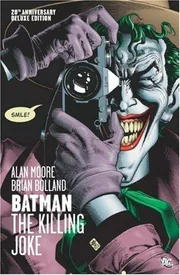
Batman: The Killing Joke is a superhero graphic novel from DC Comics, first published in 1988 as a standalone story. It was written by Alan Moore and drawn by Brian Bolland, with the original colors by John Higgins. Later editions were recolored by Bolland himself. The book runs about 64 pages and has appeared in 22 editions.
The story is set in Gotham City and centers on Batman and the Joker. The Joker escapes from Arkham Asylum and sets out to show that one terrible day is enough to push anyone into madness. His chosen targets are Commissioner Jim Gordon and Gordon's daughter Barbara. Interwoven with this plot is a flashback offering a possible origin for the Joker, adapted loosely from a 1951 story by Bill Finger, the co-creator of Batman. Batman, meanwhile, races to stop him. The book deals with violent and mentally ill offenders and with the boundary between good and evil, sanity and insanity, and comedy and tragedy.
Setting
United StatesGotham City
Themes
Comic books, stripsBatman (Fictitious character)Violent offendersMentally ill offendersJoker (Fictitious character)New York Times bestsellerComics & graphic novels, superheroesComics & graphic novels, general
- Want to read 167
- Reading now 17
- Read 75
Most people shelving it are saving it for later.
Of 259 readers who put it on a shelf, 64% want to read it, 7% are reading it now, 29% have finished it and 0% stopped before the end.
By the numbers
- The median edition runs 64 pages. Counting about 275 words a page and an adult reading pace of 250 words a minute, that is about 70 minutes of reading.
- Open Library tracks 22 editions from 14 publishers, the earliest dated 1988 and the latest 2023, across 3 languages.
- On reader demand it ranks in the top 2% of the modern books in our catalog (15,152 of them).
- Libraries shelve it under Dewey 741.5942 and Library of Congress class PN-6728.00000000.B36M6633 2023.
 BookWard’s take
A short, sharp Batman story built around one bad day
At 64 pages, The Killing Joke is about as tight as a book gets, and it uses that space well. The Joker escapes Arkham and sets out to prove that one terrible day can break anyone, using Commissioner Gordon and his daughter Barbara to do it. A flashback offers a possible origin for the Joker, so the book moves between two timelines, which makes it a little more shifting than I usually like. The pace is brisk and the opening hooks fast. Its shock is the real debate: some readers will say it earns its darkness, others will say it leans on it. The ending is deliberately unsettled, which runs a little against my taste for resolution.
Sixty-four pages, one sitting; it is as tight as BookWard's taste demands.
The Joker origin is adapted loosely from a 1951 story, so the ideas are fresh but not wholly new.
The text is lean and pointed, with poetic flourishes more than ornament.
A plot of escape and pursuit carries it, with the Joker's psychology close behind.
The book argues that goodness is fragile, so its outlook is dark.
The flashback interleaving is a mild departure from straight comics storytelling.
The Joker brings grim gallows humor, but the book is serious at heart.
Violence and cruelty to the Gordons make it one of the darker superhero stories.
The book hits hard, with intense scenes of cruelty and grief.
See all 50 dialsEvery position, side by side with this book
Where it lines up
- LengthBookWard 1 · book 1
- PaceBookWard 8 · book 8
- SentimentBookWard 8 · book 8
Where it pulls apart
- Familiar tropesBookWard 10 · book 5
- Internal logicBookWard 10 · book 6
- EndingBookWard 8 · book 3
Sixty-four pages, one sitting; it is as tight as BookWard's taste demands.
The Joker's escape and his plan start the engine quickly, which suits BookWard.
It works inside familiar superhero ground, with a famous hero and villain, so it only partly avoids trope.
The Joker's scheme follows a clear thesis, though the possible origin is meant to be doubted.
The Joker origin is adapted loosely from a 1951 story, so the ideas are fresh but not wholly new.
The Joker and Gordon carry real weight, while others stay close to their archetypes.
It closes on an unsettled note rather than a clean resolution, a mismatch with BookWard's taste.
The story is bleak and unsparing rather than tender, which BookWard tends to admire.
The book is built on cruelty, and whether that darkness is earned is the usual argument.
Moore's script and Bolland's art give it a strong, recognizable personality.
The plot serves a debate about sanity and bad days, tilting it a little toward ideas.
Much is shown through images and flashback, with some explaining through the Joker's speeches.
At this length there is no room to sag, and the story stays taut.
The text is lean and pointed, with poetic flourishes more than ornament.
A plot of escape and pursuit carries it, with the Joker's psychology close behind.
The book argues that goodness is fragile, so its outlook is dark.
The flashback interleaving is a mild departure from straight comics storytelling.
The Joker brings grim gallows humor, but the book is serious at heart.
It reads quickly and easily, though the themes reward a second look.
The story follows Batman, the Joker and the Gordons, but stays mostly tight.
Present action alternates with the flashback origin, so time is clearly shifting.
Gotham and its costumed figures are heightened, but the human cruelty stays grounded.
A handful of characters carry the whole story.
It is an intimate clash between a few people, not a citywide spectacle.
The Joker's madness and Batman's action share space, leaning a little toward the inner.
Speeches and exchanges matter, but the art does as much talking.
Romance is not a concern here.
Gotham City is well known to superhero readers, so the setting feels familiar.
It is set in a stylized Gotham with a late-1980s feel, not contemporary life.
Its questions about sanity and tragedy have kept it in print across many editions.
The Joker's origin is offered as a possibility, and his own memory is unreliable.
The book blurs the line between hero and villain, leaving little comfort.
Bolland's detailed art carries rich visual description.
The book is meant to disturb and provoke, not soothe.
Violence and cruelty to the Gordons make it one of the darker superhero stories.
The book hits hard, with intense scenes of cruelty and grief.
The Joker's humor is sardonic and theatrical, tilting a little broad.
There are sustained scenes of cruelty and its aftermath on the page.
There is some sexualized violence, which makes it a sensitive read.
It is a character study, not a political book.
The language is plain and easy to follow.
The Joker's philosophy is pushed hard, giving the narration a strong slant.
The story turns on the past, the Joker's possible origin, more than the future.
It is deeply cynical about how thin the barrier between order and madness is.
Review written by BookWard, dial version 1, November 2026.
Who is Batman right for?
Best suited to mature teens and adults. It contains graphic violence, cruelty toward a female character and sexualized harm, which some readers will find very upsetting.
It reads quickly and easily, though the themes reward a second look.
Violence and cruelty to the Gordons make it one of the darker superhero stories.
The book hits hard, with intense scenes of cruelty and grief.
There are sustained scenes of cruelty and its aftermath on the page.
Book CompanionBatman: ideas, characters, themes
The Joker bets that one terrible day is all it takes to turn anyone into him, and Batman has to prove otherwise.
- The Joker escapes. After breaking out of Arkham Asylum, the Joker begins a plan meant to prove his point about sanity.
- The Gordons are the targets. He aims at Commissioner Jim Gordon and Gordon's daughter Barbara to test how far one bad day can push a person.
- A possible origin. A flashback gives a possible account of how the Joker became who he is, adapted loosely from a 1951 story.
- Batman races to stop him. Batman pursues the Joker while the story questions how different the two men really are.
- A tight standalone. The book is a single 64-page story that works without prior Batman reading.
Characters
Batman
Protagonist
Gotham's masked defender, racing to stop the Joker's plan.
The Joker
Antagonist
A villain escaped from Arkham who wants to prove that anyone can be broken.
Jim Gordon
Target
Gotham's top cop, chosen as the Joker's test subject.
Barbara Gordon
Target
The Commissioner's daughter, also caught in the Joker's scheme.
Themes
How thin the line is between the two.
Whether hero and villain are truly opposites.
How humor and suffering can live in the same story.
Whether a person's past can be trusted or is invented.
The idea that a single event can define a life.
Discussion questions
- Do you accept the Joker's claim that one bad day can break anyone?
- How much do you trust the Joker's version of his own past?
- Does the book earn its darkness, or lean on it for effect?
- What does the story suggest Batman and the Joker share?
- How does the unsettled ending change how you read what came before?
Personalize your Book Companion
This is the general edition. In BookWard, the Companion is written for you: your reading profile, your notes, and spoiler-safe to the page you are on.
Buy, listen or borrow Batman
Each link opens a search for this book on that store, in a new tab.
Read on a device
Borrow
Reviews and community
If you liked Batman
Four tight novellas about retribution, with no comfort offered
The Virgin SuicidesJeffrey EugenidesA haunting chorus of boys circles five sisters they never knew
Horror MoviePaul TremblayA cursed cult film, a lone survivor, and a narrator you can't trust
Dark PlacesGillian FlynnA cold-case thriller where a child survivor must question her memory
Sources: Open Library.
Track Batman and find your next favorite
Add it to your shelf, rate what you have read, and BookWard will recommend what fits you.
Free to start. No credit card needed.