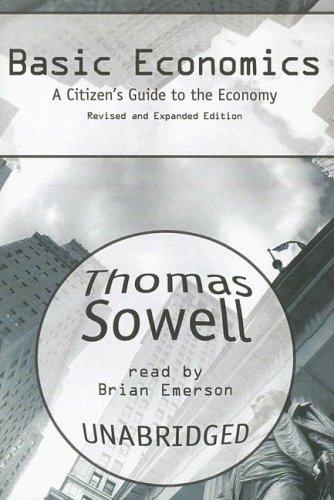
Basic Economics
by Thomas Sowell
★ Top 25 book of 2000 · #16 on Best Books of 2000
Thomas Sowell explains economics in plain English, with no graphs, equations, or jargon. Using examples from around the world and across centuries, he shows how whole societies create prosperity or poverty.
Best for: General readers wanting an easy, jargon-free introduction to how economies work
Basic Economics is #16 on BookWard's Best Books of 2000, out of 46 2000 books that cleared our data bar.
What Basic Economics is about
Thomas Sowell argues that much of the answer to why societies create prosperity or poverty lies in how a society organizes its economy, and he sets out to explain the workings in language anyone can follow. There are no charts, graphs or equations, and he avoids jargon.
The book starts from scarcity and trade-offs, then moves through prices and markets, industry, wages and work, time and risk, the national economy and international trade. A later edition adds a section on special issues. Along the way Sowell takes up price controls, taxes, subsidies, monopoly, regulation, minimum wages and the contest between free markets and central planning, with examples from many countries and centuries. His tone is plainspoken and firmly opinionated. It will help students, voters and curious readers who want a clear footing in economics before they argue about it.
Basic Economics on the Best Books of 2000
Basic Economics came out in 2000. Of the 46 books first published in 2000 that met BookWard's data bar, it ranks #16 on our Best Books of 2000 list.
Why it made the list: 331 readers have shelved it on Open Library; readers rate it 3.7 out of 5 (11 ratings). The list ranks each year’s books on how many readers have picked them up, how highly readers rate them, and how many are reading them right now.
Nearby on the 2000 list
- The Wide Window Lemony Snicket, #14
- Gathering Blue Lois Lowry, #15
- The Princess Diaries Meg Cabot, #17
- Me Talk Pretty One Day David Sedaris, #18
See all Best Books of 2000 Best books by year
More years: Best Books of 1999 Best Books of 2001.
The numbers behind it
- Readers: 297 want to read it, 18 are reading it now and 16 have read it, according to Open Library.
- Ratings: 3.7 out of 5 from 11 Open Library ratings.
| Signal | This book (0 to 100) | Weight |
|---|---|---|
| Reach | 70 | 55% |
| Reader love | 28 | 25% |
| Being read right now | 65 | 20% |
Questions about Basic Economics
When was Basic Economics published?
Basic Economics by Thomas Sowell was first published in 2000.
Was Basic Economics one of the best books of 2000?
Basic Economics is #16 on BookWard's Best Books of 2000, out of 46 2000 books that cleared our data bar. 331 readers have shelved it on Open Library; readers rate it 3.7 out of 5 (11 ratings).
Why is Basic Economics on the Best Books of 2000 list?
331 readers have shelved it on Open Library; readers rate it 3.7 out of 5 (11 ratings).
More of the best books of 2000
- Harry Potter and the Goblet of Fire J. K. Rowling, #1
- The 48 Laws of Power Robert Greene, #2
- Because of Winn-Dixie Kate DiCamillo, #3
- The Gruffalo Julia Donaldson, #4
- Life of Pi Yann Martel, #5
- Esperanza Rising Pam Muñoz Ryan, #6
See the full Best Books of 2000, the Top 100, or new books on Rising.
How we know
This page uses public data: Open Library reader counts and ratings, and Wikipedia page views for recent years. The description is paraphrased from real source text. Rankings reflect reading interest, not quality or sales, and can be affected by data gaps. Lists update monthly.
Suited to curious older teens and adults, and designed for general readers with no prior economics.
Depends on the edition you pick.
Economics in plain English, no graphs, no jargon, no mercy. 45% taste match
 BookWard’s take
Economics in plain English, no graphs, no jargon, no mercy
Basic Economics explains how societies end up prosperous or poor through the way they organize their economies, and it does so with no charts, graphs or equations. That plain-English promise is the book's real achievement. Sowell explains every principle outright rather than dramatizing it, which runs against my own taste for ideas shown in scene, but here the directness is the point. The rigor is where it earns its keep: examples span centuries and continents, and each one serves an analytical point. It is idea-led rather than story-led, and Sowell's voice is opinionated and distinctive. Expect a long, steady tour from prices and markets through work, risk, national economies and trade. The pace is measured, not fast, but a sagging middle is not a worry when every chapter builds on the last.
A sweeping survey of whole economies across six parts makes this a long read, which sits against BookWard's love of the short and tight.
Short chapters grouped into sections keep it moving at a steady, teaching pace rather than a brisk one, a little slower than BookWard prefers.
Its strength is clarity rather than novelty; the principles are standard, but the range of worldwide and historical illustrations is its own.
Plain English is the explicit goal, with no jargon and no ornament, which is a bit plainer than BookWard's middle-leaning taste.
It diagnoses why societies stay poor but also shows how prosperity gets created, so it leans mildly hopeful.
A conventional textbook-style layout of six topical parts, each ending in an overview, with nothing experimental.
The tone is earnest and explanatory, with pointed anecdotes rather than jokes, so it reads as serious.
The subject can be grim, such as poverty and hunger, but it is treated analytically and without lingering.
Analytical and even-toned, aiming to inform rather than move.
See all 50 dialsEvery position, side by side with this book
Where it lines up
- Sagging middleBookWard 8 · book 8
- Internal logicBookWard 10 · book 9
- SentimentBookWard 8 · book 9
Where it pulls apart
- LengthBookWard 1 · book 8
- ExpositionBookWard 2 · book 10
- Story or ideasBookWard 3 · book 10
A sweeping survey of whole economies across six parts makes this a long read, which sits against BookWard's love of the short and tight.
It opens by framing scarcity and trade-offs and sets out its stakes early, but it builds as a course rather than grabbing you at once.
The core arguments will be familiar to anyone who has met standard economics, though the globe-spanning examples keep them from feeling stock.
Each principle is built step by step on the last, from scarcity through prices to international trade, which suits BookWard's appetite for airtight argument.
Short chapters grouped into sections keep it moving at a steady, teaching pace rather than a brisk one, a little slower than BookWard prefers.
Its strength is clarity rather than novelty; the principles are standard, but the range of worldwide and historical illustrations is its own.
Sowell argues in a sober, matter-of-fact way and keeps feeling out of the analysis, which matches BookWard's restrained taste.
Arguments are tied to real cases from around the world and across centuries, though without graphs or equations it trades formal proof for plain explanation.
Sowell's plain, pointed, opinionated style is recognizably his own, which BookWard values in nonfiction.
It is almost wholly about ideas, with each chapter built around a principle, far more idea-led than BookWard usually leans.
Principles are stated and explained outright, with examples as illustration, the reverse of BookWard's preference for showing in scene.
Because each section builds toward a wrap-up overview, the middle of this long book stays purposeful rather than drifting.
Plain English is the explicit goal, with no jargon and no ornament, which is a bit plainer than BookWard's middle-leaning taste.
It diagnoses why societies stay poor but also shows how prosperity gets created, so it leans mildly hopeful.
A conventional textbook-style layout of six topical parts, each ending in an overview, with nothing experimental.
The tone is earnest and explanatory, with pointed anecdotes rather than jokes, so it reads as serious.
With no graphs, equations or jargon it is built to be easy to absorb, though its length takes sustained attention.
A single authorial voice argues one coherent perspective throughout.
The argument runs in a straight line from basic concepts to complex ones, with historical examples as support.
Entirely grounded in real economies, real history and everyday cases.
It surveys national and international economies, so the subject is broad even though the explanations are everyday.
There is no dialogue; it is pure exposition and example.
Not a feature of a book about prices, work and trade.
Examples range across countries and centuries, bringing in places and situations many readers will not know.
Published in 2000 and revised since, it speaks to modern economies while drawing on much older history.
Its focus on foundational principles, not headlines, gives it staying power beyond any one moment.
The author speaks plainly and directly, with no unreliable narrating voice.
It argues a clear point of view on how economies work, so the lines are drawn rather than blurred.
Illustrations are brief and functional, there to prove a point rather than paint a scene.
Analytical in structure and aim, though it leans on lively anecdotes and examples to carry readers through.
Sowell writes as a teacher making his case, with a clear stance rather than a detached survey.
A standalone work, though it has gone through several revised editions.
There are few surprises in structure, though some conclusions run against common assumptions.
It pushes readers to rethink assumptions about prices, regulation and poverty, which can be uncomfortable.
The subject can be grim, such as poverty and hunger, but it is treated analytically and without lingering.
Analytical and even-toned, aiming to inform rather than move.
Humor, where it appears, is dry and incidental.
Little appears on the page beyond passing historical references.
Not a topic here.
Economics shapes policy debates directly here, with the author taking clear positions on regulation, minimum wages and markets.
Deliberately plain language aimed at the general reader.
Sowell argues a clear case and does not hide his views.
It draws heavily on history and settled principles while applying them to current economic life.
It is pragmatic and skeptical of good intentions that ignore incentives, rather than starry-eyed.
Review written by BookWard, dial version 1, November 2026.
Who is Basic Economics right for?
Suited to curious older teens and adults, and designed for general readers with no prior economics. It argues clear political and economic positions, so it works best read alongside other views.
With no graphs, equations or jargon it is built to be easy to absorb, though its length takes sustained attention.
The subject can be grim, such as poverty and hunger, but it is treated analytically and without lingering.
Analytical and even-toned, aiming to inform rather than move.
Little appears on the page beyond passing historical references.
Book CompanionBasic Economics: ideas, characters, themes
Societies prosper or stay poor largely because of how their economies are organized, and the basic principles of economics explain why.
- Scarcity and trade-offs. The book opens by framing economics around limited resources and the choices they force.
- Prices and markets. It covers the role of prices, incentives and competition, and the consequences of price controls.
- Industry and commerce. Markets coordinate production in the face of widely dispersed information, a theme developed through profit, loss and specialization.
- Work, pay and risk. Sections on minimum wages, income distribution and mobility sit beside a discussion of time and risk.
- National and international economies. The later parts take the principles up to whole economies and the global trade between them.
Themes
Resources are limited, so every choice has a cost in forgone alternatives.
People respond to the rewards and penalties built into a system.
How coordination happens when information is spread across many people.
How the way an economy is organized shapes how well its people live.
Discussion questions
- Which everyday example of a price control made you rethink your assumptions?
- Does explaining economics without graphs or equations help or limit the argument?
- How persuasive is the case that incentives explain so many puzzling outcomes?
- Where do you notice the author's own viewpoint shaping the analysis?
- Which section, such as risk, work or trade, changed your view the most?
Personalize your Book Companion
This is the general edition. In BookWard, the Companion is written for you: your reading profile, your notes, and spoiler-safe to the page you are on.
Buy, listen or borrow Basic Economics
Each link opens a search for this book on that store, in a new tab.
Read on a device
Borrow
Reviews and community
If you liked Basic Economics
Why some societies conquered others, argued from geography, not genes
Le capital au XXIe siècleThomas PikettyA data-heavy, 816-page case that capital outgrows growth
NexusYuval Noah HarariA sweeping history of information, and why AI raises the stakes
SapiensYuval Noah HarariA big-idea tour of humankind, bold and endlessly arguable
Find your own best books
Add what you have read, rate it, and BookWard will recommend what to read next.
Free to start. No credit card needed.