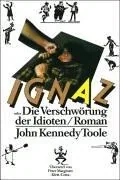
A Confederacy of Dunces
by John Kennedy Toole · 1980
Best suited to adult and older teen readers who enjoy satire and verbal comedy.
391 pages, about 6 to 9 hours.
A glorious comic monster loose in New Orleans, wildly original. 62% taste match
The story
A Confederacy of Dunces is a comic picaresque novel by John Kennedy Toole, first published in 1980 and set in New Orleans, Louisiana. The story centers on Ignatius J. Reilly, a large and fastidious young man who lives with his mother, Irene Reilly, and moves through the city's French Quarter and its working-class streets. Around him are figures such as Myrna Minkoff, Santa Battaglia, Claude Robichaux, Angelo Mancuso, Lana Lee, Burma Jones and Gus Levy, and the action takes in settings including Canal Street, D.H. Holmes, Werlein's Music Store and the Prytania Theater.
Toole died eleven years before the book appeared. It reached print through the efforts of Walker Percy and Toole's mother, Thelma, and went on to earn a posthumous Pulitzer Prize for Fiction in 1981. Its themes of mothers and sons, loneliness and the lives of young men run through a humorous series of adventures in the city. The novel is regarded as a canonical work of modern Southern literature and runs to about 391 pages in a typical edition.
A green hunting cap squeezed the top of the fleshy balloon of a head.
Characters
Ignatius J. ReillyMyrna MinkoffIrene ReillySanta BattagliaClaude RobichauxAngelo Mancuso
Setting
New Orleans (La.)New OrleansLouisianaFrench QuarterCanal Street
Themes
motherstravelhousingcharactersonsgroupslonelinessYoung men
- Want to read 292
- Reading now 20
- Read 134
Most people shelving it are saving it for later.
Of 446 readers who put it on a shelf, 65% want to read it, 4% are reading it now, 30% have finished it and 0% stopped before the end.
By the numbers
- The median edition runs 391 pages. Counting about 275 words a page and an adult reading pace of 250 words a minute, that is about 7.2 hours of reading.
- Open Library tracks 69 editions from 35 publishers, the earliest dated 1980 and the latest 2022, across 5 languages.
- On reader demand it ranks in the top 1% of the modern books in our catalog (15,152 of them).
- Libraries shelve it under Dewey 813.69 and Library of Congress class PS-3570.00000000.O54 C66 1981.
 BookWard’s take
A glorious comic monster loose in New Orleans, wildly original
Ignatius J. Reilly is one of fiction's great creations, and the book knows it. The voice is distinctive from the first line, a green hunting cap squeezed onto a fleshy balloon of a head, and the comedy never lets up. I tend to prefer a tight, airtight story, and this one sprawls at 391 pages, wandering with the loose logic of a picaresque, so that is where I part ways with it. But the originality is real, the dialogue crackles, and the French Quarter cast feels drawn from life rather than from tropes. It is broader than the dry humor I usually favor, yet the character depth is genuine. Few comic novels hold their energy this long, and the story behind its publication only adds to it.
At 391 pages it runs long for a comic novel, well past the tight end where BookWard sits.
The episodes keep coming at a brisk clip, though the comic digressions slow it more than BookWard usually likes.
Few novels feel less like anything else; Ignatius has no real peer in fiction, which suits BookWard's taste.
The prose is sharp and playful, with Ignatius's pompous diction adding a mock-grand edge.
Ignatius's character drives nearly everything, and the plot is what happens when he meets the city.
Neither bleak nor sunny, it leaves a measured, ironic hope for its misfits.
Conventional in form, with its inventiveness reserved for voice and comic set pieces.
This is the book's chief claim to fame, a comic novel that stays funny across hundreds of pages.
Mostly light and comic, though loneliness and thwarted lives run underneath.
Feeling is present but kept in check by the humor.
See all 50 dialsEvery position, side by side with this book
Where it lines up
- OriginalityBookWard 9 · book 9
- Character depthBookWard 8 · book 8
- EndingBookWard 8 · book 7
Where it pulls apart
- Internal logicBookWard 10 · book 4
- LengthBookWard 1 · book 6
- OpeningBookWard 10 · book 8
At 391 pages it runs long for a comic novel, well past the tight end where BookWard sits.
Ignatius is on the page in the first sentence, hunting cap and all, and the book starts moving at once.
Its cast of New Orleans oddballs reads as freshly observed rather than assembled from stock types, which BookWard values.
A picaresque built on coincidence and collision, it runs on comic momentum more than airtight cause and effect.
The episodes keep coming at a brisk clip, though the comic digressions slow it more than BookWard usually likes.
Few novels feel less like anything else; Ignatius has no real peer in fiction, which suits BookWard's taste.
Ignatius and the people around him are drawn with enough specificity to feel real even at their most absurd.
The threads come to a clear landing, in line with BookWard's preference for resolution.
Mother and son carry real feeling, but the book keeps it under a layer of comic armor.
The darkness is incidental to the satire and the comedy rather than a bid for effect.
Not applicable to a novel.
Ignatius's pompous, aggrieved voice is unmistakable and carries the whole book.
It is story-led, built from schemes, jobs and misadventures, though Ignatius's worldview gives the plot its spine.
Characters reveal themselves through scene and speech, and the book rarely stops to explain.
The energy mostly holds, though a few of the longer subplots test the momentum.
The prose is sharp and playful, with Ignatius's pompous diction adding a mock-grand edge.
Ignatius's character drives nearly everything, and the plot is what happens when he meets the city.
Neither bleak nor sunny, it leaves a measured, ironic hope for its misfits.
Conventional in form, with its inventiveness reserved for voice and comic set pieces.
This is the book's chief claim to fame, a comic novel that stays funny across hundreds of pages.
Easy to follow, though Ignatius's elaborate language asks a little attention.
The narrative moves among Ignatius and several other residents of the city, giving a wide, communal view.
The story moves forward in a straightforward line without time jumps.
Grounded in a real, recognizable New Orleans, with exaggeration confined to character.
A large gallery of New Orleans types, each with their own distinct voice.
The stakes are personal and local, set within a few city blocks.
It balances Ignatius's grandiose inner life with plenty of outward comic incident.
Talk drives the comedy, and the dialogue is among the book's great strengths.
Romance sits at the margins, with relationships mostly played for comedy.
A very particular New Orleans, French Quarter and working-class streets, that most readers will find unfamiliar.
Set in a mid-century city that now reads firmly as the past.
Its comic character has outlived its moment and keeps finding new readers.
The narration is trustworthy, but Ignatius's account of himself is wildly self-serving.
The book refuses easy verdicts, leaving even its worst offender oddly sympathetic.
The city is rendered in vivid, lived-in detail that gives the comedy a firm setting.
A single self-contained novel.
Plot turns arrive through collision and coincidence, and many are genuinely surprising.
Easy to enjoy, with its challenge mostly in how it unsettles our sympathies.
Mostly light and comic, though loneliness and thwarted lives run underneath.
Feeling is present but kept in check by the humor.
The comedy is broad and theatrical, a long way from understatement.
Little violence appears, and it is played for farce.
Sexual content is limited and treated comically.
Social and political attitudes are skewered, but as comic background rather than argument.
Period slang and local speech, plus Ignatius's grandiloquence, add some density.
Ignatius is ferociously opinionated, and the narration revels in his judgments.
It looks backward, with Ignatius pining for an imagined better age.
A cynical comedy about a world that mostly lets its dreamers down.
Review written by BookWard, dial version 1, November 2026.
Who is A Confederacy of Dunces right for?
Best suited to adult and older teen readers who enjoy satire and verbal comedy. Expect period attitudes and crude characters played for laughs.
Easy to follow, though Ignatius's elaborate language asks a little attention.
Mostly light and comic, though loneliness and thwarted lives run underneath.
Feeling is present but kept in check by the humor.
Little violence appears, and it is played for farce.
Book CompanionA Confederacy of Dunces: ideas, characters, themes
A grandiose, self-deluded young man lives with his mother in New Orleans and collides with the city's working-class world in a series of comic misadventures.
- A picaresque in the French Quarter. The story follows Ignatius J. Reilly through the streets and shops of New Orleans in a loose run of adventures.
- Mother and son. Ignatius lives with his mother, Irene Reilly, and their relationship is at the center of the book.
- A city full of characters. Figures like Myrna Minkoff, Santa Battaglia, Claude Robichaux, Angelo Mancuso, Lana Lee and Burma Jones fill out the world.
- True-to-life dialogue. The talk of the city's lower depths is a central pleasure of the book.
- A posthumous classic. Published in 1980, eleven years after Toole's death, it won the Pulitzer Prize for Fiction in 1981.
Characters
Ignatius J. Reilly
Protagonist
A huge, fastidious young man who sees himself as a lone thinker in a decayed world.
Irene Reilly
Ignatius's mother
The mother he lives with, whose bond with her son drives much of the story.
Myrna Minkoff
Figure in Ignatius's life
One of the key figures who moves in Ignatius's orbit.
Lana Lee
New Orleans character
One of the city's denizens that Ignatius encounters.
Burma Jones
New Orleans character
Another of the book's memorable city figures.
Themes
The tangled, comic bond between Ignatius and his mother.
The isolation beneath the pomposity and the comedy.
The gap between how Ignatius sees himself and how the world sees him.
New Orleans as a living character with its own voices and rhythms.
The lives of ordinary workers in the city's lower depths.
Discussion questions
- Is Ignatius a hero, a villain or something stranger?
- How does the setting of New Orleans shape the comedy?
- What does the relationship between Ignatius and his mother reveal about both of them?
- Why does the book's humor still land decades later?
- Does knowing the story of its publication change how you read it?
Personalize your Book Companion
This is the general edition. In BookWard, the Companion is written for you: your reading profile, your notes, and spoiler-safe to the page you are on.
Buy, listen or borrow A Confederacy of Dunces
Each link opens a search for this book on that store, in a new tab.
Read on a device
Borrow
Reviews and community
If you liked A Confederacy of Dunces
A mock-Arthurian comedy of poverty on a Monterey hillside
Novels (Adventures of Huckleberry Finn / Adventures of Tom Sawyer)Mark TwainTwo Twain classics: a boy's summer, then a river escape
The Right StuffTom WolfeWolfe turns test pilots and astronauts into a living, argumentative culture
Hell's AngelsHunter S. ThompsonThompson rides with the Angels and files a gonzo classic
Sources: Open Library.
Track A Confederacy of Dunces and find your next favorite
Add it to your shelf, rate what you have read, and BookWard will recommend what fits you.
Free to start. No credit card needed.