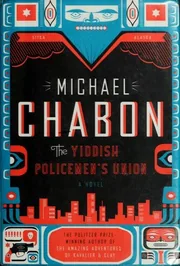
The Yiddish Policemen's Union
by Michael Chabon · 2006
Best suited to adult readers and mature teens comfortable with dense language and a murder-driven plot.
427 pages, about 7 to 10 hours.
A Yiddish noir in Alaska that earns its strangeness. 65% taste match
The story
The Yiddish Policemen's Union is a detective novel by Michael Chabon, first published in 2006. It belongs to the hard-boiled tradition and also works as alternative history, blending literary fiction with the conventions of the mystery genre. The book runs to roughly 427 pages and has appeared in 36 editions, including an unabridged audio version.
The story takes place in an alternate present, built on the idea that a temporary settlement for Jewish refugees was founded in Sitka, Alaska, in 1941, and that the young State of Israel was destroyed in 1948. In this world, Sitka has grown into a large city where Yiddish is the everyday language. Meyer Landsman, a detective, lives at the Hotel Zamenhof, and the cast around him includes Berko Shemets, Naomi, Mendel Shpilman, Willie Dick, and Hertz Shemets. The Tlingit people of Alaska also figure in the setting, which touches on places such as Jerusalem, Berlin, and the Soviet Union. The novel won the Hugo, Nebula, Locus, and Sidewise awards and was shortlisted for the Edgar Allan Poe Award for Best Novel.
Characters
Meyer LandsmanTlingitBerko ShemetsMendel ShpilmanNaomiWillie Dick
Setting
AlaskaSitkaHotel ZamenhofIsraelPalestine
Period
1948
Themes
alternative historyHistorical - GeneralLiteraryAudiobookshomocideArab-Israeli WarHolocaustdetective story
- Want to read 90
- Reading now 5
- Read 39
Most people shelving it are saving it for later.
Of 134 readers who put it on a shelf, 67% want to read it, 4% are reading it now, 29% have finished it and 0% stopped before the end.
By the numbers
- The median edition runs 427 pages. Counting about 275 words a page and an adult reading pace of 250 words a minute, that is about 7.8 hours of reading.
- Open Library tracks 36 editions from 22 publishers, the earliest dated 2006 and the latest 2021, across 7 languages.
- On reader demand it ranks in the top 7% of the modern books in our catalog (15,152 of them).
- Libraries shelve it under Dewey 813.6 and Library of Congress class PS-3553.00000000.H15Y54 2007.
 BookWard’s take
A Yiddish noir in Alaska that earns its strangeness
Chabon builds a detective story on a bold premise: a Jewish refugee settlement in Sitka, Alaska, and a short-lived Israel. Meyer Landsman works out of the Hotel Zamenhof, and the book commits fully to the hard-boiled mode while giving it a world nobody else has written. The originality here is close to the top of what the genre offers, and the voice is just as strong, a style that is unmistakably his. The internal logic holds, because the alternate history is worked out rather than gestured at. The prose is richer than a lean mystery usually wants, and the reading takes real effort in places, with Yiddish flavor throughout. At 427 pages it is longer than I'd normally like, but the setting is the reward.
At 427 pages it runs longer than BookWard's taste for tight books, though the dense world justifies much of it.
The investigation keeps moving, though the world-building and digressions slow it below BookWard's preferred speed.
A Yiddish-speaking Sitka and a vanished Israel make this one of the most original premises in genre fiction.
The prose is ornate and playful, richer than BookWard's usual taste, though it serves the noir voice.
The case drives events, but Landsman's personal damage matters almost as much, so it balances both.
The tone is melancholy and fatalistic, with a displaced people facing the loss of their temporary home.
It follows a conventional detective structure, with the alternate-history setting supplying the novelty.
Dry, wisecracking humor runs through the narration, though the book stays largely serious about its subject.
A murder and a doomed community give it a dark tone, though it stays on the right side of grim.
The feeling runs deep under the noir surface, giving it more weight than a cold puzzle.
See all 50 dialsEvery position, side by side with this book
Where it lines up
- Character depthBookWard 8 · book 8
- Internal logicBookWard 10 · book 9
- OriginalityBookWard 9 · book 10
Where it pulls apart
- LengthBookWard 1 · book 6
- OpeningBookWard 10 · book 8
- Familiar tropesBookWard 10 · book 8
At 427 pages it runs longer than BookWard's taste for tight books, though the dense world justifies much of it.
It opens as a detective story should, with a dead man in a seedy hotel, and the case draws you in quickly.
It wears hard-boiled conventions openly, but the Yiddish Alaska setting keeps them from feeling stale.
The alternate history is carefully worked out, so the world and the mystery both hold together, which suits BookWard well.
The investigation keeps moving, though the world-building and digressions slow it below BookWard's preferred speed.
A Yiddish-speaking Sitka and a vanished Israel make this one of the most original premises in genre fiction.
Landsman is drawn as a weary, damaged detective with a past, which gives the genre frame real weight.
The central case is resolved, though the book leaves some human questions unsettled, close to BookWard's taste.
Feeling is present but filtered through noir toughness, so it avoids easy sentiment, mostly in line with BookWard.
The darkness grows out of the setting and the case instead of being added for effect, which BookWard values.
This is a novel, so rigor as a nonfiction measure does not apply.
Chabon's voice is unmistakable, full of inventive similes and Yiddish-inflected wit, well above BookWard's bar.
The mystery drives the book, but the alternate-history idea is just as central, so it sits slightly more story-led.
The world is mostly delivered through scene and idiom, though some history is explained outright, a little above BookWard's taste.
The middle stays engaged through the investigation, though the book's many digressions can loosen the grip.
The prose is ornate and playful, richer than BookWard's usual taste, though it serves the noir voice.
The case drives events, but Landsman's personal damage matters almost as much, so it balances both.
The tone is melancholy and fatalistic, with a displaced people facing the loss of their temporary home.
It follows a conventional detective structure, with the alternate-history setting supplying the novelty.
Dry, wisecracking humor runs through the narration, though the book stays largely serious about its subject.
Yiddish vocabulary, dense metaphor and a layered setting ask for attention beyond a typical genre novel.
The story stays close to Landsman, which keeps the investigation focused on one perspective.
The investigation moves forward in order, with backstory kept in the background.
There is no magic; the strangeness comes from altered history, so the world feels grounded.
A good-sized supporting cast surrounds Landsman, including Berko Shemets, Naomi and Willie Dick, without sprawling.
The story is a murder case, but its backdrop of a displaced people gives it wider stakes.
Landsman's inner state and the outer investigation get roughly equal attention.
Sharp, idiomatic talk between detectives and suspects carries much of the book, which BookWard enjoys.
Landsman's history with Naomi matters, but romance stays secondary to the case.
A Yiddish-speaking Sitka is about as unfamiliar a setting as fiction offers, and it is built convincingly.
It is set in an alternate present day, though shaped by an altered twentieth century.
The craft and the imagined world suggest staying power well beyond its moment.
The narration is straightforward and trustworthy, with no games played on the reader.
The book recognizes real moral gray, with people compromised by circumstance, more than BookWard's usual clear lines.
Sitka and its streets are rendered in rich, textured detail that makes the setting vivid.
This is fiction, so a nonfiction style measure does not apply.
This is fiction, so a nonfiction perspective measure does not apply.
It reads as a self-contained novel, with its mystery resolved within one book.
Like any good mystery, it rewards the reader with turns in the case as the layers come off.
It asks readers to hold a lot of invented history and language, so it is more challenging than comforting.
A murder and a doomed community give it a dark tone, though it stays on the right side of grim.
The feeling runs deep under the noir surface, giving it more weight than a cold puzzle.
The humor is wry and understated, closer to dry than broad.
A murder drives the plot, but violence is not lingered on, so it sits in the middle.
Sexual content is limited and incidental to the story.
Questions of displacement, homeland and power run through the plot, making politics a real presence.
Yiddish words and dense idiom raise the difficulty beyond plain prose.
The narration has strong attitude and wit, with a clear point of view, more opinionated than neutral.
The book looks back at a lost history, though it is framed as the present of its world.
It leans cynical, with a worn-down detective and a community facing its end.
Review written by BookWard, dial version 1, November 2026.
Who is The Yiddish Policemen's Union right for?
Best suited to adult readers and mature teens comfortable with dense language and a murder-driven plot. It contains violence, adult themes and strong language.
Yiddish vocabulary, dense metaphor and a layered setting ask for attention beyond a typical genre novel.
A murder and a doomed community give it a dark tone, though it stays on the right side of grim.
The feeling runs deep under the noir surface, giving it more weight than a cold puzzle.
A murder drives the plot, but violence is not lingered on, so it sits in the middle.
Book CompanionThe Yiddish Policemen's Union: ideas, characters, themes
A noir detective story set in an alternate present where Jewish refugees settled Sitka, Alaska, and Israel did not survive, using the mystery to explore displacement and home.
- The premise. A temporary refugee settlement founded in Sitka in 1941 grows into a large, Yiddish-speaking city, while the young State of Israel is destroyed in 1948.
- The detective. Meyer Landsman lives at the Hotel Zamenhof and works the case through the conventions of hard-boiled fiction.
- Genre blending. The book mixes literary fiction, mystery and alternative history instead of settling into one category.
- The setting as character. Sitka, with its Yiddish street life and the Tlingit people nearby, shapes the story as much as the plot does.
- Recognition. It won the Hugo, Nebula, Locus and Sidewise awards and was shortlisted for the Edgar Allan Poe Award for Best Novel.
Characters
Meyer Landsman
Detective
A Sitka detective who lives at the Hotel Zamenhof and sits at the center of the investigation.
Berko Shemets
Colleague
A figure close to Landsman in the story's circle of characters.
Naomi
Part of Landsman's world
A significant presence in the cast around Landsman.
Mendel Shpilman
Figure in the case
A name that surrounds the mystery at the heart of the novel.
Willie Dick
Supporting character
Part of the wider cast that fills out Sitka.
Themes
What it is to live in a place meant to be temporary.
The pull and loss of a place a people can no longer return to.
How Yiddish and culture hold a community together.
How a changed past reshapes the present and its politics.
The weary, compromised detective confronting a corrupt world.
Discussion questions
- How does the Sitka setting change what a detective story can say?
- What does the book suggest about a home that was never meant to last?
- How does Landsman fit or break the hard-boiled detective mold?
- Does the alternate history feel plausible, and why does that matter?
- How do humor and sadness coexist in the narration?
Personalize your Book Companion
This is the general edition. In BookWard, the Companion is written for you: your reading profile, your notes, and spoiler-safe to the page you are on.
Buy, listen or borrow The Yiddish Policemen's Union
Each link opens a search for this book on that store, in a new tab.
Read on a device
Borrow
Reviews and community
If you liked The Yiddish Policemen's Union
Snails, romance tours and a road trip into invasion
The Plot Against AmericaPhilip RothRoth's alternate 1940s Newark, seen through a frightened child's eyes
Stag DanceTorrey PetersA lumberjack novel and three stories on gender and desire
The Ministry of TimeKaliane BradleyA time-travel romance that argues with Britain's past and present
Sources: Open Library.
Track The Yiddish Policemen's Union and find your next favorite
Add it to your shelf, rate what you have read, and BookWard will recommend what fits you.
Free to start. No credit card needed.