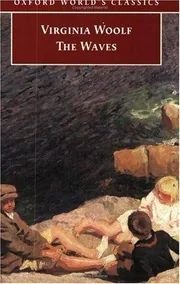
The Waves
by Virginia Woolf · 1931
Best suited to mature readers comfortable with dense, poetic prose and a patient pace.
256 pages, about 4 to 6 hours.
Six voices, one tide: Woolf's most daring, least conventional novel. 46% taste match
The story
The Waves is a novel by English writer Virginia Woolf, first published in 1931. It belongs to British literary fiction and is a work of psychological fiction centered on friendship and the nature of identity. The book follows a group of friends from their early years through to middle age, with attention given to what goes on inside each of them more than to the events of their outward lives.
The story is told through the soliloquies of six characters: Bernard, Susan, Rhoda, Neville, Jinny and Louis. A seventh figure, Percival, is spoken about by the others but never speaks in his own voice. Social occasions, personal achievements and disappointments mark the passing years, while the narration moves between the six minds. The novel opens at dawn, with the line "The sun had not yet risen." Many editions of the book have been issued over the years, running to around 256 pages.
THE sun had not yet risen.
Themes
Identity (Psychology)FriendshipFacsimilesManuscriptsEnglish ManuscriptsLiteratureHuman beings in literatureEmotional maturity
- Want to read 332
- Reading now 17
- Read 21
Most people shelving it are saving it for later.
Of 370 readers who put it on a shelf, 90% want to read it, 5% are reading it now, 6% have finished it and 0% stopped before the end.
By the numbers
- The median edition runs 256 pages. Counting about 275 words a page and an adult reading pace of 250 words a minute, that is about 4.7 hours of reading.
- Open Library tracks 256 editions from 82 publishers, the earliest dated 1931 and the latest 2023, across 11 languages.
- On reader demand it ranks in the top 5% of the classic books in our catalog (8,749 of them).
- Libraries shelve it under Dewey 823.912 and Library of Congress class PR-6045.00000000.O72 Wav2.
 BookWard’s take
Six voices, one tide: Woolf's most daring, least conventional novel
The Waves follows six friends from childhood to middle age, but almost entirely from the inside. It is the opposite of the books that usually win this reviewer over with a gripping opening, brisk momentum and clean exposition: it begins at dawn with a slow, lyrical build, and its soliloquies state feeling outright instead of dramatising events. Where it earns its place is in originality and in a voice that is unmistakable. Nothing else reads quite like it, and it sidesteps familiar tropes by refusing a conventional plot at all. The characters have real depth, though the six voices are built from imagery and rhythm more than incident. It asks a lot of the reader, and the plot is thin by design. If you prize pace and story-driven tension, this is a book to admire at a distance. If you want to see what a novel can do when it drops scene entirely, it is essential.
At 256 pages it is compact, which suits BookWard, though the dense lyric texture makes it feel longer.
Time moves like a tide through decades of thought, deliberately unhurried, well below BookWard's preference for speed.
Few novels have attempted six sustained interior monologues like this, and BookWard gives that boldness full credit.
Rich, rhythmic and poetic language is the whole engine of the book, far more ornate than BookWard's middle ground.
Outward events are only scaffolding; character is the entire subject, an emphasis BookWard leans toward but here exceeds.
Friendship and endurance offset loss and fading, a balance that sits close to BookWard's mild lean toward hope.
Six voices in alternating soliloquy with no conventional scenes is highly experimental, beyond BookWard's moderate comfort.
This is a serious, contemplative book with almost no comedy, which sits apart from BookWard's lightness.
Loss and the passing of time give it a shadow, but it is contemplative rather than grim.
Feeling runs deep beneath the poetry, intense without being loud.
See all 50 dialsEvery position, side by side with this book
Where it lines up
- Familiar tropesBookWard 10 · book 10
- Character depthBookWard 8 · book 8
- Shock for effectBookWard 9 · book 9
Where it pulls apart
- OpeningBookWard 10 · book 3
- Internal logicBookWard 10 · book 6
- PaceBookWard 8 · book 2
At 256 pages it is compact, which suits BookWard, though the dense lyric texture makes it feel longer.
It opens at dawn with a quiet, atmospheric line instead of a jolt, a slow entry against BookWard's taste for immediate hooks.
Six interlocking soliloquies instead of scenes and plot avoid nearly every familiar fictional device, which BookWard rewards.
Its internal order is poetic rather than causal, coherent in design but not airtight in the way BookWard prefers.
Time moves like a tide through decades of thought, deliberately unhurried, well below BookWard's preference for speed.
Few novels have attempted six sustained interior monologues like this, and BookWard gives that boldness full credit.
Bernard, Susan, Rhoda, Neville, Jinny and Louis are drawn deeply from within, matching BookWard's love of rich inner lives.
It closes on a sense of completion for its voices, resolved in feeling rather than in tied-off events.
Emotion is conveyed through poetic imagery, lyrical rather than sugary, a middle path BookWard accepts.
There is no shock for effect here; whatever darkness appears is earned through reflection and loss.
Woolf's lyric technique is unmistakable and unlike anyone else's, exactly what BookWard prizes.
The book is led by inner life and the nature of identity rather than plot, far more idea-led than BookWard's usual taste.
The characters articulate their thoughts directly in soliloquy, the reverse of BookWard's preference for showing in scene.
Its rhythm is consistent but the unchanging soliloquy form can blur in the middle, mostly sustained by the prose.
Rich, rhythmic and poetic language is the whole engine of the book, far more ornate than BookWard's middle ground.
Outward events are only scaffolding; character is the entire subject, an emphasis BookWard leans toward but here exceeds.
Friendship and endurance offset loss and fading, a balance that sits close to BookWard's mild lean toward hope.
Six voices in alternating soliloquy with no conventional scenes is highly experimental, beyond BookWard's moderate comfort.
This is a serious, contemplative book with almost no comedy, which sits apart from BookWard's lightness.
Dense soliloquies and a lack of plot make it demanding reading, more effortful than BookWard usually likes.
Six distinct minds carry the narration, with a seventh figure seen only through others, fitting BookWard's taste for many viewpoints.
It runs chronologically from childhood to middle age, with the voices moving fluidly through time.
The world is recognisably real; its strangeness is in perception and form, not events.
Six central voices and one absent seventh make a small, tightly focused group.
The scope is lifelong but the focus stays intimate, held inside six minds.
Almost everything happens inside the characters' thoughts, as far toward inner as a novel can go.
There is no conversational dialogue; speech takes the form of stylised soliloquy.
Romantic feeling appears among the friends but is not the book's centre.
Ordinary English lives and settings, familiar ground that BookWard finds a little less novel.
Published in 1931, it is firmly a book of its period, and feels distant from the present day.
Its questions about selfhood and friendship have kept it alive for generations, a quality BookWard values.
The soliloquies are sincere self-reports; they can be partial but are not deceptive.
It poses questions about identity and meaning without handing out judgments, leaning ambiguous.
Imagery of waves, light and natural cycles saturates the text, rich description throughout.
A standalone novel with no sequels.
There is little plot to twist; the drift of inner lives replaces surprise.
It asks for patience and attention, challenging in form more than in subject.
Loss and the passing of time give it a shadow, but it is contemplative rather than grim.
Feeling runs deep beneath the poetry, intense without being loud.
Humor barely registers, and what exists is dry and passing.
There is next to no violence on the page.
Sexual content is minimal and not a focus.
The book stays with private inner life, not public affairs.
The language is dense and poetic, which makes it harder going than plain prose.
The voices reflect and interpret their own lives, but no authorial stance is pressed on the reader.
Its gaze tends backward, tracing lives as they grow and age.
It finds meaning in friendship and perception while admitting the pull of loss, a balanced outlook.
Review written by BookWard, dial version 1, November 2026.
Who is The Waves right for?
Best suited to mature readers comfortable with dense, poetic prose and a patient pace. Nothing in it is graphic, but its reflections on loss and the passage of time can weigh heavily.
Dense soliloquies and a lack of plot make it demanding reading, more effortful than BookWard usually likes.
Loss and the passing of time give it a shadow, but it is contemplative rather than grim.
Feeling runs deep beneath the poetry, intense without being loud.
There is next to no violence on the page.
Book CompanionThe Waves: ideas, characters, themes
A group of friends is traced from childhood to middle age through their inner lives, asking how identity forms and holds against time.
- Six soliloquies. The story is carried by the spoken thoughts of Bernard, Susan, Rhoda, Neville, Jinny and Louis rather than by narrated events.
- An absent seventh voice. Percival appears in the others' soliloquies but never speaks in his own voice.
- Inner life over outer events. Social occasions, achievements and disappointments form the outer frame, while the focus stays on what the characters feel and think.
- Lyric technique. Wikipedia describes it as the culmination of Woolf's experimental lyric technique, with soliloquies that are ambiguous and cryptic.
- A dawn opening. The novel begins with the line 'The sun had not yet risen,' setting its tone of cycles and light.
Characters
Bernard
One of the six voices
A soliloquist whose thoughts form part of the book's chorus of inner lives.
Susan
One of the six voices
Another of the six friends, tracked through her own interior monologue.
Rhoda
One of the six voices
A member of the circle whose perceptions are given in her own words.
Neville
One of the six voices
One of the friends, revealed through his soliloquies.
Percival
The unheard seventh figure
Discussed by the others but never heard speaking in his own voice.
Themes
How a self forms, shifts and persists across a life.
The bonds that hold a group together through decades.
The passage from childhood to middle age, echoed in natural cycles.
The gap between what happens to people and what they feel.
How people grow, disappoint themselves and adapt over the years.
Discussion questions
- Why might Woolf withhold Percival's own voice while letting the other six speak?
- Do the six voices feel distinct, or do they blend into one?
- What does a book gain, and lose, by dropping conventional scenes and plot?
- How does the dawn opening shape your reading of what follows?
- Is the idea of a stable identity convincing in this novel?
Personalize your Book Companion
This is the general edition. In BookWard, the Companion is written for you: your reading profile, your notes, and spoiler-safe to the page you are on.
Buy, listen or borrow The Waves
Each link opens a search for this book on that store, in a new tab.
Read on a device
Borrow
Reviews and community
If you liked The Waves
One June day in London, told entirely from the inside
À reboursJoris-Karl HuysmansA single aesthete retreats from the world and catalogues his tastes
Livro do DesassossegoFernando PessoaA bookkeeper's notebook of Lisbon, melancholy, and restless thought
Der SteppenwolfHermann HesseA suicidal outsider's inner life, told with startling directness
Sources: Open Library.
Track The Waves and find your next favorite
Add it to your shelf, rate what you have read, and BookWard will recommend what fits you.
Free to start. No credit card needed.