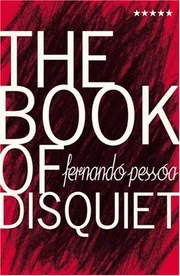
Livro do Desassossego
by Fernando Pessoa · 1982
Best for mature readers comfortable with abstract, reflective prose.
472 pages, about 7.5 to 11 hours.
A bookkeeper's notebook of Lisbon, melancholy, and restless thought. 39% taste match
What it covers
Livro do Desassossego is a fragmentary prose work by the Portuguese writer Fernando Pessoa, who lived from 1888 to 1935. It first appeared in 1982, long after his death, and it was never edited into a finished form by its author. Pessoa himself described it as a "factless autobiography," and it takes the shape of a notebook or diary made up of reflections, aphorisms and observations rather than a continuous story.
Most of the texts are written in the voice of Bernardo Soares, an assistant bookkeeper whom Pessoa called a semi-heteronym, one of several alternate names under which he wrote. The setting is Lisbon, and the work belongs to the twentieth century. The first lines place the reader in the upper floors of Lisbon taverns, where modest eating places can be found. An English edition by Margaret Jull Costa arranges the texts chronologically and draws on the whole span of Pessoa's writing life. The book has appeared in 85 editions, and a typical edition runs to 472 pages.
Installed on the upper floors of certain respectable taverns in Lisbon can be found a small number of restaurants or eating places, which have the stolid, homely look of those restaurants you see in towns that lack even a train station.
Characters
Fernando Pessoa
Setting
Lisbon (Portugal)
Period
20th century20e siècle
Themes
Portuguese PoetsPoetas portuguesesBiografíaBiographyPoetryPoetry (poetic works by one author)Pessoa, fernando, 1888-1935Poets, biography
- Want to read 328
- Reading now 27
- Read 17
Most people shelving it are saving it for later.
Of 372 readers who put it on a shelf, 88% want to read it, 7% are reading it now, 5% have finished it and 0% stopped before the end.
By the numbers
- The median edition runs 472 pages. Counting about 275 words a page and an adult reading pace of 250 words a minute, that is about 8.7 hours of reading.
- Open Library tracks 85 editions from 64 publishers, the earliest dated 1982 and the latest 2024, across 7 languages.
- On reader demand it ranks in the top 9% of the modern books in our catalog (15,152 of them).
- Libraries shelve it under Dewey 869.84107 and Library of Congress class PQ-9261.00000000.P417 Z4655 2008.
 BookWard’s take
A bookkeeper's notebook of Lisbon, melancholy, and restless thought
This is a book to dip into, not to race through. Pessoa never assembled it, and it comes as a notebook of reflections and aphorisms in the voice of Bernardo Soares, an assistant bookkeeper in Lisbon. The voice is unmistakable and carries everything. It asks for patience, since there is no plot to pull you along and the opening works by atmosphere rather than event. The character is drawn with real depth, though he is a consciousness more than a person moving through scenes. As for an ending, the question barely arises, because the work stays open by design. I tend to want hooks and tight shape, so this is a tough fit for me, but the originality is real.
At 472 pages in a typical edition it is substantial, though its fragments let it feel lighter than the count suggests.
There is no forward momentum; it moves at the speed of reflection, far slower than BookWard prefers.
A 'factless autobiography' in fragments under a semi-heteronym is a genuinely singular form, which BookWard rewards.
The sentences are crafted and often ornate, a touch richer than BookWard's usual middle ground.
There is essentially no plot; it is all character and consciousness, past even BookWard's lean.
Its outlook is melancholy and weary, darker than BookWard's mild lean toward hope.
A notebook of fragments with no fixed order is about as experimental as structure gets.
The tone is serious and contemplative, with little comedy, below BookWard's slight lean toward humor.
The mood is melancholy and weighed down rather than graphic or gruesome.
Feeling runs deep but is held in measured, reflective language.
See all 50 dialsEvery position, side by side with this book
Where it lines up
- Familiar tropesBookWard 10 · book 10
- SentimentBookWard 8 · book 8
- OriginalityBookWard 9 · book 10
Where it pulls apart
- OpeningBookWard 10 · book 4
- LengthBookWard 1 · book 6
- PaceBookWard 8 · book 1
At 472 pages in a typical edition it is substantial, though its fragments let it feel lighter than the count suggests.
Nothing here pulls you forward with a hook; the opening works by mood, which runs against BookWard's taste for immediate grip.
A fragmentary notebook by a bookkeeper-narrator avoids familiar tropes almost entirely, which BookWard values highly.
The fragments hold together by a consistent sensibility rather than argument, so the internal logic is loose by design.
There is no forward momentum; it moves at the speed of reflection, far slower than BookWard prefers.
A 'factless autobiography' in fragments under a semi-heteronym is a genuinely singular form, which BookWard rewards.
Soares is drawn deeply from the inside through his thoughts, which suits BookWard's appetite for rich characters.
Pessoa never edited it into a finished whole, so it ends open and unresolved, unlike BookWard's preference for resolution.
The melancholy is felt but expressed through exacting observation, not sweetness.
It earns its sadness through thought rather than any shock for effect.
This is a literary notebook, not an evidence-driven work, so the rigor dial does not apply.
Soares speaks in one of the most distinctive voices in modern literature, a clear match for BookWard's taste.
Reflections and aphorisms carry the book, so it is idea-led where BookWard leans toward story.
Thoughts are stated outright rather than dramatized, a mismatch with BookWard's preference for showing in scene.
With no arc to sag, the pull of the voice varies fragment to fragment, though the quality stays high.
The sentences are crafted and often ornate, a touch richer than BookWard's usual middle ground.
There is essentially no plot; it is all character and consciousness, past even BookWard's lean.
Its outlook is melancholy and weary, darker than BookWard's mild lean toward hope.
A notebook of fragments with no fixed order is about as experimental as structure gets.
The tone is serious and contemplative, with little comedy, below BookWard's slight lean toward humor.
Dense, abstract reflection takes real attention, more demanding than BookWard's typical read.
Nearly everything comes through the single voice of Bernardo Soares, unlike BookWard's taste for several viewpoints.
Texts spanning Pessoa's whole writing life, arranged chronologically, do not form a single linear story.
It stays grounded in the real Lisbon of a bookkeeper's daily life, with only inner flights.
The book centers on one narrating mind, so the cast is tiny.
Its world is one man's room, office and street, as intimate as scale gets.
Almost everything is inner thought, with little outward action at all.
This is monologue and reflection, with virtually no dialogue.
Romance is not a driving concern of the book.
Lisbon taverns and offices of the early twentieth century are somewhat unfamiliar to most readers today.
Written in the early twentieth century and published in 1982, it reads as past, not present day.
Its questions about self, solitude and meaning feel as live today as when they were written.
Soares is an assistant bookkeeper who is a semi-heteronym, a persona rather than a straight self, so reliability is blurred.
It explores questions without handing down clear verdicts, leaving much ambiguous.
Lisbon's streets and rooms appear in vivid fragments, though the focus is on thought.
Though classed as memoir, it is reflective and aphoristic more than a told life story.
It is intimate and confessional, a first-person inner life laid bare.
It stands alone as a single, unfinished lifetime project.
There are no plot surprises, only shifts of thought.
It confronts loneliness and futility without offering comfort.
The mood is melancholy and weighed down rather than graphic or gruesome.
Feeling runs deep but is held in measured, reflective language.
Where humor appears it is dry and rueful.
There is no violence on the page.
Sexual content is essentially absent.
Politics sits at the edge; the book is about inner life, not public affairs.
The language is literary and abstract, which can feel dense in places.
Everything is filtered through one strongly opinionated sensibility.
It looks inward and backward, turned to memory and dream more than to the future.
Disillusion and weariness dominate over idealism.
Review written by BookWard, dial version 1, November 2026.
Who is Livro do Desassossego right for?
Best for mature readers comfortable with abstract, reflective prose. It deals with loneliness and futility but has no graphic content.
Dense, abstract reflection takes real attention, more demanding than BookWard's typical read.
The mood is melancholy and weighed down rather than graphic or gruesome.
Feeling runs deep but is held in measured, reflective language.
There is no violence on the page.
Book CompanionLivro do Desassossego: ideas, characters, themes
A bookkeeper in Lisbon keeps a notebook of reflections, a 'factless autobiography' of his inner life.
- A work never finished. Pessoa left it unedited, so editions differ in how the fragments are ordered.
- The semi-heteronym. Most texts are credited to Bernardo Soares, a semi-heteronym of Pessoa.
- Posthumous publication. It first appeared in 1982, decades after Pessoa died in 1935.
- Lisbon as setting. The city's taverns, streets and offices anchor the reflections.
- The Jull Costa edition. This English edition presents the texts chronologically across Pessoa's writing life.
Characters
Bernardo Soares
Narrator
An assistant bookkeeper in Lisbon whose voice carries most of the texts.
Fernando Pessoa
Author
The Portuguese modernist who wrote the book and credited it to Soares.
Themes
The ache and clarity of living largely inside one's own mind.
How a self can be split across personas, as with Pessoa's alternate names.
A restless unease with life that never fully settles.
Finding meaning, or its absence, in routine office work and city streets.
Discussion questions
- Why might Pessoa have left the book unfinished and unordered?
- Does Bernardo Soares feel like a separate person or like Pessoa himself?
- How does the Lisbon setting shape the mood of the reflections?
- Is the book's melancholy a weakness or a source of its power?
- Would you read it straight through or in small pieces, and why?
Personalize your Book Companion
This is the general edition. In BookWard, the Companion is written for you: your reading profile, your notes, and spoiler-safe to the page you are on.
Buy, listen or borrow Livro do Desassossego
Each link opens a search for this book on that store, in a new tab.
Read on a device
Borrow
Reviews and community
If you liked Livro do Desassossego
A diary of disgust that turns philosophy into a story
À reboursJoris-Karl HuysmansA single aesthete retreats from the world and catalogues his tastes
The WavesVirginia WoolfSix voices, one tide: Woolf's most daring, least conventional novel
A Hora da EstrelaClarice LispectorA ninety-six-page novel that turns on its own narrator
Sources: Open Library.
Track Livro do Desassossego and find your next favorite
Add it to your shelf, rate what you have read, and BookWard will recommend what fits you.
Free to start. No credit card needed.