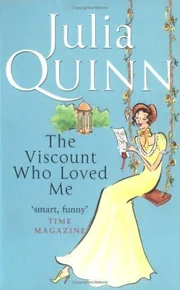
The Viscount Who Loved Me
by Julia Quinn · 2000
This suits adult and older teen readers who enjoy historical romance.
392 pages, about 6 to 9 hours.
A witty Regency courtship that trades on tropes and charm. 52% taste match
The story
The Viscount Who Loved Me is a historical romance by Julia Quinn, first published in 2000 by Avon. It is the second novel in the Bridgerton series, set in Regency-era England, and centers on Anthony, Viscount Bridgerton, the eldest of the Bridgerton siblings. The story unfolds in London in 1814, among the ballrooms and social circles of the season, and is interspersed with items from the gossip column Lady Whistledown's Society Papers.
Anthony is London's most elusive bachelor and a celebrated rake, yet he has decided to marry and has settled on a bride. Standing in his way is her older sister, Kate Sheffield, who is determined to stop the match and doubts that a reformed rake makes a good husband. As the two clash, the novel explores courtship, marriage, sisterhood, and the manners and customs of the period. The book runs to roughly 392 pages and has appeared in 27 editions.
The topic of rakes has, of course, been previously discussed in this column, and This Author has come to the conclusion that there are rakes, and there are Rakes.
Characters
Kate SheffieldAnthony Bridgerton
Setting
London England
Themes
Londres (Inglaterra)NovelaHermanasNew York Times bestseller
- Want to read 867
- Reading now 57
- Read 120
Most people shelving it are saving it for later.
Of 1044 readers who put it on a shelf, 83% want to read it, 5% are reading it now, 11% have finished it and 0% stopped before the end.
By the numbers
- The median edition runs 392 pages. Counting about 275 words a page and an adult reading pace of 250 words a minute, that is about 7.2 hours of reading.
- Open Library tracks 27 editions from 14 publishers, the earliest dated 2000 and the latest 2022, across 3 languages.
- On reader demand it ranks in the top 1% of the modern books in our catalog (15,152 of them).
- Libraries shelve it under Dewey 813.6 and Library of Congress class PS-3617.00000000.U57 V5818 2003.
Read it
A digital copy can be borrowed for free.
1 ebook provider carry it and a scanned copy is on the Internet Archive.
 BookWard’s take
A witty Regency courtship that trades on tropes and charm
Julia Quinn's second Bridgerton novel is assembled from familiar romance parts: a notorious rake, a meddling older sister, a season of ballrooms. It leans hard on convention, and a reader who prizes the unexpected will notice. Where it pulls ahead is in voice and tone. The Lady Whistledown gossip items between scenes give the book a playful, distinctive texture, and the clash between Anthony and Kate runs almost entirely on banter, so the dialogue carries a great deal of the weight. The pace is quick, and the opening gets going at once. The ending is the fully resolved kind the genre promises, and the mood stays warm and hopeful rather than bleak. It is a comfort read with real wit, not a challenge, and it asks little of you beyond enjoying the sparring.
At 392 pages it is a standard-length novel, longer than BookWard's tight preference but not sprawling.
Scenes of sparring and scheming keep the courtship moving briskly, close to what BookWard enjoys.
It delivers the familiar Regency romance formula well rather than reinventing it, which BookWard values less than freshness.
The writing is clean and conversational rather than ornate, near BookWard's plain-leaning taste.
The courtship turns on Anthony's and Kate's personalities and clashes more than on external events, like BookWard's preference.
A romance promises a happy outcome, so the outlook is warm and hopeful, a bit above BookWard's setting.
It follows a conventional courtship arc, with the gossip columns as a light structural flourish.
Banter and the arch gossip excerpts make it playful, sitting more comic than BookWard's moderately funny taste.
The tone is light and gentle, with little heavy material.
Romantic longing and tension give it real feeling, in the neighborhood of BookWard's moderate intensity.
See all 50 dialsEvery position, side by side with this book
Where it lines up
- PaceBookWard 8 · book 7
- EndingBookWard 8 · book 9
- Shock for effectBookWard 9 · book 8
Where it pulls apart
- Familiar tropesBookWard 10 · book 2
- Internal logicBookWard 10 · book 6
- OriginalityBookWard 9 · book 3
At 392 pages it is a standard-length novel, longer than BookWard's tight preference but not sprawling.
The premise of a rake choosing a bride and an interfering sister sets the conflict going straight away, which BookWard likes.
Rakes, ballrooms and reformed-rake courtships are core Regency conventions, so it sits well toward the trope-heavy end, against BookWard's taste.
The courtship plot follows the genre's rules consistently, though it asks you to accept convenient social mechanics.
Scenes of sparring and scheming keep the courtship moving briskly, close to what BookWard enjoys.
It delivers the familiar Regency romance formula well rather than reinventing it, which BookWard values less than freshness.
Anthony and Kate are drawn with clear motives and flaws, though genre archetypes shape them.
A romance resolves its central match, so the ending lands firmly on the satisfying side, matching BookWard.
Warmth and emotional payoff are part of the appeal, so it is moderately sentimental, a little softer than BookWard prefers.
Nothing here relies on shock; the stakes are social and romantic, which suits BookWard.
The Lady Whistledown gossip excerpts and the playful narration give it a recognizable, distinctive voice, which BookWard rewards.
This is firmly story-led, driven by courtship rather than argument, which matches BookWard's preference.
Period manners are mostly shown through ballroom scenes, though the gossip column does some outright explaining.
A courtship plot with a single central conflict keeps momentum fairly steady across its length.
The writing is clean and conversational rather than ornate, near BookWard's plain-leaning taste.
The courtship turns on Anthony's and Kate's personalities and clashes more than on external events, like BookWard's preference.
A romance promises a happy outcome, so the outlook is warm and hopeful, a bit above BookWard's setting.
It follows a conventional courtship arc, with the gossip columns as a light structural flourish.
Banter and the arch gossip excerpts make it playful, sitting more comic than BookWard's moderately funny taste.
It reads easily and asks little effort, a touch lighter than BookWard's usual reading.
The story moves between Anthony and Kate, with the gossip column adding another voice.
The 1814 season unfolds in a straightforward sequence with no timeline games.
Entirely grounded in Regency London society, with nothing fantastical.
A season of society brings in a sizable social circle around the leads, beyond BookWard's smaller-cast preference.
The stakes are a courtship and family, so it is intimate rather than epic.
The focus falls on feelings and motives within the courtship more than outward action.
The romance runs on sparring conversation between the leads, so dialogue is heavy, in line with BookWard.
Romance is the entire engine of the book, far above BookWard's usual setting.
A Regency ballroom is a distinct world, though a familiar one to romance readers, so it falls mid-scale.
It is set in 1814 and reads as historical, far from the present day.
Its enduring bestseller status suggests lasting appeal, though its Regency formula is conventional.
The narration is straightforward and trustworthy, aside from the gossip column's teasing slant.
Right and wrong are clear, with good-hearted leads and no moral puzzle, unlike BookWard's ambiguity-tolerant taste.
Ballrooms and period detail are present but not the focus, a moderate amount of description.
It is the second novel in the Bridgerton series, so it belongs to a larger set rather than standing alone.
Romance beats are largely predictable by design, with few real surprises.
It is a comfort read that sets out to please rather than test the reader.
The tone is light and gentle, with little heavy material.
Romantic longing and tension give it real feeling, in the neighborhood of BookWard's moderate intensity.
The wit is teasing and a bit broad, not bone-dry.
A society romance with little physical conflict on the page.
The blurb points to erotic tension and the genre often includes love scenes, so it sits mid-scale.
Society and marriage customs matter, but politics itself is largely absent.
The language is plain and readable, with period flavor but no dense dialect.
The gossip-column voice and arch narration take sides and add commentary, more opinionated than neutral.
It looks back at a period setting rather than ahead.
It believes in love overcoming obstacles, a more idealistic stance than BookWard's moderate setting.
Review written by BookWard, dial version 1, November 2026.
Who is The Viscount Who Loved Me right for?
This suits adult and older teen readers who enjoy historical romance. It includes romantic and sensual content typical of the genre.
It reads easily and asks little effort, a touch lighter than BookWard's usual reading.
The tone is light and gentle, with little heavy material.
Romantic longing and tension give it real feeling, in the neighborhood of BookWard's moderate intensity.
A society romance with little physical conflict on the page.
Book CompanionThe Viscount Who Loved Me: ideas, characters, themes
A famous rake decides to marry, and the sister of his chosen bride sets out to stop him, only to collide with him.
- The match and the obstacle. Anthony picks a bride, but her older sister Kate stands firmly in the way of the engagement.
- Enemies at close range. Their constant clashes drive the story and also draw them toward each other.
- Lady Whistledown's column. Gossip excerpts open sections of the book and comment on the season's goings-on.
- Second in a series. It is the second Bridgerton novel and centers on the eldest sibling, Anthony.
- Regency London setting. The story unfolds in 1814, in the ballrooms and social whirl of the season.
Characters
Anthony Bridgerton
Viscount and the eldest Bridgerton sibling
London's most elusive bachelor and a celebrated rake who has decided to marry.
Kate Sheffield
The bride's older sister
A spirited, meddling schemer who doubts that reformed rakes make good husbands.
Lady Whistledown
Society gossip columnist
The author of the Society Papers whose items run through the story.
Themes
The rituals and strategies of finding a spouse in a rigid social world.
Protective loyalty between siblings, tested by romance.
How gossip and public image shape private choices.
Whether a former rake can be believed as a husband.
Discussion questions
- Does Kate's distrust of reformed rakes seem fair, and does the book agree with her?
- How does the gossip column change the way you read the ballroom scenes?
- What makes the sparring between Anthony and Kate work as romance?
- How much does the Regency setting shape what the characters can and cannot do?
- Does knowing it is part of a series change how you read this one?
Personalize your Book Companion
This is the general edition. In BookWard, the Companion is written for you: your reading profile, your notes, and spoiler-safe to the page you are on.
Buy, listen or borrow The Viscount Who Loved Me
Each link opens a search for this book on that store, in a new tab.
Read on a device
Borrow
Reviews and community
If you liked The Viscount Who Loved Me
A friends-to-lovers Regency romance with a gossip-column secret at its center
It's in His KissJulia QuinnA sparkling Regency romance where banter does the courting
The BrideJulie GarwoodA warm, fast Highland marriage-of-convenience romance built on familiar bones
When He Was WickedJulia QuinnA Regency romance built on friendship, grief and one long secret
Sources: Open Library.
Track The Viscount Who Loved Me and find your next favorite
Add it to your shelf, rate what you have read, and BookWard will recommend what fits you.
Free to start. No credit card needed.