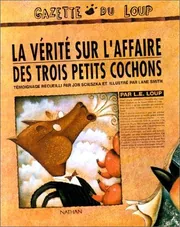
The True Story of the Three Little Pigs
by Jon Scieszka · 1989
It suits young readers who already know the traditional tale, and older children and adults will enjoy the wit.
32 pages, about 0.5 to 0.5 hours.
The wolf gets his say, and he is very convincing. 65% taste match
About the book
This children's picture book by Jon Scieszka, with illustrations by Lane Smith, was first published in 1989 by Viking Kestrel, an imprint of Viking Penguin. It was Scieszka's first published book. The story is a parody of The Three Little Pigs, retold from the point of view of the wolf, who goes by A. Wolf, short for Alexander T. Wolf. In his own words, he sets out to give what he calls the actual story of his encounter with the pigs.
The book runs about 32 pages and has appeared in many editions, with a Scholastic printing among them. It belongs to the tradition of fractured fairy tales, which take a familiar story and change the perspective from which it is told. Listed as juvenile fiction, it features pigs and wolves as its central figures and is written for young readers who already know the traditional tale. The American Library Association named it an ALA Notable Book.
Everybody knows the story of the Three Little Pigs.
Themes
The True Story of the 3 Little Pigs!By A. Wolf (As Told to Jon Scieszka)1991 Scholastic first printingBy A. Wolfhis storyactual storyhe saysFront page news
- Want to read 187
- Reading now 6
- Read 56
Most people shelving it are saving it for later.
Of 249 readers who put it on a shelf, 75% want to read it, 2% are reading it now, 22% have finished it and 0% stopped before the end.
By the numbers
- The median edition runs 32 pages. Counting about 275 words a page and an adult reading pace of 250 words a minute, that is about 35 minutes of reading.
- Open Library tracks 41 editions from 29 publishers, the earliest dated 1989 and the latest 2014, across 8 languages.
- On reader demand it ranks in the top 3% of the modern books in our catalog (15,152 of them).
- Libraries shelve it under Dewey 813.6 and Library of Congress class PZ-0007.00000000.S41267 Tr 1989.
 BookWard’s take
The wolf gets his say, and he is very convincing
Jon Scieszka's 1989 picture book hands the microphone to the wolf, who goes by A. Wolf, short for Alexander T. Wolf, and insists he is giving the actual story of the pigs. It hooks at once, because the first line reframes a tale every child already knows. The fractured fairy tale twist on perspective still feels fresh all these years later. The real engine is the narrator's voice, a wheedling, aggrieved wolf you can practically hear. At 32 pages it is tight, and the pace never drags. It is also a neat lesson in unreliable narration, a quality worth prizing in a book this small. The comedy is dry enough for adults and broad enough for small children, and Lane Smith's illustrations suit it well.
At 32 pages it is as short as books get, which matches BookWard's love of tight storytelling.
A picture-book length and a chatty narrator keep it moving briskly from start to finish.
Retelling a classic from the villain's side was a fresh move, and the premise still stands out.
The language is plain and conversational, built for reading aloud rather than ornament.
A familiar plot drives it, but the wolf's personality is what makes it memorable.
It is lighthearted and playful rather than bleak, leaning mildly upbeat.
The whole book is a monologue that reframes a known story, a gently inventive format.
Comedy is the point, from the wolf's indignation to the absurd excuses.
The material is cartoonishly mild for a story about a wolf and some pigs.
Feelings stay light and comic, with indignation as the strongest note.
See all 50 dialsEvery position, side by side with this book
Where it lines up
- LengthBookWard 1 · book 1
- OpeningBookWard 10 · book 10
- Shock for effectBookWard 9 · book 9
Where it pulls apart
- Internal logicBookWard 10 · book 7
- Character depthBookWard 8 · book 5
- Story or ideasBookWard 3 · book 5
At 32 pages it is as short as books get, which matches BookWard's love of tight storytelling.
The wolf's claim to the actual story grabs you on the first page, exactly the instant hook BookWard wants.
It takes a worn fairy tale and turns it inside out, so it dodges the usual tropes by subverting them.
The wolf's excuses hold together in their own comic way, though the humor matters more than airtight reasoning.
A picture-book length and a chatty narrator keep it moving briskly from start to finish.
Retelling a classic from the villain's side was a fresh move, and the premise still stands out.
The wolf is vividly drawn through his own voice, but the pigs and others stay light sketches.
There is no sweetness or lesson-pushing; the tone stays dry and mischievous, which suits BookWard well.
Nothing here is dark for effect; the humor comes from the premise, not from shocking the reader.
This is a picture-book story, so the nonfiction rigor dial does not apply.
A. Wolf's self-justifying, aggrieved voice is the whole book and unmistakably distinctive.
It is story-led, but the central idea of the other side of the story does a lot of the work.
The narrator tells his case outright, yet it plays out as comic scenes rather than lecture.
With so little length there is no room for a slump; the joke stays sharp throughout.
The language is plain and conversational, built for reading aloud rather than ornament.
A familiar plot drives it, but the wolf's personality is what makes it memorable.
It is lighthearted and playful rather than bleak, leaning mildly upbeat.
The whole book is a monologue that reframes a known story, a gently inventive format.
Comedy is the point, from the wolf's indignation to the absurd excuses.
It is an easy, quick read for young children and adults alike.
It is told from one perspective only, the wolf's, and that single-mindedness is the joke.
The wolf recounts events in a straightforward order with no time shifting.
Talking pigs and wolves make it a fairy-tale world, though everything is played with a straight face.
A handful of familiar animal characters is all the story needs.
It is a small, contained episode between a wolf and his neighbors.
The wolf reports both his actions and his own rationalizing thoughts in about equal measure.
It is mostly one voice telling a story, so there is little back-and-forth conversation.
There is no romance anywhere in it.
The setting is the familiar fairy-tale landscape that readers already know.
It feels timeless rather than tied to the present, though its sensibility is late twentieth century.
A parody that plays off one of the best-known tales stays fresh for new generations.
The wolf is the classic unreliable narrator, and readers are meant to doubt every word.
It invites you to question who is telling the story, leaving the right and wrong a little open.
The prose is spare and the illustrations carry the visual detail.
This is fiction, so the nonfiction style dial does not apply.
This is fiction, so the nonfiction perspective dial does not apply.
It reads fully on its own with no need for other books.
The main twist is the premise itself rather than a string of plot reversals.
It is gentle and comforting, though it nudges readers to question what they are told.
The material is cartoonishly mild for a story about a wolf and some pigs.
Feelings stay light and comic, with indignation as the strongest note.
The jokes are broad enough for children but sly enough that adults enjoy the irony.
Violence is only implied in a comic way and never lingered on.
There is no sexual content.
It carries no politics beyond a light skewering of how stories get told.
The language is plain, with nothing difficult in the vocabulary or style.
The wolf is hugely opinionated, and the narration is all argument and spin.
It looks back at a well-known old tale and rewrites it.
It leans toward playful skepticism about accepted stories rather than naive hope.
Review written by BookWard, dial version 1, November 2026.
Who is The True Story of the Three Little Pigs right for?
It suits young readers who already know the traditional tale, and older children and adults will enjoy the wit. Nothing in it is sensitive beyond mild, cartoonish fairy-tale peril.
It is an easy, quick read for young children and adults alike.
The material is cartoonishly mild for a story about a wolf and some pigs.
Feelings stay light and comic, with indignation as the strongest note.
Violence is only implied in a comic way and never lingered on.
Book CompanionThe True Story of the Three Little Pigs: ideas, characters, themes
A familiar fairy tale is retold by the wolf, who insists the pigs got it all wrong.
- A. Wolf's version. The wolf, Alexander T. Wolf, sets out to give what he calls the actual story of his encounter with the pigs.
- A familiar tale reframed. The book assumes readers already know The Three Little Pigs, and the humor depends on that knowledge.
- A fractured fairy tale. It belongs to a tradition of stories that take a known tale and change who is telling it.
- Scieszka's first book. It was the first published book written by Jon Scieszka, with illustrations by Lane Smith.
- Recognized by libraries. The American Library Association named it an ALA Notable Book.
Characters
A. Wolf
Narrator
Short for Alexander T. Wolf, he tells his own account and insists it is the real one.
The three pigs
The other side of the story
The pigs from the traditional tale, seen here only through the wolf's telling.
Themes
The same events can look entirely different depending on who tells them.
A storyteller with a stake in the outcome may bend the facts in his favor.
Well-known tales deserve a second look rather than automatic belief.
The book gets its humor by playfully twisting something already beloved.
Discussion questions
- Do you believe the wolf's version, and what makes you doubt or trust him?
- How does the story change when the wolf is the one telling it?
- Why does the humor work better if you already know the traditional tale?
- What other well-known stories might look different from the villain's side?
- How can you tell when a narrator is shaping the facts to look good?
Personalize your Book Companion
This is the general edition. In BookWard, the Companion is written for you: your reading profile, your notes, and spoiler-safe to the page you are on.
Buy, listen or borrow The True Story of the Three Little Pigs
Each link opens a search for this book on that store, in a new tab.
Read on a device
Borrow
Reviews and community
If you liked The True Story of the Three Little Pigs
Sedaris at his sharpest: family, odd jobs, and failing at French
Hyperbole and a HalfAllie BroshA funny, honest memoir in cartoons, depression chapters included
Convenience store woman村田沙耶香A short, sharp novel about a woman who fits the store, not society
The Canterville GhostOscar WildeA short, sharp ghost comedy that turns sentimental at the close
Sources: Open Library.
Track The True Story of the Three Little Pigs and find your next favorite
Add it to your shelf, rate what you have read, and BookWard will recommend what fits you.
Free to start. No credit card needed.