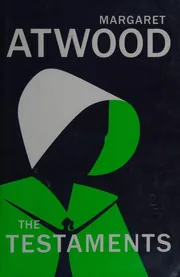
The Testaments
by Margaret Atwood · 2019
It suits mature teens and adults, and has been shelved with young adult fiction.
475 pages, about 7.5 to 11 hours.
Atwood returns to Gilead through three women's testimonies, fifteen years on. 64% taste match
The story
The Testaments is a dystopian novel by Margaret Atwood, first published in 2019 and running to about 475 pages. It continues the story begun in The Handmaid's Tale, set fifteen years after the events of that earlier book, in the totalitarian society of Gilead, which rose after the sons of Jacob took power.
The narrative is told through three female voices. Aunt Lydia, a figure known from the first novel, reflects on her life and the choices she has made. Agnes Jemima is a young woman growing up inside Gilead, and she relates her experiences of daily life there. Daisy lives in Canada and gradually comes to understand her past and her true identity.
Themes of secrecy, misogyny, relationships between men and women, surrogate motherhood and resistance to government run through the book. As a work of Canadian fiction, it sits within the science fiction and dystopian tradition and has also been shelved with young adult fiction. It has appeared in 23 editions.
Apenas os mortos têm permissão para ter estátuas, mas eu ganhei uma ainda em vida. Eu já estou petrificada.
Themes
New York Times bestsellerSurrogate mothersMan-woman relationshipsMisogynyWomenResistance to GovernmentSecrecyTotalitarianism
- Want to read 384
- Reading now 7
- Read 29
Most people shelving it are saving it for later.
Of 420 readers who put it on a shelf, 91% want to read it, 2% are reading it now, 7% have finished it and 0% stopped before the end.
By the numbers
- The median edition runs 475 pages. Counting about 275 words a page and an adult reading pace of 250 words a minute, that is about 8.7 hours of reading.
- Open Library tracks 23 editions from 18 publishers, the earliest dated 2019 and the latest 2021, across 6 languages.
- On reader demand it ranks in the top 3% of the recent books in our catalog (6,647 of them).
- Libraries shelve it under Dewey 819.13 and Library of Congress class PR-9199.30000000.A8 T48 2019.
 BookWard’s take
Atwood returns to Gilead through three women's testimonies, fifteen years on
Atwood's sequel to The Handmaid's Tale hands the story to three narrators, and the book works best because of that choice. Aunt Lydia, Agnes and Daisy each have a distinct voice, and the author's own presence is felt throughout. Lydia is the most interesting of them, a figure whose account you weigh rather than simply trust. The story has more plot than its predecessor, with secrets and escape pulling the pages along, so it moves faster than you might expect from a 475-page novel. Familiar tropes are the weak point: the dystopian conventions are all present, even if the angle on them is fresh. It reads easily, and the ending resolves rather than lingers.
At about 475 pages it is a substantial read, longer than BookWard's taste for tight books.
Escape and revelation plots keep it moving faster than its length suggests, close to BookWard's preference.
The three-voice testimony frame is a fresh way back into a known world, though the world itself is not new.
Clean, sharp and unshowy, with occasional wit, leaning plain rather than ornate.
Secrets and escape give it a plot engine, though the narrators' interiority still matters.
Written against a bleak regime, it leaves room for resistance and a degree of hope.
Alternating testimonies from three narrators is a notable but not radical structural choice.
Lydia's dry asides give moments of wit, but the tone is overwhelmingly serious.
Gilead's oppression gives it real darkness, tempered by the thread of resistance.
Feeling is present and sometimes intense, though channeled through restraint.
See all 50 dialsEvery position, side by side with this book
Where it lines up
- EndingBookWard 8 · book 8
- Authorial voiceBookWard 9 · book 9
- PaceBookWard 8 · book 7
Where it pulls apart
- LengthBookWard 1 · book 7
- Familiar tropesBookWard 10 · book 5
- OpeningBookWard 10 · book 7
At about 475 pages it is a substantial read, longer than BookWard's taste for tight books.
Three testimonies open the door to Gilead quickly, though it builds its pull rather than seizing you outright.
It works within familiar dystopian territory, which sits a little below BookWard's wish to avoid well-worn tropes.
Gilead's institutions and the machinery of its secrets hold together, which BookWard rewards.
Escape and revelation plots keep it moving faster than its length suggests, close to BookWard's preference.
The three-voice testimony frame is a fresh way back into a known world, though the world itself is not new.
Lydia, Agnes and Daisy are drawn with distinct inner lives, in line with what BookWard values.
The sequel exists to answer long-open questions, so it lands as resolved, matching BookWard's taste.
Emotion is handled with a controlled, mostly unsentimental hand, though not as cold as BookWard might like.
The darkness grows out of Gilead's own cruelty rather than shock for its own sake, which BookWard respects.
Atwood's dry, controlled voice is unmistakable, and each narrator still sounds like herself.
Ideas about power and complicity matter, but the story and its secrets lead.
Because the narrators explain Gilead from inside, some of it is told outright rather than dramatized.
The three-strand structure keeps momentum up through the middle, which BookWard likes.
Clean, sharp and unshowy, with occasional wit, leaning plain rather than ornate.
Secrets and escape give it a plot engine, though the narrators' interiority still matters.
Written against a bleak regime, it leaves room for resistance and a degree of hope.
Alternating testimonies from three narrators is a notable but not radical structural choice.
Lydia's dry asides give moments of wit, but the tone is overwhelmingly serious.
It reads smoothly and clearly, easier going than BookWard's tolerance for effort requires.
Three narrators carry the book, a clear many-voices design, in tune with BookWard.
The testimonies are set at different points and interleave, but the sweep is mostly forward.
It is a near-realistic dystopia, grounded in plausible social mechanisms.
A focused core of narrators and a few key figures keeps the cast manageable.
It follows individual lives inside a whole regime, so the canvas is wide while the focus stays personal.
Testimony mixes reflection with events, balanced between thought and action.
Narration and testimony dominate, so dialogue is present but not the main vehicle.
Romance is a minor thread beside questions of power and identity.
Gilead is an invented, unfamiliar society, which BookWard enjoys.
Set in a speculative near-future, written in 2019, it feels close to our present.
Its concerns with power over women's lives give it staying power beyond its publication moment.
Lydia's account in particular invites you to weigh what she tells you, which BookWard values.
Complicity and survival are treated with ambiguity, particularly in Lydia's case, which suits BookWard.
Gilead's rituals and surroundings are conveyed with moderate detail rather than lushness.
It is explicitly a sequel to The Handmaid's Tale and draws on that book.
Revelations about the narrators' pasts and connections drive repeated surprises.
It confronts misogyny and authoritarian control, though it stays accessible.
Gilead's oppression gives it real darkness, tempered by the thread of resistance.
Feeling is present and sometimes intense, though channeled through restraint.
Where humor appears it is dry and wry, not broad.
Gilead's brutality is part of the world, though the book is not graphically relentless.
Sexual themes sit at the heart of the regime, but they are treated mostly by implication.
Power, religion and control of women are the book's central subject.
The language is plain and accessible throughout.
The narrators speak with strong, pointed perspectives rather than a neutral stance.
It looks ahead to Gilead's possible end while carrying the weight of the past.
Resistance and testimony suggest faith in the power of truth-telling, against a cynical regime.
Review written by BookWard, dial version 1, November 2026.
Who is The Testaments right for?
It suits mature teens and adults, and has been shelved with young adult fiction. It deals with misogyny, oppression and the control of women's bodies, which some readers may find heavy.
It reads smoothly and clearly, easier going than BookWard's tolerance for effort requires.
Gilead's oppression gives it real darkness, tempered by the thread of resistance.
Feeling is present and sometimes intense, though channeled through restraint.
Gilead's brutality is part of the world, though the book is not graphically relentless.
Book CompanionThe Testaments: ideas, characters, themes
Told through three testimonies, the novel shows how a totalitarian regime sustains itself and how it can start to come apart.
- Three voices. Aunt Lydia, Agnes and Daisy each tell their own story, giving three angles on one society.
- Fifteen years on. The book picks up well after the events of The Handmaid's Tale, in a Gilead that has had time to settle.
- Inside and outside. Agnes lives within Gilead while Daisy lives in Canada, so the regime is seen from both sides of its border.
- Lydia's reflection. Aunt Lydia, known from the first book, contemplates her life and the decisions she has made.
- Answering old questions. As a sequel, it addresses what readers wondered about after the earlier novel's ending.
Characters
Aunt Lydia
Narrator
A figure from the first novel who looks back on her life and choices.
Agnes Jemima
Narrator
A young woman growing up in Gilead who describes daily life there.
Daisy
Narrator
A young woman in Canada who comes to understand her past and who she really is.
Themes
Telling one's story as an act of witness and resistance.
The systematic control of women at the heart of Gilead.
How a person comes to understand who she really is.
Opposing government power, from within and from outside.
The choices people make to survive under a regime.
Discussion questions
- Why might Atwood tell this story through three separate testimonies rather than one narrator?
- How does seeing Gilead from both inside and outside change your understanding of it?
- Is Aunt Lydia's account of her choices one you find trustworthy?
- What does the book suggest about how regimes like Gilead can come apart?
- How much does the book depend on having read The Handmaid's Tale first?
Personalize your Book Companion
This is the general edition. In BookWard, the Companion is written for you: your reading profile, your notes, and spoiler-safe to the page you are on.
Buy, listen or borrow The Testaments
Each link opens a search for this book on that store, in a new tab.
Read on a device
Borrow
Reviews and community
If you liked The Testaments
A murder mystery inside a succession contest, narrated with a wink
Different SeasonsStephen KingFour King novellas, one for each season, with horror held back
The Dead ZoneStephen KingA coma, a touch, and a choice only Johnny can make
Exit PartyEmily St. John MandelA party, a vanished host, and an America that has come apart
Sources: Open Library.
Track The Testaments and find your next favorite
Add it to your shelf, rate what you have read, and BookWard will recommend what fits you.
Free to start. No credit card needed.