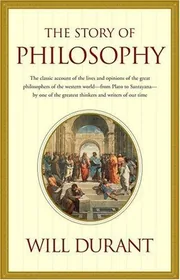
The Story of Philosophy
by Will Durant, 讀書新聞社 · 1926
Suits adult and mature teen readers curious about philosophy, and needs steady attention across its length.
543 pages, about 8.5 to 12.5 hours.
A biographical road through Western philosophy, from Socrates to Nietzsche. 39% taste match
What it covers
The Story of Philosophy, by Will Durant, is a work of nonfiction in the field of philosophy and its history, first published in 1926. It runs to roughly 543 pages in its median edition and has appeared in about 150 editions. The book is built around the lives and opinions of the greater Western philosophers, treating each thinker as a person as well as a source of ideas.
Durant begins in ancient Greece with Socrates and Plato, then moves through Aristotle, Francis Bacon, Spinoza, Voltaire, Kant, and Nietzsche. Other figures in its pages include Schopenhauer, Bertrand Russell, George Santayana, Benedetto Croce, and John Dewey. Rather than presenting each philosopher in isolation, the author traces how one thinker's ideas shaped the next, so the chapters read as a connected account running from the Greek world to the modern era. It is often counted among the classics of popular writing on philosophy and suits readers looking for a biographical route into the subject.
Characters
PlatoAristotle
Themes
PhilosophersPhilosophyHistoryBiographyPhilosophiePhilosophesPhilosophy, dictionariesPhilosophy, history
- Want to read 388
- Reading now 48
- Read 29
Most people shelving it are saving it for later.
Of 465 readers who put it on a shelf, 83% want to read it, 10% are reading it now, 6% have finished it and 0% stopped before the end.
By the numbers
- The median edition runs 543 pages. Counting about 275 words a page and an adult reading pace of 250 words a minute, that is about 10.0 hours of reading.
- Open Library tracks 150 editions from 66 publishers, the earliest dated 1926 and the latest 2024, across 10 languages.
- On reader demand it ranks in the top 3% of the classic books in our catalog (8,749 of them).
- Libraries shelve it under Dewey 190.9 and Library of Congress class B--0072.00000000.
Read it
The text of this edition is free to read online.
1 ebook provider carry it and a scanned copy is on the Internet Archive.
 BookWard’s take
A biographical road through Western philosophy, from Socrates to Nietzsche
Durant treats philosophers as people first, and that choice is what makes this a classic of popular philosophy rather than a textbook. Each chapter is a portrait, and the connected line from Plato through Aristotle, Bacon, Spinoza, Voltaire, Kant and Nietzsche gives the book a story shape that helps the ideas stick. It is strongly idea-led and not tight: at 543 pages it is a long haul, and the opening builds gradually rather than hooking you at once. The voice is distinctive and opinionated, which is a real pleasure. It is also personal and narrative in style, not rigorous in the modern scholarly sense, and it offers little that is original in its own right, so a strict reader will be most troubled on those two counts.
At 543 pages it is a long, broad survey, far from the short, tight end where BookWard sits.
Each portrait takes its time with life and ideas, so it moves at a measured, unhurried pace.
Surveying the major philosophers was not new, but pairing lives with ideas as a single story was a distinctive popular approach.
Durant's prose is polished and a little literary, richer than plain but not ornate.
The arc is carried by the philosophers as characters and by how one mind feeds the next.
It treats the pursuit of understanding with respect and some optimism, without promising answers.
Chronological by thinker, one chapter after another, in a conventional survey layout.
The tone is serious and appreciative, with only occasional lightness.
The content is gentle overall, with grim moments confined to some philosophers' lives and views.
Admiration and intellectual excitement are present, but emotion stays moderate.
See all 50 dialsEvery position, side by side with this book
Where it lines up
- Character depthBookWard 8 · book 7
- Authorial voiceBookWard 9 · book 8
- EndingBookWard 8 · book 6
Where it pulls apart
- LengthBookWard 1 · book 8
- OpeningBookWard 10 · book 4
- Familiar tropesBookWard 10 · book 4
At 543 pages it is a long, broad survey, far from the short, tight end where BookWard sits.
It opens in ancient Greece and builds steadily rather than grabbing you at once, which is slower than BookWard likes.
The great-philosophers survey is a familiar frame, though the biographical treatment of each thinker freshens it somewhat.
Each chapter follows a clear line of argument and the thinkers are linked in sequence, though popular summary smooths over difficulties.
Each portrait takes its time with life and ideas, so it moves at a measured, unhurried pace.
Surveying the major philosophers was not new, but pairing lives with ideas as a single story was a distinctive popular approach.
The philosophers are drawn as people with lives and temperaments, which gives the portraits real depth for a work of ideas.
It closes its arc at Nietzsche, a settled stopping point after the long chain of influence, though philosophy itself stays unresolved.
Durant admires his subjects openly but keeps the narration mostly measured rather than syrupy.
It is a readable popular account rather than a scholarly study, so it is more narrative than rigorous, short of BookWard's high bar.
Durant writes with a confident, personal, opinionated voice that readers recognise as his, a strength BookWard prizes.
The subject is philosophical thought, so ideas lead throughout, with biography serving as the vehicle.
Ideas are explained outright for a general reader, the opposite of BookWard's preference for showing in scene.
Interest rises and falls with the thinker on the page, so some chapters run stronger than others across the long span.
Durant's prose is polished and a little literary, richer than plain but not ornate.
The arc is carried by the philosophers as characters and by how one mind feeds the next.
It treats the pursuit of understanding with respect and some optimism, without promising answers.
Chronological by thinker, one chapter after another, in a conventional survey layout.
The tone is serious and appreciative, with only occasional lightness.
It is written for general readers, yet the ideas themselves ask for steady attention.
Each chapter takes up a different thinker, so many perspectives pass through the book.
It moves forward in order from Greece to the modern era.
This is a grounded account of real thinkers and their lives.
Many philosophers appear across the book, a sizable cast for a single volume.
It spans over two millennia of Western thought, a sweeping, wide-angle canvas.
The subject is thought and argument, so the book lives in the inner world of ideas.
Conversation is not a feature; the book is exposition and narrative summary.
Romance is not a theme, though personal lives appear in passing.
Ancient and early modern Europe will feel unfamiliar to many readers, though the survey guides you through it.
Its subjects are mostly from the past, and the book itself dates from the 1920s.
Still read and counted among the classics of popular philosophy nearly a century on.
Durant narrates as a plain guide with no unreliability.
It presents positions with sympathy, and weighing them is largely left to the reader.
Settings and portraits are sketched with some colour, though description is not the focus.
It reads as narrative biography rather than analytical argument, closer to storytelling than to a monograph.
Durant's own admiration and judgments come through, so the perspective is personal rather than detached.
It is a self-contained single volume.
There are few surprises in a survey of known thinkers, beyond the turns in the ideas themselves.
It asks you to think about difficult ideas, though with a guide holding your hand.
The content is gentle overall, with grim moments confined to some philosophers' lives and views.
Admiration and intellectual excitement are present, but emotion stays moderate.
Humor is dry and occasional, never broad.
Violence is minimal and incidental to biography.
Sexual content is negligible.
Political and social thought runs through several chapters without dominating the book.
The language is plain, with some period phrasing and unavoidable philosophical vocabulary.
Durant freely shares his own views and admirations rather than standing neutral.
The book looks back, tracing how past thinkers shaped one another.
It leans idealistic in its faith in understanding and the value of philosophy.
Review written by BookWard, dial version 1, November 2026.
Who is The Story of Philosophy right for?
Suits adult and mature teen readers curious about philosophy, and needs steady attention across its length. Nothing in it is graphic, though it engages with serious questions about belief and morality.
It is written for general readers, yet the ideas themselves ask for steady attention.
The content is gentle overall, with grim moments confined to some philosophers' lives and views.
Admiration and intellectual excitement are present, but emotion stays moderate.
Violence is minimal and incidental to biography.
Book CompanionThe Story of Philosophy: ideas, characters, themes
Philosophy is best understood as a connected story of real people whose ideas built on and answered one another.
- Philosophers as people. Each thinker is introduced through life and character, not as a bare set of doctrines.
- A chain of influence. The book traces how one philosopher's ideas fed the next, linking the chapters into one account.
- Greek beginnings. The story starts with Socrates and Plato and moves on through Aristotle.
- From Bacon to Kant. Francis Bacon, Spinoza, Voltaire and Kant carry the narrative into the modern era.
- End at Nietzsche. The survey runs on to Friedrich Nietzsche as the culmination of its line of thought.
Characters
Plato
Early Greek philosopher
Opens the story alongside Socrates and anchors the Greek foundation.
Aristotle
Greek philosopher
Follows Plato and extends the Greek tradition.
Francis Bacon
Early modern thinker
A bridge figure leading toward modern ways of thinking.
Spinoza
Philosopher
One of the major thinkers given a full portrait.
Nietzsche
Late philosopher
The final major figure in the survey.
Themes
How a thinker's personal life and temperament shape their philosophy.
How each philosopher answers and builds on those before.
Making hard ideas accessible to general readers.
The long effort to understand what can be known.
Discussion questions
- Does knowing a philosopher's life change how you judge their ideas?
- Is a connected story of philosophy more illuminating or more misleading than studying thinkers separately?
- Which philosopher in the book do you find most persuasive, and why?
- What do you gain and lose when ideas are explained for a general reader?
- Does a survey written in 1926 still serve a reader today?
Personalize your Book Companion
This is the general edition. In BookWard, the Companion is written for you: your reading profile, your notes, and spoiler-safe to the page you are on.
Buy, listen or borrow The Story of Philosophy
Each link opens a search for this book on that store, in a new tab.
Read on a device
Borrow
Reviews and community
If you liked The Story of Philosophy
Robert Greene's long, opinionated field guide to why people behave as they do
MoraliaPlutarchPlutarch's 78 essays: ancient ethics with surprising bite
The Seven Storey MountainThomas MertonA restless young man's road from the world to a Trappist monastery
The 50Th LawRobert GreeneFearlessness as strategy, told through 50 Cent and history's hard cases
Sources: Open Library.
Track The Story of Philosophy and find your next favorite
Add it to your shelf, rate what you have read, and BookWard will recommend what fits you.
Free to start. No credit card needed.