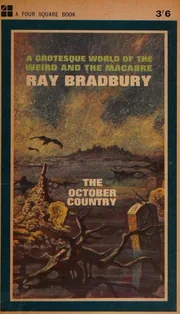
Best suited to teens and adults who enjoy gothic and macabre fiction.
306 pages, about 5 to 7 hours.
Nineteen macabre tales from the long twilight of Bradbury's imagination. 57% taste match
The story
The October Country is a collection of nineteen macabre short stories by the American writer Ray Bradbury, who worked across fantasy, horror and science fiction. Its title names a place where the year is always turning late, a land of fog, mist and long twilights, and the stories gather under that atmosphere. The book runs to roughly three hundred pages and has appeared in many editions.
The collection reprints fifteen of the twenty-seven stories from his earlier volume Dark Carnival and adds four more that had run in other publications. The tales range across settings such as a Mexican village where death draws tourists, a hidden city beneath a city where drowned lovers are reunited, and a carnival midway where a tiny man's cherished fantasy can be played out night after night. Readers who like short fiction on the darker side of fantasy, in the American tradition of the horror tale, will find a varied set of stories here rather than a single connected narrative.
... that country where it is always turning late in the year. That country where the hills are fog and the rivers are mist; where noons go quickly, dusks and twilights linger, and midnights stay.
Themes
Horror tales, AmericanAmerican Horror talesEnglish Short stories
- Want to read 101
- Reading now 6
- Read 16
Most people shelving it are saving it for later.
Of 123 readers who put it on a shelf, 82% want to read it, 5% are reading it now, 13% have finished it and 0% stopped before the end.
By the numbers
- The median edition runs 306 pages. Counting about 275 words a page and an adult reading pace of 250 words a minute, that is about 5.6 hours of reading.
- Open Library tracks 53 editions from 29 publishers, the earliest dated 1955 and the latest 2020, across 5 languages.
- On reader demand it ranks in the top 13% of the classic books in our catalog (8,749 of them).
- Libraries shelve it under Dewey 823.91 and Library of Congress class PS-3503.00000000.R167 Oc5.
 BookWard’s take
Nineteen macabre tales from the long twilight of Bradbury's imagination
The October Country gathers nineteen short stories under a single mood: fog, dusk and the late turn of the year. The variety is the pleasure here, and the pacing suits it, since each tale starts fast and is gone before it can sag. The prose is richer than I usually go for, lyrical and ornate, but it gives Bradbury a voice that is unmistakable. The familiar tropes of the American horror tale are all present, yet the settings feel fresh: a Mexican village where death draws tourists, a hidden city of drowned lovers, a carnival midway. Expect atmosphere rather than logic puzzles, and endings that sometimes close the door softly and sometimes leave it ajar. A strong pick for short, strange, beautifully made fiction.
At about three hundred pages across nineteen stories, it is moderate in size, though each tale is short; BookWard likes that economy.
Each story moves briskly toward its end, which keeps the collection quick even when the mood is slow and fogbound.
The settings, from a city beneath a city to a carnival fantasy, are imaginative enough to stand out from standard horror.
The language is poetic and ornate, richer than BookWard's usual plain-leaning taste but handled with real control.
The stories balance a central odd event with the feelings of those caught in it, landing near the middle.
The prevailing mood is autumnal and shadowed, with beauty here and there but little comfort, leaning bleak.
A conventional story collection, with each piece standing alone and no experimental framing device.
Wry touches appear now and then, but the tone is overwhelmingly serious and eerie.
Death, loss and fear are core subjects, which makes this clearly a dark collection.
Grief, longing and dread run strong beneath the polished surface, giving the tales real feeling.
See all 50 dialsEvery position, side by side with this book
Where it lines up
- Sagging middleBookWard 8 · book 8
- PaceBookWard 8 · book 7
- OriginalityBookWard 9 · book 8
Where it pulls apart
- Internal logicBookWard 10 · book 5
- Familiar tropesBookWard 10 · book 6
- LengthBookWard 1 · book 4
At about three hundred pages across nineteen stories, it is moderate in size, though each tale is short; BookWard likes that economy.
Short stories have to grab quickly, and these open on strange premises, which suits BookWard's love of an immediate pull.
These are dreamlike tales where uncanny rules govern, so internal logic is looser than BookWard's airtight preference.
Each story moves briskly toward its end, which keeps the collection quick even when the mood is slow and fogbound.
The settings, from a city beneath a city to a carnival fantasy, are imaginative enough to stand out from standard horror.
Short forms limit depth, but the stories give their central figures vivid, memorable inner lives for the space available.
Many macabre tales close on a sting or a hush rather than a full explanation, a mix BookWard finds only partly satisfying.
There is real tenderness here, especially around loss and longing, though it is kept inside a dark frame.
The darkness serves atmosphere and idea more than gore, so most of the chills feel earned rather than gratuitous.
This is fiction, so rigor does not apply.
Bradbury's lyrical, unmistakable voice is the main draw, and it lands squarely in BookWard's taste for distinctive authors.
Most tales are built around a single haunting idea, but they are told as stories first, close to BookWard's story-led lean.
Bradbury favors scene and image over explanation, which matches BookWard's preference for showing rather than telling.
Short pieces cannot sag in the middle, so the collection stays sustained, though quality varies from story to story.
The language is poetic and ornate, richer than BookWard's usual plain-leaning taste but handled with real control.
The stories balance a central odd event with the feelings of those caught in it, landing near the middle.
The prevailing mood is autumnal and shadowed, with beauty here and there but little comfort, leaning bleak.
A conventional story collection, with each piece standing alone and no experimental framing device.
Wry touches appear now and then, but the tone is overwhelmingly serious and eerie.
Accessible sentences and short lengths make for easy reading, even when the imagery is dense and strange.
Nineteen separate stories mean many perspectives, each with its own central figure and situation.
Individual tales mostly run in a straightforward line from start to finish.
Across nineteen stories the cast of characters is large, though each tale keeps its own cast small.
These are intimate stories set in single towns, midways or rooms, rather than sweeping epics.
The stories blend inner dread with outer events, balancing mood and incident about evenly.
Conversation carries some scenes but the stories lean on image and atmosphere, so dialogue is moderate.
Love and loss surface in places, as with the drowned lovers, but romance is never the main engine.
Settings range from a Mexican village to an underground city, a mix of the familiar and the strange.
First collected in the 1940s and 1950s, these tales belong to a mid-century American past.
Their themes of death, desire and the uncanny have kept the stories fresh across many editions.
Narration is mostly straightforward and trustworthy, with the strangeness coming from events, not deceit.
Several stories sit in uneasy gray zones where the dark outcomes are not neatly judged.
Fog, mist and long twilights are painted richly, and atmosphere is central to the book's appeal.
Macabre short fiction thrives on turns, and many stories arrive at a sting or reversal.
Gentle in language but unsettling in theme, the collection nudges readers toward discomfort without being punishing.
Death, loss and fear are core subjects, which makes this clearly a dark collection.
Grief, longing and dread run strong beneath the polished surface, giving the tales real feeling.
What humor there is runs dry and shadowed, never broad or slapstick.
Menace and death are present, but the book leans on suggestion and atmosphere more than graphic harm.
Sexual content is minimal; the book is more concerned with dread and wonder than with desire.
These tales deal in the uncanny and the personal, so politics is essentially absent.
The language is lyrical but plain enough to follow, with no heavy dialect to wade through.
Bradbury lets images speak, though a strong authorial sensibility colors the telling.
Many stories dwell on death, memory and what is lost, so the gaze points backward more than forward.
The worldview is shadowed and wary, with beauty offered mainly as a brief counterweight to fear.
Review written by BookWard, dial version 1, November 2026.
Who is The October Country right for?
Best suited to teens and adults who enjoy gothic and macabre fiction. Themes of death, grief and fear run throughout, though the book leans on atmosphere more than graphic content.
Accessible sentences and short lengths make for easy reading, even when the imagery is dense and strange.
Death, loss and fear are core subjects, which makes this clearly a dark collection.
Grief, longing and dread run strong beneath the polished surface, giving the tales real feeling.
Menace and death are present, but the book leans on suggestion and atmosphere more than graphic harm.
Book CompanionThe October Country: ideas, characters, themes
The October Country gathers nineteen macabre stories under one eerie atmosphere, showing how fear, loss and wonder can live side by side.
- A place defined by mood. The title names a land of fog, mist and long twilights, and the stories gather under that shared autumnal atmosphere.
- A collection assembled from earlier work. It reprints fifteen of the twenty-seven stories from Dark Carnival and adds four others published elsewhere.
- Wildly varied settings. The tales range from a Mexican village where death is a tourist attraction to a city beneath the city.
- Wonder alongside the dread. The prose is described as both chilling and enchanting, so beauty sits next to fear throughout.
- Standalone pieces, not a single plot. Each story is self-contained, so the book can be read in any order or sampled in small bites.
Themes
Several stories, such as the drowned lovers and the village where death draws visitors, treat mortality as something to be faced or even displayed.
A tiny man's cherished fantasy replayed each night shows how desire can shape and trap a life.
Carnivals, villages and city undergrounds become sites where the familiar turns strange.
Fog, twilight and the late turn of the year give the book a mood that carries feeling as much as plot does.
Discussion questions
- Which story best captures the idea of the October country, and what makes its atmosphere work?
- How does Bradbury balance beauty and dread within a single tale?
- Why might a village that makes death a tourist attraction feel both absurd and unsettling?
- How do short stories change what horror can do compared with a novel?
- Which endings land hardest, and which leave you wanting more explanation?
Personalize your Book Companion
This is the general edition. In BookWard, the Companion is written for you: your reading profile, your notes, and spoiler-safe to the page you are on.
Buy, listen or borrow The October Country
Each link opens a search for this book on that store, in a new tab.
Read on a device
Borrow
Reviews and community
If you liked The October Country
A village turns on four odd sisters, told through five voices
The Illustrated ManRay BradburyEighteen strange, brief tales framed by a tattooed man
MarinaCarlos Ruiz ZafónA gothic Barcelona mystery that blends ghosts, memory and first love
The Starving SaintsCaitlin StarlingA besieged castle, a feast of dark origin, three women
Sources: Open Library.
Track The October Country and find your next favorite
Add it to your shelf, rate what you have read, and BookWard will recommend what fits you.
Free to start. No credit card needed.