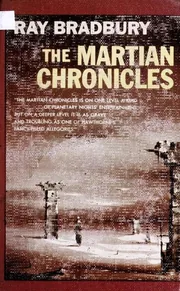
The Martian Chronicles
by Ray Bradbury · 1950
It suits teens and adults who enjoy classic science fiction and reflective, image-rich writing.
262 pages, about 4 to 6 hours.
Linked stories that read as one novel about settling Mars. 52% taste match
The story
The Martian Chronicles is a science fiction work by the American writer Ray Bradbury, first published in 1950. It is built from linked short stories arranged so that they read as a single novel, and it follows the human settlement of Mars across a span of years. The stories move in order from the earliest voyages to the planet through the growth of a colony there.
The people at the center are Americans who leave Earth and arrive on a world already home to Martians. For a time the newcomers and the native inhabitants share Mars. Back on Earth, nuclear war brings devastation, and the settlers are left to rely on themselves. They set about building a new Earth on the red planet.
The book belongs to the tradition of interplanetary voyage and space colony fiction. It has been printed in about 138 editions, with a median length of 262 pages, and has been translated into other languages, including Russian. Readers who like early science fiction about leaving Earth and starting over on another world will find a classic example of the form here.
One minute it was Ohio winter, with doors closed, windows locked, the panes blind with frost, icicles fringing every roof, children skiing on slopes, housewives lumbering like great black bears in their furs along the icy streets.
Setting
Mars (Planet)Marte (Planeta)
Themes
Ciencia-ficciónDramaEnglish Language Short storiesFicciónInterplanetary voyagesBibliographySpace coloniesLong Now Manual for Civilization
- Want to read 613
- Reading now 24
- Read 175
Most people shelving it are saving it for later.
Of 812 readers who put it on a shelf, 75% want to read it, 3% are reading it now, 22% have finished it and 0% stopped before the end.
By the numbers
- The median edition runs 262 pages. Counting about 275 words a page and an adult reading pace of 250 words a minute, that is about 4.8 hours of reading.
- Open Library tracks 138 editions from 84 publishers, the earliest dated 1950 and the latest 2025, across 8 languages.
- On reader demand it ranks in the top 1% of the classic books in our catalog (8,749 of them).
- Libraries shelve it under Dewey 813.54 and Library of Congress class PS-3503.00000000.R167 Mar2.
 BookWard’s take
Linked stories that read as one novel about settling Mars
Bradbury's 1950 book is a fix-up: linked short stories arranged chronologically so they read as a single novel about Americans leaving Earth for Mars. It begins with the first voyages, shares the planet for a time with the native Martians, then follows a colony left to fend for itself after nuclear war back home. Its ideas were notably original for their era, and the prose is more lyrical than this reader usually favors. The structure is loose rather than tightly plotted, and with many viewpoints instead of one lead, the characters get spread thin across the stories. It is driven by ideas more than people, and it has aged well. The familiar tropes of colonization are here, but they come with a pointed sense of what settlers carry with them.
At 262 pages of linked stories it stays short, which matches BookWard's liking for tight books.
Short stories move briskly, but the book lingers in mood, so it never quite races.
A cycle of linked tales about colonizing Mars was fresh in 1950, and BookWard rates that kind of invention highly.
The language is lyrical and image-rich, richer than BookWard's usual middle-of-the-road taste.
Ideas and atmosphere carry the book more than any single character's arc.
The book carries a melancholy note, with Earth devastated, though the settlers still try to build anew.
A novel assembled from linked short stories is an unconventional form, more experimental than BookWard's usual pick.
The tone is mostly serious and reflective, with little in the way of comic relief.
Nuclear war devastating Earth gives the book a serious, somber core.
Loss and longing run through the stories, giving a moderately strong emotional pull.
See all 50 dialsEvery position, side by side with this book
Where it lines up
- LengthBookWard 1 · book 2
- OriginalityBookWard 9 · book 8
- Authorial voiceBookWard 9 · book 10
Where it pulls apart
- OpeningBookWard 10 · book 6
- Internal logicBookWard 10 · book 6
- Story or ideasBookWard 3 · book 8
At 262 pages of linked stories it stays short, which matches BookWard's liking for tight books.
Each story opens on its own terms, so the pull comes in waves rather than from one grabbing first page.
Interplanetary settlement is a familiar setup, though Bradbury's treatment of it feels less stock than the premise suggests.
The stories connect through chronology rather than strict mechanics, so the world holds together without being airtight.
Short stories move briskly, but the book lingers in mood, so it never quite races.
A cycle of linked tales about colonizing Mars was fresh in 1950, and BookWard rates that kind of invention highly.
Many people pass through the stories, so few are drawn in depth, which sits below BookWard's preference.
The arc of settlement reaches a settled point, though the book favors a closing image over tidy resolution.
Wistful feeling runs through the book, so it is warmer than the restraint BookWard tends to prefer.
Darkness comes from the book's central events rather than from gratuitous effect, which BookWard respects.
This is fiction, so the dial does not apply.
Bradbury's voice is unmistakable, and that distinctive style is a large part of why the book endures.
The stories serve ideas about settlement and loss more than they serve a single driving plot.
The tales lean on scene and mood to carry meaning, which suits BookWard's taste for showing over explaining.
As a set of short pieces it avoids a long saggy middle, though some stories land harder than others.
The language is lyrical and image-rich, richer than BookWard's usual middle-of-the-road taste.
Ideas and atmosphere carry the book more than any single character's arc.
The book carries a melancholy note, with Earth devastated, though the settlers still try to build anew.
A novel assembled from linked short stories is an unconventional form, more experimental than BookWard's usual pick.
The tone is mostly serious and reflective, with little in the way of comic relief.
The prose is accessible and the stories short, so it is not a heavy read.
The stories shift between many people over the years, so no single perspective holds the book.
The stories move in order from the first voyages onward, so time is mostly linear.
Martians and interplanetary travel put this well on the fantastical side of the dial.
Many people appear across the span of settlement, so the cast is wide even if each part is brief.
It spans a planet's settlement across years and Earth's devastation, giving it a broad sweep.
Events of settlement and the mood of the characters share the page fairly evenly.
Scenes mix talk and narration without leaning heavily on either.
Romance is not a driving concern in this story of settlement.
A Mars shared with its native inhabitants is an unfamiliar setting that BookWard enjoys.
Published in 1950 and set in the future, it reads as a book from the past.
Its questions about leaving a ruined home and starting over keep it relevant decades later.
The narration is a straightforward guide to events rather than a deceiver.
Questions about what settlers owe the natives and the planet are left open to the reader.
The book builds Mars through vivid imagery, so description is rich.
This is fiction, so the dial does not apply.
This is fiction, so the dial does not apply.
It stands alone as a single book of linked stories.
The structure holds some surprises, but it does not run on plot reversals.
The book asks the reader to think about colonization and its costs, not just to be entertained.
Nuclear war devastating Earth gives the book a serious, somber core.
Loss and longing run through the stories, giving a moderately strong emotional pull.
Humor is not a strong element of the book.
Conflict and war are part of the backdrop but are not dwelt on at length.
Sexual content is not a feature of this book.
Colonization and war carry political weight, though the book is not a polemic.
The language is plain enough for a general reader.
The book has a point of view about settlement and loss, voiced through its stories.
The book looks forward to the future of humanity, though it also looks back with regret.
The book sets hope for a fresh start against a sober sense of human failure.
Review written by BookWard, dial version 1, November 2026.
Who is The Martian Chronicles right for?
It suits teens and adults who enjoy classic science fiction and reflective, image-rich writing. It deals with nuclear war and the devastation of Earth, which some younger readers may find unsettling.
The prose is accessible and the stories short, so it is not a heavy read.
Nuclear war devastating Earth gives the book a serious, somber core.
Loss and longing run through the stories, giving a moderately strong emotional pull.
Conflict and war are part of the backdrop but are not dwelt on at length.
Book CompanionThe Martian Chronicles: ideas, characters, themes
A cycle of linked stories follows humanity's settlement of Mars and asks what settlers bring with them when they leave a troubled Earth.
- A novel built from stories. The book is a fix-up, linked short stories arranged to read as a single novel.
- Chronological settlement. The stories move in order from the earliest voyages to the growth of a colony.
- Shared planet. For a time the newcomers and the native Martians share Mars.
- Earth devastated. Nuclear war on Earth leaves the colony to rely on itself.
- Building anew. The settlers resolve to build a new Earth on Mars.
Themes
What happens when one people settles a land already home to another.
The hope and cost of leaving a ruined home to rebuild elsewhere.
The devastation of Earth that leaves the colonists on their own.
The settlers' reliance on themselves once Earth is out of reach.
Discussion questions
- Why might Bradbury have told this as linked stories rather than one continuous narrative?
- What do the settlers carry with them from Earth, and how does it shape Mars?
- How does the book treat the native Martians compared with the newcomers?
- Does the idea of building a new Earth on Mars read as hopeful or as a warning?
- Which story in the sequence would you keep if you could keep only one, and why?
Personalize your Book Companion
This is the general edition. In BookWard, the Companion is written for you: your reading profile, your notes, and spoiler-safe to the page you are on.
Buy, listen or borrow The Martian Chronicles
Each link opens a search for this book on that store, in a new tab.
Read on a device
Borrow
Reviews and community
If you liked The Martian Chronicles
Eighteen strange, brief tales framed by a tattooed man
Sublimia SyndromeExurb1aA million-year-old mystery, chased by five seekers across the stars
Exit PartyEmily St. John MandelA party, a vanished host, and an America that has come apart
The End of EverythingM. John HarrisonA strange Kent tideline, and an object that won't hold still
Sources: Open Library.
Track The Martian Chronicles and find your next favorite
Add it to your shelf, rate what you have read, and BookWard will recommend what fits you.
Free to start. No credit card needed.