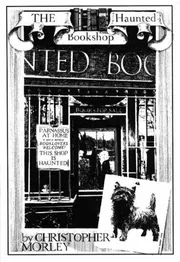
The Haunted Bookshop
by Christopher Morley · 1919
It suits adult and older teen readers who enjoy classic, cozy mysteries and bookish settings.
256 pages, about 4 to 6 hours.
A cozy Brooklyn bibliomystery that loves books more than menace. 48% taste match
The story
Christopher Morley's The Haunted Bookshop first appeared in 1919 and sits in the mystery and thriller category, with a setting in the book trade. It is a classic often cited as an early example of the bibliomystery, a form of detective fiction that takes place among books, booksellers and the shops where they are sold.
The story is set in Brooklyn, New York, in a quiet side street where a secondhand bookstore stands. Roger Mifflin is the bookseller who runs it. Aubrey Gilbert, who works in advertising, becomes part of the picture, and Titania Chapman arrives to take a job at the store. Subjects associated with the novel include booksellers and bookselling, bookstores, haunted places and detective stories, and some editions are shelved with horror fiction as well. The book runs to roughly 256 pages in its median edition, and about 69 editions have been published, which reflects its long life in print. It suits readers who like mysteries with a literary backdrop, early twentieth century city settings, and stories centered on the daily life of a bookshop.
IF YOU are ever in Brooklyn, that borough of superb sunsets and magnificent vistas of husband-propelled baby-carriages, it is to be hoped you may chance upon a quiet by-street where there is a very remarkable bookshop.
Setting
Brooklyn (New York, N.Y.)
Themes
Detective and mystery storiesBooksellers and booksellingMystery and detective storiesClassic LiteratureBookstoresHaunted places
- Want to read 206
- Reading now 18
- Read 16
Most people shelving it are saving it for later.
Of 240 readers who put it on a shelf, 86% want to read it, 8% are reading it now, 7% have finished it and 0% stopped before the end.
By the numbers
- The median edition runs 256 pages. Counting about 275 words a page and an adult reading pace of 250 words a minute, that is about 4.7 hours of reading.
- Open Library tracks 69 editions from 48 publishers, the earliest dated 1919 and the latest 2022, across 2 languages.
- On reader demand it ranks in the top 8% of the classic books in our catalog (8,749 of them).
- Libraries shelve it under Dewey 813.52 and Library of Congress class PS-3525.00000000.O71 Hau13.
 BookWard’s take
A cozy Brooklyn bibliomystery that loves books more than menace
Morley's 1919 novel is a gentle bibliomystery set in a Brooklyn secondhand bookshop, and it earns its charm from voice more than plot. The narration is opinionated, warm and full of talk about books and bookselling, and that distinctive personality is the real draw. The pace is gentler than I usually like, though. The book prefers to settle you into the shop before the mystery tightens, and the opening takes its time. It reads easily and leans warm rather than restrained in its sentiment, which is where I part ways with it a little. Roger Mifflin, Aubrey Gilbert and Titania Chapman make a small, intimate cast, and that closeness suits the setting. It is a short, affectionate classic, best taken as a love letter to bookshops with a mystery tucked inside.
At about 256 pages it is compact and never overstays its welcome, which suits BookWard's preference for tight books.
It moves at an easy, conversational walk, slower than BookWard's brisk preference.
A mystery about booksellers was fresh in 1919 and still feels distinctive, even if the form is now familiar.
The prose is clear and genial with a literary polish, neither plain nor ornate.
Character and atmosphere lead, with the mystery supporting them rather than driving everything.
A warm, humane outlook runs through it, in line with BookWard's lean toward hope.
A conventional, linear novel structure with no formal experiments.
Gentle wit and bookish banter lighten the tone, so it reads as amusing more than solemn.
Its haunted-shop premise stays gentle, with little real darkness on the page.
Feeling runs warm and mild rather than intense.
See all 50 dialsEvery position, side by side with this book
Where it lines up
- EndingBookWard 8 · book 8
- Authorial voiceBookWard 9 · book 9
- Shock for effectBookWard 9 · book 8
Where it pulls apart
- OpeningBookWard 10 · book 4
- Familiar tropesBookWard 10 · book 4
- Internal logicBookWard 10 · book 6
At about 256 pages it is compact and never overstays its welcome, which suits BookWard's preference for tight books.
The bookshop setting invites you in gently rather than grabbing you at once, a softer start than BookWard prefers.
The bibliomystery frame and period setting carry some familiar genre comforts, so it sits mid-low for BookWard's tropes-averse taste.
The mystery holds together well enough for a light, character-first story, though it is not built like a puzzle box.
It moves at an easy, conversational walk, slower than BookWard's brisk preference.
A mystery about booksellers was fresh in 1919 and still feels distinctive, even if the form is now familiar.
Warmth and affection for books run through it, so it leans more sentimental than BookWard's restrained taste.
Its darkness is mild and never used for effect, so it earns its tone without leaning on shock.
Not applicable, since this is a novel.
Morley's chatty, bookish narration is the book's signature and a clear match for BookWard's love of distinct voices.
Story leads, but musings on reading and bookselling carry real weight, so ideas get more room than usual.
The narrator often explains and opines outright, more than BookWard's show-it-in-scene preference.
The slender length and lively talk keep the middle moving, with only mild drift between mystery beats.
The prose is clear and genial with a literary polish, neither plain nor ornate.
Character and atmosphere lead, with the mystery supporting them rather than driving everything.
A warm, humane outlook runs through it, in line with BookWard's lean toward hope.
A conventional, linear novel structure with no formal experiments.
Gentle wit and bookish banter lighten the tone, so it reads as amusing more than solemn.
Easy and companionable to read, a low-effort classic.
It stays close to a small circle of characters rather than ranging across many perspectives.
The events unfold in a plain forward sequence.
Despite the haunted tag, the story stays grounded in a real Brooklyn bookshop.
A small, close cast built around the shop keeps things intimate.
One side street and a handful of people make this a decidedly intimate story.
Conversation and observation share the stage with outward events in a fairly even balance.
Talk drives much of the book, with characters trading ideas and banter freely.
Titania's arrival brings a gentle romantic thread, present but not the whole point.
A Brooklyn bookshop is a familiar, easy-to-picture setting rather than an unfamiliar world.
Set in the late 1910s, it is firmly a period piece.
Its love of bookshops and reading still speaks to book lovers a century later.
The narrator is open and trustworthy, with no games played on the reader.
Right and wrong are drawn fairly clearly, with little moral murk.
Shelves, streets and shop life are drawn with affectionate, rich detail.
Not applicable, since this is a novel.
Not applicable, since this is a novel.
It stands on its own as a single novel.
There are some turns in the mystery, but it is not a twist-driven book.
A comforting, easygoing read that asks little of you emotionally or intellectually.
Its haunted-shop premise stays gentle, with little real darkness on the page.
Feeling runs warm and mild rather than intense.
The humor is dry and literary rather than broad.
Violence is minimal in this cozy-leaning mystery.
There is essentially no sexual content.
Period concerns surface in the talk, but politics is not the focus.
The language is plain and readable, with only a period flavor.
The narration freely shares opinions about books, reading and selling them.
Rooted in its own era and in the book trade's traditions, it looks more backward than forward.
Faith in books and in people gives it a clearly idealistic streak.
Review written by BookWard, dial version 1, November 2026.
Who is The Haunted Bookshop right for?
It suits adult and older teen readers who enjoy classic, cozy mysteries and bookish settings. Its content is mild, though its period outlook and pace may feel dated to some.
Easy and companionable to read, a low-effort classic.
Its haunted-shop premise stays gentle, with little real darkness on the page.
Feeling runs warm and mild rather than intense.
Violence is minimal in this cozy-leaning mystery.
Book CompanionThe Haunted Bookshop: ideas, characters, themes
A mystery set in a Brooklyn secondhand bookshop celebrates books and bookselling while a small circle of characters is drawn into its intrigue.
- A bibliomystery pioneer. First published in 1919, it is often cited as an early example of detective fiction set among books and booksellers.
- The shop as a character. The secondhand bookstore on a quiet Brooklyn side street is the heart of the story and sets its mood.
- A bookseller at the center. Roger Mifflin runs the shop and anchors the story, giving it its bookish voice and outlook.
- New arrivals shift the shop. Aubrey Gilbert, who works in advertising, becomes part of the picture, and Titania Chapman comes to work at the store.
- Haunted, in a gentle way. Subjects tied to the book include haunted places, and some editions are shelved with horror, but the tone stays light.
Characters
Roger Mifflin
Bookseller
He runs the secondhand bookshop in Brooklyn and is the story's central figure.
Aubrey Gilbert
Advertising man
He works in advertising and becomes part of the story around the shop.
Titania Chapman
Shop assistant
She comes to work at Mifflin's bookshop.
Themes
The story treats reading and bookselling as worthwhile, even noble, pursuits.
A small circle of people gathers around one shop and shapes one another's lives.
The pull between selling things and valuing them runs between the bookshop and the advertising world.
The haunted-shop idea suggests there is more going on beneath the surface of ordinary places.
Discussion questions
- What makes a bookshop a good setting for a mystery?
- How does Morley's chatty narration shape your sense of the story?
- Does the haunted label fit the tone of the book as you read it?
- How do the bookseller and the advertising man differ in how they see books?
- Why might a book from 1919 still appeal to readers who love bookshops?
Personalize your Book Companion
This is the general edition. In BookWard, the Companion is written for you: your reading profile, your notes, and spoiler-safe to the page you are on.
Buy, listen or borrow The Haunted Bookshop
Each link opens a search for this book on that store, in a new tab.
Read on a device
Borrow
Reviews and community
If you liked The Haunted Bookshop
A Regency homecoming where the charming surface hides a murder plot
VenetiaGeorgette HeyerA Regency romance with real wit and a heroine worth trusting
The Canterville GhostOscar WildeA short, sharp ghost comedy that turns sentimental at the close
A Walk in the WoodsBill BrysonA funny, warm Appalachian Trail memoir that wanders into history and ecology
Sources: Open Library.
Track The Haunted Bookshop and find your next favorite
Add it to your shelf, rate what you have read, and BookWard will recommend what fits you.
Free to start. No credit card needed.