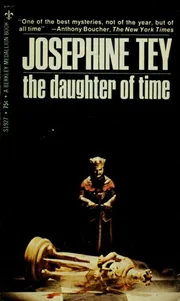
The Daughter of Time
by Josephine Tey · 1951
Suits adult and mature teen readers who enjoy puzzles and history.
207 pages, about 3.5 to 5 hours.
A bedridden detective cracks a 500-year-old case, and it's gripping. 67% taste match
The story
The Daughter of Time is a detective novel by Josephine Tey, first published in 1951. It features Inspector Alan Grant of Scotland Yard, who is laid up in a hospital bed with a broken leg and has little to do but stare at the ceiling. When he comes across a portrait of King Richard III, the face he sees does not match the villain he remembers from the history books. That mismatch sets him on a private investigation into a very old case.
Rather than chasing a present-day criminal, Grant treats the reign of Richard III, which ran from 1483 to 1485, as a cold case. His inquiry centers on the king's reputation and on the fate of the young princes in the Tower, and it takes him into questions of evidence, slander, and how history gets written. He draws on the British Museum and on the help of an American scholar. The story is set in England and blends the police procedural with historical research. It was the last book Tey published during her lifetime, and it appears on the British Crime Writers' Association list of the top 100 crime novels, where it was ranked first in 1990. The book runs about 207 pages in its typical edition.
Grant lay on his high white cot and stared at the ceiling.
Characters
Richard III King of England
Setting
Great BritainEngland
Period
Richard III, 1483-1485
Themes
Alan Grant (Fictitious character)PoliceKings and rulersHistoryHospitalsPoliaDetective and mystery storiesLibel and slander
- Want to read 126
- Reading now 9
- Read 25
Most people shelving it are saving it for later.
Of 160 readers who put it on a shelf, 79% want to read it, 6% are reading it now, 16% have finished it and 0% stopped before the end.
By the numbers
- The median edition runs 207 pages. Counting about 275 words a page and an adult reading pace of 250 words a minute, that is about 3.8 hours of reading.
- Open Library tracks 129 editions from 52 publishers, the earliest dated 1951 and the latest 2023, across 6 languages.
- On reader demand it ranks in the top 9% of the classic books in our catalog (8,749 of them).
- Libraries shelve it under Dewey 823.912 and Library of Congress class PR-6025.00000000.A2547 D3 1988.
 BookWard’s take
A bedridden detective cracks a 500-year-old case, and it's gripping
Josephine Tey's 1951 novel does something few mysteries attempt: the crime is centuries old and the detective never leaves his hospital bed. At 207 pages, it is short and tight, and the premise hooks you from the first look at a portrait. Where BookWard prizes airtight internal logic, this one delivers, because Alan Grant treats Richard III's reign like a cold case and tests every claim against evidence. It is idea-led rather than story-led, and the exposition is stated outright rather than staged, which is the opposite of what we usually prefer. But the premise is original, the voice is distinctive, and the book earns its place as the CWA's top-ranked crime novel of all time.
At 207 pages it is as compact as a mystery gets, which suits BookWard's love of tight, short books.
Momentum comes from argument and discovery rather than action, so it moves steadily but not fast, a little under BookWard's pace.
Treating a medieval reign as a cold case was a fresh idea in 1951 and still feels unlike other crime novels.
The writing is clear and polished without ornament, a touch plainer than BookWard's middle position.
The case and the character of Grant share the work about equally, with a slight lean to the puzzle.
It is cool and curious rather than bleak, with a quiet satisfaction in setting the record straight.
The form is a conventional investigation, with the setting being the only unusual element.
Dry wit runs through Grant's irritable convalescence, lighter than a comedy but never grim.
The subject is a notorious crime, but the treatment is cerebral and gentle in tone.
Feeling stays subdued, driven by indignation and curiosity, not heightened emotion.
See all 50 dialsEvery position, side by side with this book
Where it lines up
- LengthBookWard 1 · book 1
- OriginalityBookWard 9 · book 9
- EndingBookWard 8 · book 8
Where it pulls apart
- ExpositionBookWard 2 · book 9
- Story or ideasBookWard 3 · book 9
- OpeningBookWard 10 · book 8
At 207 pages it is as compact as a mystery gets, which suits BookWard's love of tight, short books.
A single portrait and a mismatched face set the inquiry going early, though the hook is quieter than an action opening.
A detective solving a historical case from a hospital bed sidesteps nearly every standard mystery trope, which BookWard rewards.
Grant tests each claim against evidence step by step, so the reasoning holds together tightly, exactly what BookWard wants.
Momentum comes from argument and discovery rather than action, so it moves steadily but not fast, a little under BookWard's pace.
Treating a medieval reign as a cold case was a fresh idea in 1951 and still feels unlike other crime novels.
Grant is vividly drawn through his habits of mind, though the supporting figures are lightly sketched compared with BookWard's preference.
The inquiry reaches a firm conclusion about the case, which fits BookWard's taste for resolution.
The tone stays dry and observant rather than tearful, matching BookWard's liking for restraint.
There is no gratuitous darkness here; the grim subject of the princes is handled through evidence, not spectacle.
It reasons like a historian, weighing sources and slander, though it remains a novel and not a rigorous study.
Tey's wry, confident narration is unmistakably her own, the kind of voice BookWard values.
The book is driven by an argument about evidence and reputation more than by incident, leaning well toward ideas.
Much of the history is explained outright through conversation and Grant's reasoning, the reverse of BookWard's show-it-in-scene taste.
The inquiry stays purposeful, though a bed-bound structure of reading and talking can slow in places.
The writing is clear and polished without ornament, a touch plainer than BookWard's middle position.
The case and the character of Grant share the work about equally, with a slight lean to the puzzle.
It is cool and curious rather than bleak, with a quiet satisfaction in setting the record straight.
The form is a conventional investigation, with the setting being the only unusual element.
Dry wit runs through Grant's irritable convalescence, lighter than a comedy but never grim.
The prose is easy, but following the historical evidence takes some attention, so effort sits in the middle.
We stay almost entirely with Grant, keeping the viewpoint narrow.
The story unfolds in the present while examining the past, so the telling itself runs linearly.
Everything is grounded in real people, places and records.
A handful of characters carry the story, with the historical figures discussed more than seen.
The action is confined to a hospital room, though the question concerns a throne.
Almost all the action happens in conversation and thought, with little physical movement.
Much of the research comes through talk with visitors and helpers, making dialogue a main engine.
Romance is not a concern of the story.
The setting is a familiar English hospital, with the medieval court seen only through documents.
A mid-century setting, now seen as a period piece, sits closer to the past than to today.
Its questions about evidence and reputation remain fresh decades later, as its top ranking suggests.
The narration follows Grant plainly and can be trusted.
The book sets out to clear a name, so its judgments are fairly clear.
Description serves the investigation and does not linger, giving a moderate texture.
It reads as an argument about history yet is delivered as story, leaning narrative.
The book is dominated by Grant's personal curiosity and irritable temperament.
Grant appears in other Tey novels, but this one stands well alone, so it sits mid-scale.
The surprises come as reversals in how the evidence reads, a handful rather than a barrage.
It asks you to doubt received history, a mild but real challenge to settled opinion.
The subject is a notorious crime, but the treatment is cerebral and gentle in tone.
Feeling stays subdued, driven by indignation and curiosity, not heightened emotion.
The humor is understated and dry throughout.
Violence is a matter of historical record and stays off the page.
Sexual content is essentially absent.
Questions of kingship and usurpation are central to the case, though handled as history.
The language is plain and readable, with only period names and terms to learn.
Grant and the narration have strong views and argue them with relish.
The whole book looks backward, reopening a case from the fifteenth century.
There is an optimism in the belief that truth can be recovered by patient inquiry.
Review written by BookWard, dial version 1, November 2026.
Who is The Daughter of Time right for?
Suits adult and mature teen readers who enjoy puzzles and history. The subject touches on the death of children, but nothing graphic is shown.
The prose is easy, but following the historical evidence takes some attention, so effort sits in the middle.
The subject is a notorious crime, but the treatment is cerebral and gentle in tone.
Feeling stays subdued, driven by indignation and curiosity, not heightened emotion.
Violence is a matter of historical record and stays off the page.
Book CompanionThe Daughter of Time: ideas, characters, themes
A bedridden detective applies police methods to a 500-year-old case and finds that the accepted story of Richard III may not survive scrutiny.
- A cold case from the past. Alan Grant treats the reign of Richard III as an unsolved case, not a settled chapter of history.
- Starting with a face. A portrait that does not match the villain of the history books sets the whole inquiry in motion.
- Evidence over reputation. The investigation weighs sources and slander, asking how reliable the record really is.
- Outside help. Grant draws on the British Museum and an American scholar to gather what he cannot fetch himself.
- The princes in the Tower. The fate of the young princes is the central question driving the inquiry.
Characters
Alan Grant
Scotland Yard inspector
A detective laid up with a broken leg who turns his boredom into a historical investigation.
Richard III
King of England, subject of the inquiry
The reputed villain whose reign, 1483 to 1485, Grant reexamines as a cold case.
The American scholar
Research helper
An outside researcher who assists Grant in digging into the historical record.
Themes
The way accounts of the past are shaped by those who win and by those who write them down.
How a name can be damaged and how hard it is to repair.
Weighing sources carefully before accepting a conclusion.
The gap between how someone looks or is described and who they actually are.
How a confined, idle mind can turn to inquiry and find purpose.
Discussion questions
- Did the portrait persuade you that a face can tell you something about character, or is that a trap?
- How much should we trust history written by the winners?
- What makes Grant's method feel convincing, and where might it fall short?
- Does solving a case from a bed make the detective work more or less satisfying?
- Which part of the 'accepted story' do you most want to double-check after reading?
Personalize your Book Companion
This is the general edition. In BookWard, the Companion is written for you: your reading profile, your notes, and spoiler-safe to the page you are on.
Buy, listen or borrow The Daughter of Time
Each link opens a search for this book on that store, in a new tab.
Read on a device
Borrow
Reviews and community
If you liked The Daughter of Time
A plant's-eye view of us, one apple at a time
Paul KleePaul KleeA compact look at Klee, from Blaue Reiter to the Bauhaus
InfluenceRobert B. CialdiniSix levers of persuasion, laid out with evidence and field work
Uno, nessuno e centomilaLuigi PirandelloOne man unravels his own identity, one nose-tilt at a time
Sources: Open Library.
Track The Daughter of Time and find your next favorite
Add it to your shelf, rate what you have read, and BookWard will recommend what fits you.
Free to start. No credit card needed.