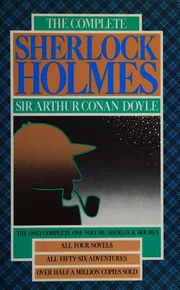
The Complete Sherlock Holmes [4 novels, 56 stories]
by Arthur Conan Doyle · 1900
Suits confident teen readers and adults, and many of the shorter stories work well read aloud.
1122 pages, about 18 to 26 hours.
All of Holmes in one volume, and mostly worth the weight. 58% taste match
The story
This collected edition by Arthur Conan Doyle gathers all four novels and fifty-six stories featuring the detective Sherlock Holmes. The series began in print in 1900 and belongs to the mystery and adventure tradition. The cases are narrated by John H. Watson, a physician who trained in London and went on to army surgical training at Netley before sharing rooms with Holmes. Included are collected short cases such as A Scandal in Bohemia, The Case of Identity, The Boscombe Valley Mystery, Five Orange Pips, The Blue Carbuncle and The Speckled Band.
Most of the action centers on London and the wider English countryside, with threads reaching to India, Agra Fort and the Andaman Islands. Among the people who appear are Mary Morstan, John Sholto, Jonathan Small, Mahomet Singh, Abdullah Khan and Dost Akbar, alongside the dog Toby. The dates that run through the stories span from 1857 to 1888, with several cases set around 1878, 1881 and 1882. Subjects touched on include poisons, air guns, aristocracy, ancestors and anonymity. The book has appeared in 118 editions.
IN THE YEAR 1878 I took my degree of Doctor of Medicine of the University of London, and proceeded to Netley to go through the course prescribed for surgeons in the Army.
Characters
Sherlock HolmesJohn H. WatsonMary MorstanJohn SholtoJonathan SmallMahomet Singh
Setting
EnglandInglaterraIndiaLangham HotelLondon
Period
18881857December 1878
Themes
Adventure storiesair gunsAmericansamoralityancestorsAndamaneseAnglo-Saxonsanise
- Want to read 848
- Reading now 88
- Read 80
- Stopped 2
Most people shelving it are saving it for later.
Of 1018 readers who put it on a shelf, 83% want to read it, 9% are reading it now, 8% have finished it and 0% stopped before the end.
By the numbers
- The median edition runs 1122 pages. Counting about 275 words a page and an adult reading pace of 250 words a minute, that is about 21 hours of reading.
- Open Library tracks 118 editions from 94 publishers, the earliest dated 1900 and the latest 2023, across 7 languages.
- On reader demand it ranks in the top 1% of the classic books in our catalog (8,749 of them).
- Libraries shelve it under Dewey 823.91 and Library of Congress class PR-4620.00000000.C66 2002.
Read it
The text of this edition is free to read online.
1 ebook provider carry it and a scanned copy is on the Internet Archive.
 BookWard’s take
All of Holmes in one volume, and mostly worth the weight
This is the whole canon: four novels and fifty-six stories narrated by Dr. John Watson, starting with the Netley-trained army surgeon's first meeting with Holmes. It's at its best in the openings, since the cases tend to begin with a visitor, a puzzle and a deduction almost at once. The internal logic is close to airtight, and the reasoning is laid out so you can follow it step by step. The short cases move briskly, though the sheer length means you will want to dip in rather than march straight through. The honest caveat is how familiar it all feels: so much crime fiction was built on this template that it can read as well-worn now, but here it is the original. The Holmes and Watson pairing has real depth, while the characters around them are drawn more lightly.
At over a thousand pages and sixty cases, this is about as long as a reading commitment gets, far from BookWard's love of tight books.
Short cases keep things moving briskly, though the Victorian rhythm is a touch slower than modern thrillers.
It established the template for the consulting detective and his chronicler, so the invention is large even where later imitation has dulled it.
Clear, orderly Victorian prose that is more plain than ornate, with period flavor.
The case drives each story, with character revealed through how Holmes and Watson respond to it.
Justice is usually restored and order returns, giving a mildly hopeful outlook despite the crimes.
A conventional structure of client, investigation and explanation repeats reliably across the stories.
Dry wit surfaces between Holmes and Watson, but the tone stays largely serious.
Murder, blackmail and poison appear, though the tone stays measured rather than bleak.
Feeling runs restrained and understated rather than intense.
See all 50 dialsEvery position, side by side with this book
Where it lines up
- Authorial voiceBookWard 9 · book 9
- OpeningBookWard 10 · book 9
- Internal logicBookWard 10 · book 9
Where it pulls apart
- LengthBookWard 1 · book 10
- Familiar tropesBookWard 10 · book 4
- ExpositionBookWard 2 · book 6
At over a thousand pages and sixty cases, this is about as long as a reading commitment gets, far from BookWard's love of tight books.
Cases typically open with a client at the door and a puzzle laid down fast, which matches BookWard's appetite for immediate hooks.
Its devices are the ones countless later detective stories borrowed, so they read familiar today, though here they are the source.
Holmes explains how each solution follows from the clues, which suits BookWard's demand for airtight internal logic.
Short cases keep things moving briskly, though the Victorian rhythm is a touch slower than modern thrillers.
It established the template for the consulting detective and his chronicler, so the invention is large even where later imitation has dulled it.
Holmes and Watson are vividly drawn and grow familiar across the canon, while many clients and culprits are sketched more lightly.
Cases nearly always close with the mystery solved and explained, which BookWard appreciates.
Feeling is kept understated and gentlemanly, with an occasional sentimental touch near the end of a case.
Crimes can be grim, but they serve the puzzle rather than exist for effect, so the darkness feels earned.
This is fiction, so the nonfiction rigor dial does not apply.
Watson's warm, measured narration gives the whole collection a recognizable and distinctive voice.
Plot and puzzle lead, with deduction as the engine, though the method of reasoning is itself a recurring pleasure.
Holmes often explains his reasoning outright at the close, which sits further toward telling than BookWard prefers.
Individual cases stay tight, but over such a long collection some entries feel lighter than the best ones.
Clear, orderly Victorian prose that is more plain than ornate, with period flavor.
The case drives each story, with character revealed through how Holmes and Watson respond to it.
Justice is usually restored and order returns, giving a mildly hopeful outlook despite the crimes.
A conventional structure of client, investigation and explanation repeats reliably across the stories.
Dry wit surfaces between Holmes and Watson, but the tone stays largely serious.
Easy to read in small doses, with period vocabulary the main thing that asks anything of the reader.
Watson tells nearly everything, keeping the viewpoint essentially single.
Cases mostly unfold in order, with occasional backstory recounted by a client or culprit.
The world is firmly grounded, with explanations resting on observation and deduction.
Sixty cases bring a large parade of clients, suspects and villains, even if the core pair stays constant.
Most cases are domestic or local in scale, with occasional reach toward India and empire.
Investigation, travel and confrontation drive things outward, though Holmes's mind is the true engine.
Conversation with clients and between Holmes and Watson carries a great deal of each story.
Romance is minor and incidental, with Holmes himself largely aloof from it.
Victorian London and the English countryside feel vivid, with glimpses of India and farther afield.
Written in the late Victorian era, with dates running well back in the nineteenth century.
More than a century on, Holmes remains a lasting cultural fixture and the stories still hold up.
Watson narrates honestly and loyally, though he understands less than Holmes does.
Right and wrong are mostly clear, with Holmes occasionally bending justice in a humane direction.
London fog, country houses and rooms at Baker Street are drawn with enough detail to establish mood.
Four novels and fifty-six stories make this the entire series gathered in one place.
Reversals and reveals come regularly as Holmes upends first impressions in each case.
Mostly a comfortable read in familiar territory, with the puzzles offering the main challenge.
Murder, blackmail and poison appear, though the tone stays measured rather than bleak.
Feeling runs restrained and understated rather than intense.
Humor is dry and understated rather than broad.
Crimes are central but typically handled with restraint rather than graphic detail.
Sexual content is essentially absent.
Class and empire shape some cases, but politics is rarely the point.
Victorian diction and occasional dialect add some density without becoming difficult.
Watson and Holmes share firm views, giving the narration some personality.
The stories look back from a settled Victorian vantage point rather than forward.
Reason and justice are treated as forces that can prevail, with a modestly idealistic cast.
Review written by BookWard, dial version 1, November 2026.
Who is The Complete Sherlock Holmes [4 novels, 56 stories] right for?
Suits confident teen readers and adults, and many of the shorter stories work well read aloud. Some cases involve murder, poison and blackmail, and period attitudes toward race and empire appear.
Easy to read in small doses, with period vocabulary the main thing that asks anything of the reader.
Murder, blackmail and poison appear, though the tone stays measured rather than bleak.
Feeling runs restrained and understated rather than intense.
Crimes are central but typically handled with restraint rather than graphic detail.
Book CompanionThe Complete Sherlock Holmes [4 novels, 56 stories]: ideas, characters, themes
A brilliant consulting detective and his loyal doctor chronicler solve crimes through observation, deduction and nerve across Victorian England and beyond.
- Watson as narrator. John H. Watson, a doctor trained in London and army surgery at Netley, tells the cases, which gives the stories a grounded, trustworthy voice.
- Short cases and novels. The collection mixes four novels with fifty-six shorter stories, so you can sample single cases or follow longer arcs.
- Deduction on display. Holmes's method rests on noticing small details and reasoning from them, and the stories let readers follow along.
- Empire in the background. Threads reach to India, Agra Fort and the Andaman Islands, linking London crimes to wider imperial history.
- Familiar cases inside. Well-known stories such as A Scandal in Bohemia, The Speckled Band and The Blue Carbuncle sit alongside lesser-known entries.
Characters
Sherlock Holmes
Consulting detective
A brilliant, eccentric investigator who solves cases through observation and deduction.
John H. Watson
Narrator and companion
A doctor who trained in London and at Netley and shares rooms with Holmes, recording his cases.
Mary Morstan
Client and later connection
A figure whose case draws Holmes and Watson into a story tied to India.
Jonathan Small
Figure in a colonial-era mystery
A central name in a case connecting England with India and the Andaman Islands.
Toby
Tracking dog
A dog whose sense of smell helps the investigators follow a trail.
Themes
Careful observation and logic turn confusing events into an explanation that makes sense.
The bond between Holmes and Watson steadies the whole collection.
Holmes sometimes weighs strict law against what seems fair.
Aristocrats, clerks and clients are judged and sometimes misjudged on surface impressions.
Events in India and beyond reach back to trouble in England.
Discussion questions
- Why does Watson make a better narrator than Holmes would?
- Which case best shows Holmes's method, and what makes it work?
- When, if ever, is Holmes right to let a wrongdoer go?
- How do the stories treat class, wealth and aristocracy?
- Does the formula wear thin across sixty cases, or does it reward repetition?
Personalize your Book Companion
This is the general edition. In BookWard, the Companion is written for you: your reading profile, your notes, and spoiler-safe to the page you are on.
Buy, listen or borrow The Complete Sherlock Holmes [4 novels, 56 stories]
Each link opens a search for this book on that store, in a new tab.
Read on a device
Borrow
Reviews and community
If you liked The Complete Sherlock Holmes [4 novels, 56 stories]
The village mystery where Miss Marple first sits down with her knitting
Murder in MesopotamiaAgatha ChristiePoirot in the Iraqi desert: a classic puzzle in a closed circle
PostmortemPatricia CornwellThe forensic procedural that made Kay Scarpetta a fixture of crime fiction
Close to DeathAnthony HorowitzHorowitz and Hawthorne return for a puzzle-box murder among the famous
Sources: Open Library.
Track The Complete Sherlock Holmes [4 novels, 56 stories] and find your next favorite
Add it to your shelf, rate what you have read, and BookWard will recommend what fits you.
Free to start. No credit card needed.