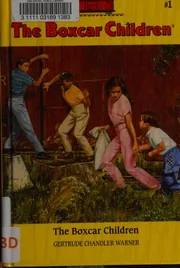
The Boxcar Children
by Gertrude Chandler Warner · 1924
It suits young readers, roughly early elementary age, and works well as a read-aloud or a first chapter book.
154 pages, about 2.5 to 3.5 hours.
Four orphans, a boxcar, and a home they build themselves. 46% taste match
About the book
The Boxcar Children is a children's mystery and adventure novel by Gertrude Chandler Warner, first published in 1924. It is written for young readers and belongs to the high interest, low vocabulary category, with a story built around siblings, a detective thread, and life far from any ordinary home.
The central characters are four orphaned brothers and sisters, Henry, Jessie, Benny, and Violet. After their parents die, they refuse to be split up and leave rather than live with a grandfather they fear. In the woods they find an abandoned railroad boxcar and turn it into a place to live, learning to look after themselves. A dog named Watch is part of the household. When Violet falls seriously ill, the children have to look for help, even though doing so puts their independence at risk. Doctors, a neighbor, and the village of Middlesex figure into the story, which also mentions Silver City. Several editions exist, and the original 1924 text differs slightly from the revised 1942 version most readers know. At about 154 pages in a typical edition, it is a short book that suits younger readers.
ONE WARM NIGHT four children stood in front of a bakery.
Characters
Boxcar ChildrenWatch
Setting
MiddlesexSilver City
Themes
Orphansbrothers and sistersrailroad carsdetective and mystery storiesmystery and detective storiesadventuremystery and suspenseChildren Detectives
- Want to read 338
- Reading now 32
- Read 72
Most people shelving it are saving it for later.
Of 442 readers who put it on a shelf, 76% want to read it, 7% are reading it now, 16% have finished it and 0% stopped before the end.
By the numbers
- The median edition runs 154 pages. Counting about 275 words a page and an adult reading pace of 250 words a minute, that is about 2.8 hours of reading.
- Open Library tracks 87 editions from 44 publishers, the earliest dated 1924 and the latest 2024, across 2 languages.
- On reader demand it ranks in the top 2% of the classic books in our catalog (8,749 of them).
- Libraries shelve it under Dewey [Fic] and Library of Congress class PZ-0007.10000000.B688 2018.
 BookWard’s take
Four orphans, a boxcar, and a home they build themselves
The Boxcar Children is short and brisk. It opens with four children standing in front of a bakery, and the premise arrives almost immediately: orphaned siblings who refuse to be separated. At about 154 pages, it is tightly built, and the opening hooks at once. The pace is quick and the middle never sags, since the children are always fixing, finding or fending for themselves. The adventure is the cozy kind familiar from classic children's books, so it isn't especially original, but the story's logic holds together and the ending is fully resolved. The warmth runs higher than I usually go for, and the prose is plain by design. For a first chapter book, it does exactly what it sets out to do.
At about 154 pages it is a short, quick read, which matches BookWard's love of tight books.
Events move steadily with little lingering, a good fit for BookWard's preference for fast stories.
The boxcar home is memorable, but the overall shape is a familiar children's adventure, a step below BookWard's taste.
The language is deliberately plain for young readers, a little plainer than BookWard's middle ground.
Events and the situation drive the story more than inner development, so it sits on the plot side of BookWard's lean.
The children's resourcefulness and togetherness give it a hopeful feel, in line with BookWard's outlook.
It is told straightforwardly from start to finish, more conventional than BookWard's mild appetite for structure play.
It is gently earnest rather than funny, well below BookWard's leaning toward humor.
Orphaning and illness appear, but the tone stays gentle overall, milder than BookWard's middle ground.
Feelings are present but kept simple and mild, less intense than BookWard's usual taste.
See all 50 dialsEvery position, side by side with this book
Where it lines up
- LengthBookWard 1 · book 1
- Shock for effectBookWard 9 · book 9
- Sagging middleBookWard 8 · book 8
Where it pulls apart
- Familiar tropesBookWard 10 · book 3
- OriginalityBookWard 9 · book 4
- Character depthBookWard 8 · book 3
At about 154 pages it is a short, quick read, which matches BookWard's love of tight books.
It starts with four children outside a bakery, and the situation takes hold from the first page, just as BookWard likes.
Runaway orphans and a secret home are well-worn adventure ideas, so it leans on familiar ground where BookWard wants freshness.
The children's plan to stay together and live in the boxcar follows sensibly, though it is simpler than BookWard's airtight ideal.
Events move steadily with little lingering, a good fit for BookWard's preference for fast stories.
The boxcar home is memorable, but the overall shape is a familiar children's adventure, a step below BookWard's taste.
The four siblings are drawn with clear roles and simple traits, lighter than the deeply drawn characters BookWard prefers.
The story resolves cleanly, which matches BookWard's liking for endings that settle things.
It leans into warmth and the comfort of family, more sentimental than BookWard's restrained taste.
There is no shock for effect, and any hardship, like Violet's illness, serves the story, which BookWard approves of.
This is a novel, so rigor does not apply.
The telling is clear and friendly but fairly generic, short of the distinctive voice BookWard prizes.
This is firmly story-led, with a plot of survival and discovery, and that suits BookWard's story-first lean.
Events are mostly shown through what the children do, with some plain explaining, close to BookWard's preference.
With so short a length and steady incident, the middle stays active throughout, as BookWard wants.
The language is deliberately plain for young readers, a little plainer than BookWard's middle ground.
Events and the situation drive the story more than inner development, so it sits on the plot side of BookWard's lean.
The children's resourcefulness and togetherness give it a hopeful feel, in line with BookWard's outlook.
It is told straightforwardly from start to finish, more conventional than BookWard's mild appetite for structure play.
It is gently earnest rather than funny, well below BookWard's leaning toward humor.
Written in simple language for new readers, it is very easy going, easier than BookWard's usual reading.
The story follows the children together from a single point of view, fewer than BookWard enjoys.
The story proceeds in a straight line, a touch more linear than BookWard typically prefers.
Everything stays within the real world, more grounded than BookWard's slight taste for the fantastical.
It centers on four siblings plus a small circle of helpers, in keeping with BookWard's modest cast size.
The story is intimate, about a few children and their home, in line with BookWard's lean toward the personal.
The focus is on what the children do and build, more outward than BookWard's balanced taste.
Conversation carries parts of the story but is not dominant, a bit lighter than BookWard likes.
There is no romance in the story, which is typical for a children's adventure, a little below BookWard's usual.
The woods and boxcar are mostly everyday settings, more familiar than BookWard's taste for the unfamiliar.
First published in 1924, it belongs to the past, further back than BookWard's usual period.
Its survival-and-family premise still appeals to young readers, keeping decent staying power for BookWard.
The narration is straightforward and trustworthy, far from the unreliable narrators BookWard enjoys.
Right and wrong are clear, and the children's wish to stay together is plainly sympathetic, less ambiguous than BookWard prefers.
Setting is sketched in simple strokes rather than lush detail, a little sparser than BookWard's taste.
This is fiction, so the nonfiction style dial does not apply.
This is fiction, so the nonfiction perspective dial does not apply.
It launched a long-running series, so it leans toward series reading, more so than BookWard's balance.
The plot has some turns, but mostly follows an expected course, fewer than BookWard's taste for surprises.
It is a comforting read for young people, much cozier than the challenge BookWard leans toward.
Orphaning and illness appear, but the tone stays gentle overall, milder than BookWard's middle ground.
Feelings are present but kept simple and mild, less intense than BookWard's usual taste.
Any humor is light and gentle rather than broad, which is a little drier than BookWard's middle.
There is essentially no violence on the page, lighter than BookWard's accepting range.
There is no sexual content, as expected for this audience, less than BookWard's usual tolerance.
Politics do not figure in the story, a bit lower than BookWard's neutral stance.
The language is plain and clear for young readers, simpler than BookWard's occasional appetite for density.
The narration mostly stays neutral, with a gentle friendliness, slightly less opinionated than BookWard likes.
It looks back toward an older sense of childhood independence, less forward-looking than BookWard's lean.
It believes in family loyalty and quiet resourcefulness, more idealistic than BookWard's lean.
Review written by BookWard, dial version 1, November 2026.
Who is The Boxcar Children right for?
It suits young readers, roughly early elementary age, and works well as a read-aloud or a first chapter book. The story begins with orphaned children and includes a character's serious illness, which are gentle but worth knowing about for sensitive readers.
Written in simple language for new readers, it is very easy going, easier than BookWard's usual reading.
Orphaning and illness appear, but the tone stays gentle overall, milder than BookWard's middle ground.
Feelings are present but kept simple and mild, less intense than BookWard's usual taste.
There is essentially no violence on the page, lighter than BookWard's accepting range.
Book CompanionThe Boxcar Children: ideas, characters, themes
Four orphaned siblings refuse to be separated and make a home of their own in an abandoned boxcar.
- The refusal to separate. Henry, Jessie, Benny and Violet leave rather than live with a grandfather they fear, which sets the story in motion.
- The boxcar home. The children convert an abandoned boxcar in the woods into a safe, comfortable place to live.
- Learning to care for themselves. They take on practical work and share responsibilities, learning to look after one another.
- Violet's illness. When Violet becomes seriously ill, the children must seek help and risk their independence.
- Two editions. The original 1924 text differs slightly from the revised 1942 version most readers know.
Characters
Henry
Eldest sibling
One of the four orphaned Alden children who stay together.
Jessie
Sibling
One of the four siblings, sharing in the work of making a home.
Violet
Sibling
The sibling whose serious illness forces the children to seek help.
Benny
Youngest sibling
The youngest of the four children in the boxcar.
Watch
Dog
A dog who becomes part of the children's household.
Themes
The children's bond is strong enough that they would rather leave than be split up.
They learn to manage their own lives without grown-ups.
They turn a discarded boxcar into a home through ingenuity.
The children must weigh their fear of a grandfather against the need for help.
Home is shown as something people make together, not just a place.
Discussion questions
- Why do the children choose to run away instead of living with their grandfather?
- What makes the boxcar a good home for them?
- How do the four siblings divide responsibility among themselves?
- What risk do they take when Violet becomes ill?
- Why do you think this story has stayed popular with young readers?
Personalize your Book Companion
This is the general edition. In BookWard, the Companion is written for you: your reading profile, your notes, and spoiler-safe to the page you are on.
Buy, listen or borrow The Boxcar Children
Each link opens a search for this book on that store, in a new tab.
Read on a device
Borrow
Reviews and community
If you liked The Boxcar Children
A brisk, cozy treasure hunt that starts the Famous Five
Lost in Little Bear’s RoomElse Holmelund MinarikA gentle Little Bear day, tidy, cozy and close to home
Dinosaurs Before DarkMary Pope OsborneA short, brisk first trip into time travel and dinosaurs
The RiverGary PaulsenA short, tense survival sequel that stays on the water
Sources: Open Library.
Track The Boxcar Children and find your next favorite
Add it to your shelf, rate what you have read, and BookWard will recommend what fits you.
Free to start. No credit card needed.