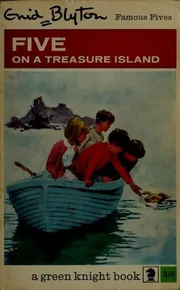
Five on a Treasure Island
by Enid Blyton · 1942
It suits readers in the upper primary years, roughly Grades 4 to 6, and works well as a first chapter-book adventure.
186 pages, about 3 to 4.5 hours.
A brisk, cozy treasure hunt that starts the Famous Five. 45% taste match
About the book
Five on a Treasure Island is a children's adventure novel by Enid Blyton, first published in 1942. It opens the Famous Five series, which follows Julian, Dick, Anne, George and Timmy the dog. The first edition carried illustrations by Eileen Soper. The book is aimed at readers in the upper primary years, roughly Grades 4 to 6, and it has also appeared in translation, including German editions.
The story centers on a shipwreck found near Kirrin Island and the buried treasure that may be connected to it. The children set out to follow the trail of clues, but another party is pursuing the same goal, so the search becomes a race. It combines elements of the mystery and detective tale with the classic treasure hunt, and it is a good fit for anyone who enjoys stories of young people tackling a puzzle and a rival together. At around 186 pages in a typical edition, it is a compact read, and it has been issued in dozens of editions since its first appearance.
Mother have you heard
Characters
Famous Five
Themes
Famous Five (Fictitious characters)famous fivekid's bookadventureChildren's stories, GermanChildren's storiesBuried treasureAdventure and adventurers
- Want to read 421
- Reading now 59
- Read 51
Most people shelving it are saving it for later.
Of 531 readers who put it on a shelf, 79% want to read it, 11% are reading it now, 10% have finished it and 0% stopped before the end.
By the numbers
- The median edition runs 186 pages. Counting about 275 words a page and an adult reading pace of 250 words a minute, that is about 3.4 hours of reading.
- Open Library tracks 85 editions from 38 publishers, the earliest dated 1942 and the latest 2023, across 3 languages.
- On reader demand it ranks in the top 2% of the classic books in our catalog (8,749 of them).
- Libraries shelve it under Dewey 823.912 and Library of Congress class PZ-0007.00000000.
 BookWard’s take
A brisk, cozy treasure hunt that starts the Famous Five
Five on a Treasure Island launches the Famous Five with a shipwreck off Kirrin Island, a trail of clues and a rival party chasing the same prize. At 186 pages it is compact, and it moves quickly because the search never stops being a race. That suits a reader who likes a brisk story, though the familiarity is where it falls short of fresh: the buried treasure, the hidden rivals and the plucky young sleuths are classic fare rather than new ground. The characters are lighter than I would like, since the children work as distinct types more than deeply drawn people. The ending is tidy and resolved, which is satisfying. It is a good-natured, clearly told adventure for young readers, valued more for its momentum than for surprises.
At 186 pages it is a compact, quick read, which matches BookWard's taste for short books.
The search turns into a race against another party, keeping events moving at a brisk clip that BookWard enjoys.
As the opener of a long-running series it set a pattern, but the premise itself is a familiar adventure template.
The language is plain and clear, aimed at upper primary readers, a little plainer than BookWard's usual taste.
Events and the clue-hunt carry the book far more than inner change, which sits on the plot-driven side.
A cheerful children's adventure with a bright outlook, more hopeful than BookWard's usual measure.
A straightforward quest told in order, with no structural experiments.
Light and good-humored in spirit, but the hunt itself is played mostly straight.
Gentle in tone, with only the mild peril that comes with a treasure race.
Feelings are light and friendly, with excitement more than intensity.
See all 50 dialsEvery position, side by side with this book
Where it lines up
- PaceBookWard 8 · book 8
- Shock for effectBookWard 9 · book 9
- LengthBookWard 1 · book 2
Where it pulls apart
- Familiar tropesBookWard 10 · book 2
- Internal logicBookWard 10 · book 6
- OriginalityBookWard 9 · book 3
At 186 pages it is a compact, quick read, which matches BookWard's taste for short books.
A shipwreck and a hunt for treasure give the story a ready-made lure from early on, which BookWard welcomes.
Buried treasure, clue trails and rival seekers are well-worn adventure staples, which BookWard finds a weakness.
A children's mystery with a clear chain of clues holds together reasonably well, though it is not built to be airtight.
The search turns into a race against another party, keeping events moving at a brisk clip that BookWard enjoys.
As the opener of a long-running series it set a pattern, but the premise itself is a familiar adventure template.
The children read as clear, distinct types suited to young readers rather than deeply drawn people, short of BookWard's preference.
A treasure hunt for younger readers resolves its mystery cleanly, which fits BookWard's liking for closure.
Warm and wholesome in spirit, it leans toward the cozy side more than BookWard's restrained taste.
Any danger is mild and in service of adventure, not shock, so it does not lean on cheap darkness.
Blyton's plain, brisk storytelling is recognizable, though it is more serviceable than strikingly distinctive.
This is a story-led adventure driven by the hunt, with ideas playing almost no role.
Young-reader fiction tends to explain things plainly, so setup is clearer and more direct than BookWard likes.
With a short length and a constant chase, there is little room for the middle to drag.
The language is plain and clear, aimed at upper primary readers, a little plainer than BookWard's usual taste.
Events and the clue-hunt carry the book far more than inner change, which sits on the plot-driven side.
A cheerful children's adventure with a bright outlook, more hopeful than BookWard's usual measure.
A straightforward quest told in order, with no structural experiments.
Light and good-humored in spirit, but the hunt itself is played mostly straight.
Written for Grades 4 to 6, it is very easy to read.
The adventure is told as one shared story of the group, with little shifting of perspective.
The hunt unfolds in a simple forward sequence.
A grounded adventure of shipwrecks and treasure hunters, with no fantasy element.
A small band of four children and a dog, plus the rival party, keeps the cast tight.
The action centers on one island and one hunt, an intimate adventure rather than an epic.
The story is about searching, exploring and chasing clues, so outward action dominates.
Adventure stories for children lean on spoken exchanges among the friends, so dialogue carries a good share.
This is a friends-and-family adventure with no romantic focus.
A coastal island and a shipwreck feel like an adventurous but accessible setting.
First published in 1942, it is firmly a story of its own period.
Its enduring reach, with dozens of editions and translations, shows lasting appeal despite its age.
A plain, trustworthy narrator guides the story with no tricks.
Heroes and rivals are clearly drawn, so the moral lines are easy to read.
Setting is sketched with enough color to place the island and wreck without lingering.
It opens the Famous Five series, so it is the first of many rather than a standalone.
The rival hunt adds some turns, but they are the expected kind for a clue-chasing mystery.
A comforting, easy-going adventure rather than a challenging read.
Gentle in tone, with only the mild peril that comes with a treasure race.
Feelings are light and friendly, with excitement more than intensity.
Humor is gentle and middle-of-the-road, nothing dry or broad.
A children's adventure keeps any danger mild and off the grim side.
No sexual content is part of a story aimed at young readers.
The adventure has no political concerns.
The language is plain and accessible for young readers.
The narration mostly tells the tale without heavy editorializing.
A period adventure that looks backward more than forward.
Friendship, courage and cooperation drive the story, giving it an idealistic bent.
Review written by BookWard, dial version 1, November 2026.
Who is Five on a Treasure Island right for?
It suits readers in the upper primary years, roughly Grades 4 to 6, and works well as a first chapter-book adventure. The peril is mild, though as a book from 1942 some of its attitudes reflect its period.
Written for Grades 4 to 6, it is very easy to read.
Gentle in tone, with only the mild peril that comes with a treasure race.
Feelings are light and friendly, with excitement more than intensity.
A children's adventure keeps any danger mild and off the grim side.
Book CompanionFive on a Treasure Island: ideas, characters, themes
Four children and a dog set out to follow clues to buried treasure from a shipwreck, racing a rival party to the prize.
- The shipwreck discovery. A wreck found off Kirrin Island sets the whole adventure in motion.
- A trail of clues. The children search for clues that might lead to the treasure.
- A rival party. Someone else has the same idea, which turns the hunt into a race.
- Start of a series. This is the first Famous Five book, introducing the group and their dog.
- Illustrated edition. The first edition was illustrated by Eileen Soper.
Characters
Julian
One of the Famous Five
A member of the group of children on the treasure trail.
Dick
One of the Famous Five
Another of the children searching for the treasure.
Anne
One of the Famous Five
One of the young adventurers in the group.
George
One of the Famous Five
A member of the five, taking part in the hunt.
Timmy
The dog
The group's canine companion on the adventure.
Themes
Excitement found in exploring, searching and chasing a goal.
The children succeed by working together as a team.
A rival party forces the search to become a race.
Clues and puzzles drive the story forward.
Discussion questions
- Why does the presence of a rival make the treasure hunt more exciting?
- Which clue-following moment would you most like to have taken part in, and why?
- How does the group's teamwork shape what they can achieve?
- What makes an adventure story feel satisfying by the end?
- How might this story feel different to readers today than in 1942?
Personalize your Book Companion
This is the general edition. In BookWard, the Companion is written for you: your reading profile, your notes, and spoiler-safe to the page you are on.
Buy, listen or borrow Five on a Treasure Island
Each link opens a search for this book on that store, in a new tab.
Read on a device
Borrow
Reviews and community
If you liked Five on a Treasure Island
Four orphans, a boxcar, and a home they build themselves
Il Codice del DragoElisabetta DamiA lighthearted mouse mystery at Mouseford Academy, short and quick
Dinosaurs Before DarkMary Pope OsborneA short, brisk first trip into time travel and dinosaurs
Grosso guaio a New YorkElisabetta DamiA light New York mystery for young Thea Stilton fans
Sources: Open Library.
Track Five on a Treasure Island and find your next favorite
Add it to your shelf, rate what you have read, and BookWard will recommend what fits you.
Free to start. No credit card needed.