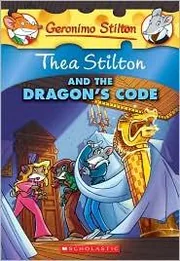
Il Codice del Drago
by Elisabetta Dami · 2005
It suits young readers who enjoy school settings, friend groups and light mysteries.
173 pages, about 2.5 to 4 hours.
A lighthearted mouse mystery at Mouseford Academy, short and quick. 44% taste match
About the book
Il Codice del Drago is a children's mystery and adventure novel by Elisabetta Dami, first published in 2005 and part of the Thea Stilton series. It is a school story told with an all-mouse cast, set at Mouseford Academy, where journalist Thea Stilton arrives to teach a journalism class.
Thea meets five students who become known as the Thea Sisters, among them Colette, who is described as energetic and full of ideas. The group's friendship and their different temperaments, from a peacemaker who dislikes arguments to a traveler who enjoys helping others, shape how they work together. When another student goes missing, Thea and the five students take up the search and try to solve the puzzle behind it, a question the book frames around the Dragon's Code.
The story combines classroom life with detective work and a sense of action. Geronimo Stilton is also connected to the series. The edition runs to roughly 173 pages, and the book has appeared in 26 editions. It suits young readers who enjoy school settings, friendship groups of sisters in spirit, and missing-person mysteries with a lighthearted animal cast.
Characters
Thea StiltonGeronimo StiltonThea Sistersthe Thea Sisters (Colette
Setting
Mouseford AcademyOhio
Themes
JournalistsTeachersSchoolsMissing personsMiceMystery and detective storiesAction AdventureSchool
- Want to read 162
- Reading now 11
- Read 38
Most people shelving it are saving it for later.
Of 211 readers who put it on a shelf, 77% want to read it, 5% are reading it now, 18% have finished it and 0% stopped before the end.
By the numbers
- The median edition runs 173 pages. Counting about 275 words a page and an adult reading pace of 250 words a minute, that is about 3.2 hours of reading.
- Open Library tracks 26 editions from 15 publishers, the earliest dated 2005 and the latest 2020, across 5 languages.
- On reader demand it ranks in the top 4% of the modern books in our catalog (15,152 of them).
- Libraries shelve it under Dewey 853.92 and Library of Congress class PZ-0007.00000000.T336 2009.
 BookWard’s take
A lighthearted mouse mystery at Mouseford Academy, short and quick
Il Codice del Drago is a short children's mystery, 173 pages, set at Mouseford Academy and built around a missing student and a puzzle called the Dragon's Code. The brevity works in its favor. The hook is immediate: Thea Stilton arrives to teach, and a mystery follows almost at once. The trouble is that it leans hard on the boarding-school and friend-group formula, so very little here feels fresh. Character depth is light, with five students each defined by a single trait, like the peacemaker or the traveler. It runs on plot rather than inner life, with a gentle tone and plenty of fun. Good for young readers who want a quick, cheerful case.
At 173 pages it is brisk and compact, which suits BookWard's preference for short books.
The all-mouse cast adds charm, but the school-mystery framework is well worn, short of BookWard's originality bar.
Plain, easy sentences aimed at young readers, far from ornate.
The mystery drives events, with characters serving the search more than shaping it.
A cheerful friend group and a lighthearted tone make this a decidedly hopeful read.
It follows a conventional beginning, middle and end, with no formal experiments.
Mouse puns and exclamations like 'Holey Swiss cheese' set a playful, funny tone.
A disappearance adds some stakes, but the tone stays gentle.
Friendship and worry for a missing classmate bring feeling, kept mild for young readers.
See all 50 dialsEvery position, side by side with this book
Where it lines up
- EndingBookWard 8 · book 8
- LengthBookWard 1 · book 2
- PaceBookWard 8 · book 7
Where it pulls apart
- Familiar tropesBookWard 10 · book 2
- Internal logicBookWard 10 · book 5
- OriginalityBookWard 9 · book 3
At 173 pages it is brisk and compact, which suits BookWard's preference for short books.
A new teacher arrives and a student soon vanishes, so the mystery starts early, in line with BookWard's taste.
School setting, friend group and missing-student plot are familiar ground, which runs against BookWard's wish to avoid tropes.
A kids' mystery tends to resolve its puzzle simply and cleanly, though it is not built for airtight scrutiny.
The all-mouse cast adds charm, but the school-mystery framework is well worn, short of BookWard's originality bar.
Each of the five students is shaped around a main trait, so they read as types more than deep portraits.
Friendship and warmth are central, so it leans gentle and sentimental rather than restrained.
Nothing is there to shock; the missing-student mystery stays light, so any darkness is mild and earned.
Not applicable, since this is fiction.
The narrating Thea Stilton gives it a chatty, branded voice with playful cheese-themed exclamations.
This is firmly story-led, driven by the search for a missing student rather than by ideas.
A first-person narrator who introduces the students and their traits spells things out more than it shows.
Plain, easy sentences aimed at young readers, far from ornate.
The mystery drives events, with characters serving the search more than shaping it.
A cheerful friend group and a lighthearted tone make this a decidedly hopeful read.
It follows a conventional beginning, middle and end, with no formal experiments.
Mouse puns and exclamations like 'Holey Swiss cheese' set a playful, funny tone.
Written for young readers, so it asks very little effort.
Told largely through Thea's eyes, so the viewpoint stays narrow rather than many-sided.
An all-mouse world with talking animals sits clearly in the fantastical, though the school feels familiar.
Thea, five students and the missing student make a modest but not tiny cast.
One academy and one disappearance keep the scale intimate.
The weight falls on searching and investigating rather than on inner reflection.
A group of friends solving a case means lots of back-and-forth talk.
The pack points to friendship and sisterhood, with no romance at the centre.
A school setting is familiar, though the mouse academy adds a touch of the unfamiliar.
Published in 2005 with a school setting, it feels contemporary for its time.
Friendship and mystery last, but the branded series style is fairly tied to its moment.
A first-person narrator telling her own adventure comes across as straightforward and trustworthy.
Friendship, helpfulness and cooperation are clearly on the side of good, with little grey.
Light scene-setting for a quick read, with description kept brief.
It belongs to the Thea Stilton series and connects to Geronimo Stilton, so it is firmly part of a larger run.
A missing-student puzzle brings some turns, but a children's mystery keeps them modest.
This is comforting reading, built to entertain without unsettling.
A disappearance adds some stakes, but the tone stays gentle.
Friendship and worry for a missing classmate bring feeling, kept mild for young readers.
Mouse puns and exclamations are broad, openly playful humor.
A school mystery for children keeps violence close to absent.
Nothing in a book for young readers touches on sex.
Politics do not enter this school adventure.
Plain language throughout, with only playful exclamations to note.
Thea narrates with enthusiastic asides, so the narration has plenty of personality and opinion.
It lives in the present of its story, neither nostalgic nor futuristic.
Cooperation, kindness and friendship are treated as real strengths, an idealistic stance.
Review written by BookWard, dial version 1, November 2026.
Who is Il Codice del Drago right for?
It suits young readers who enjoy school settings, friend groups and light mysteries. Nothing sensitive stands out beyond the worry of a missing classmate.
Written for young readers, so it asks very little effort.
A disappearance adds some stakes, but the tone stays gentle.
Friendship and worry for a missing classmate bring feeling, kept mild for young readers.
A school mystery for children keeps violence close to absent.
Book CompanionIl Codice del Drago: ideas, characters, themes
A visiting journalist and five very different students team up to find a missing classmate and crack the Dragon's Code.
- A new teacher arrives. Thea Stilton comes to Mouseford Academy to teach a journalism class.
- Five students, five temperaments. The Thea Sisters are drawn from different personalities, from the energetic to the peace-loving.
- A student goes missing. The disappearance turns a school term into a search.
- The Dragon's Code. The mystery is framed around a puzzle named in the title.
- Friendship drives the solution. The group's differences shape how they work together.
Characters
Thea Stilton
Narrator and teacher
A journalist invited to teach at Mouseford Academy who joins the search.
Nicky
Student
Always in a good mood when she is outdoors.
Colette
Student
Energetic and full of great ideas.
Pamela
Student
A peacemaker who cannot stand arguments.
Violet
Student
Detail-oriented and always open to new things.
Themes
Companions with different strengths accomplish more together.
Different temperaments combine to solve a shared problem.
Asking questions and noticing details lead to answers.
Care for a missing classmate motivates the search.
A new place and new classmates form the backdrop for growing up.
Discussion questions
- Which of the five students would you want on your team, and why?
- How do the students' different personalities help or slow the search?
- What makes a good mystery for a young reader?
- Why might the book use mice and cheese-themed jokes?
- What would you have done first when a classmate went missing?
Personalize your Book Companion
This is the general edition. In BookWard, the Companion is written for you: your reading profile, your notes, and spoiler-safe to the page you are on.
Buy, listen or borrow Il Codice del Drago
Each link opens a search for this book on that store, in a new tab.
Read on a device
Borrow
Reviews and community
If you liked Il Codice del Drago
A light New York mystery for young Thea Stilton fans
La montagna parlanteElisabetta DamiA cross-country mouse adventure for young mystery lovers
Big Nate in the ZoneLincoln PeirceA lucky foot, a hot streak, and a sixth grader on a roll
Quattro Topi Nella Giungla NeraElisabetta DamiA timid mouse gets dragged into the jungle, and the fun starts
Sources: Open Library.
Track Il Codice del Drago and find your next favorite
Add it to your shelf, rate what you have read, and BookWard will recommend what fits you.
Free to start. No credit card needed.