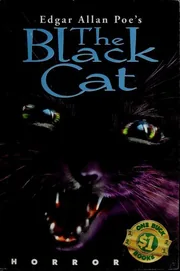
The Black Cat
by Edgar Allan Poe · 1914
Best for mature teens and adults, since the story is short and clear but graphic about animal cruelty and murder.
32 pages, about 0.5 to 0.5 hours.
Poe's confession of a man undone by his own cruelty. 60% taste match
The story
"The Black Cat" is a short horror story by the American writer Edgar Allan Poe, told in the first person by an unnamed narrator. It first appeared in The Saturday Evening Post in August 1843, and this edition dates from 1914. Running to about 32 pages, it sits within Gothic and horror fiction and has circulated in well over a hundred editions, including miniature-book and children's formats.
The narrator begins as a man devoted to animals, with a favorite pet in a black cat. Drink and a perverse streak turn him toward cruelty, and the story follows how that cruelty grows, touching the cat, a second black cat that later comes into his home, and his wife. A fire, a cellar wall, and a visit from the police figure in the later events. Because the account comes from the narrator himself, with his self-hatred and shaky reliability at the center, the story reads as a confession and a study of guilt, set in a domestic American world of the nineteenth century. It also turns up in many collections of Poe's best-known tales and of classic horror stories.
FOR the most wild, yet most homely narrative which I am about to open, I neither expect nor solicit belief.
Themes
catsshort storyfirst-person narrativeunreliable narratorsself-hatredgallowsMiniature booksSpecimens
- Want to read 119
- Reading now 5
- Read 34
Most people shelving it are saving it for later.
Of 158 readers who put it on a shelf, 75% want to read it, 3% are reading it now, 22% have finished it and 0% stopped before the end.
By the numbers
- The median edition runs 32 pages. Counting about 275 words a page and an adult reading pace of 250 words a minute, that is about 35 minutes of reading.
- Open Library tracks 122 editions from 40 publishers, the earliest dated 1914 and the latest 2022, across 5 languages.
- On reader demand it ranks in the top 7% of the classic books in our catalog (8,749 of them).
- Libraries shelve it under Dewey 428.6461 and Library of Congress class PS-2618.00000000.B57 1994.
 BookWard’s take
Poe's confession of a man undone by his own cruelty
At about 32 pages, this is Poe at his most compressed: a first-person confession from an unnamed narrator who starts as an animal lover and curdles into something else. It hooks at once, because the narrator announces his own downfall and then walks you through it. The story lives in its unreliable narrator, since everything we learn arrives through a man who is lying to himself. The logic is tight, every cruelty feeding the next, and the ending is fully resolved. It earns its darkness more than it shocks for effect, though the violence is unsparing. The prose is ornate, but the length keeps it quick. A story about guilt that still feels lean.
At roughly 32 pages it is as short and tight as a story gets, which fits BookWard's taste exactly.
The story moves briskly from affection to cruelty to catastrophe without lingering, close to BookWard's preference.
The confessional, self-incriminating narrator was strikingly inventive in its day, though later imitation dulls it somewhat.
The nineteenth-century diction and heightened Gothic cadences read as ornate to modern ears, richer than BookWard's usual plainness.
Events matter, but the story is driven by one man's compulsions, so it leans slightly toward character.
There is no redemption here; the story ends in ruin and exposure, far from BookWard's mildly hopeful middle.
A single linear confession keeps the structure conventional, close to BookWard's taste.
The tone is grim throughout, with no comic relief.
Animal cruelty, alcoholism, and murder make this a dark story.
The narrator's dread and rage build to genuine intensity, even as the telling stays controlled.
See all 50 dialsEvery position, side by side with this book
Where it lines up
- LengthBookWard 1 · book 1
- PaceBookWard 8 · book 8
- OpeningBookWard 10 · book 9
Where it pulls apart
- Familiar tropesBookWard 10 · book 6
- OutlookBookWard 7 · book 1
- ToneBookWard 7 · book 1
At roughly 32 pages it is as short and tight as a story gets, which fits BookWard's taste exactly.
The narrator frames his own ruin from the opening lines, so the pull starts immediately, matching what BookWard wants.
The haunted-cat and guilty-confession shapes became well-worn Gothic ground, partly because Poe set the pattern, so it feels less fresh now.
Each act of cruelty follows from the last and the final discovery is neatly seeded, which suits BookWard's love of airtight plotting.
The story moves briskly from affection to cruelty to catastrophe without lingering, close to BookWard's preference.
The confessional, self-incriminating narrator was strikingly inventive in its day, though later imitation dulls it somewhat.
We know the narrator intimately from the inside, yet the wife and the cats stay thin, so depth is uneven.
The final scene closes the story decisively, leaving little ambiguity, in line with BookWard's taste.
Poe offers no consolation or softening, only cold self-accounting, which BookWard's restrained taste welcomes.
The cruelty is graphic but tied to the narrator's unraveling, so the darkness feels earned more than gratuitous.
This is fiction, so the nonfiction rigor dial does not apply.
The feverish, self-justifying first-person voice is unmistakably Poe, distinctive and hard to imitate.
It is a story first, though the study of guilt and perversity gives it real thematic weight.
The narrator explains his own motives at length rather than only showing them, which sits above BookWard's preference.
At this length there is no room to sag; tension builds steadily to the end.
The nineteenth-century diction and heightened Gothic cadences read as ornate to modern ears, richer than BookWard's usual plainness.
Events matter, but the story is driven by one man's compulsions, so it leans slightly toward character.
There is no redemption here; the story ends in ruin and exposure, far from BookWard's mildly hopeful middle.
A single linear confession keeps the structure conventional, close to BookWard's taste.
The tone is grim throughout, with no comic relief.
Short and clear in plot, though the period language asks for some attention.
Everything comes through one narrator's eyes, which is far fewer viewpoints than BookWard usually likes.
The narrator recounts events in order from a retrospective frame, so the timeline is essentially linear.
The burned cat outline and the cry from the wall hover between superstition and coincidence, nudging past pure realism.
A narrator, a wife, and two cats make for a very small cast.
The action stays inside one household, as intimate as a story can be.
The weight falls on the narrator's mind and motives more than on external action.
Spoken exchange is sparse; the story is almost entirely narration.
The marriage is background, not a romantic plot.
A domestic American nineteenth-century setting reads as fairly familiar.
Set and written in the 1840s, it sits firmly in the past.
The study of guilt and self-destruction still lands, and the story remains endlessly anthologized.
The narrator's self-excusing account is the heart of the story, making him about as unreliable as narrators get.
The narrator's guilt is plain, but his account of perversity and his unreliability leave some ambiguity about causes.
Poe uses vivid, sometimes lurid detail for the key images, though the story is not lavishly descriptive.
It is a standalone tale, though it appears in many Poe collections.
The walled-in cat in the final scene delivers a payoff, though the story signals its doom early.
The subject matter and moral discomfort make it unsettling rather than comforting.
Animal cruelty, alcoholism, and murder make this a dark story.
The narrator's dread and rage build to genuine intensity, even as the telling stays controlled.
There is no humor to speak of.
The cruelty to the cat and the murder of the wife are described plainly and are central to the plot.
No sexual content appears.
The story has no political dimension.
The language is formal and period-flavored, but not dialect or especially dense.
The narrator argues his case and judges himself, so the narration is far from neutral.
The story is an after-the-fact reckoning, looking backward on a fall already complete.
The worldview is bleak and self-lacerating, with no idealism in sight.
Review written by BookWard, dial version 1, November 2026.
Who is The Black Cat right for?
Best for mature teens and adults, since the story is short and clear but graphic about animal cruelty and murder. Sensitive readers should know that violence against pets and a wife is central and unsoftened.
Short and clear in plot, though the period language asks for some attention.
Animal cruelty, alcoholism, and murder make this a dark story.
The narrator's dread and rage build to genuine intensity, even as the telling stays controlled.
The cruelty to the cat and the murder of the wife are described plainly and are central to the plot.
Book CompanionThe Black Cat: ideas, characters, themes
A man who loves animals and then destroys what he loves narrates his own downfall, and the story questions whether his self-account can be trusted.
- The turn from love to cruelty. The narrator begins as a devoted animal lover, and the story tracks how drink and a perverse impulse turn that affection into abuse.
- A confession as a frame. Because the narrator tells his own story, we see his rationalizations and evasions as part of the evidence against him.
- The second cat. A similar black cat later enters his home, and his hatred of it grows out of what he already did to the first.
- Fire and the wall. A house fire and a hidden cellar wall carry the story's physical imagery of guilt and concealment.
- The police visit. The arrival of the police sets up the story's final confrontation, where the narrator's pride and the cat's cry collide.
Characters
The narrator
Unnamed first-person speaker
A man who starts as a gentle pet lover and descends into cruelty, telling the story in a self-justifying voice.
The narrator's wife
His long-suffering spouse
She shares his love of animals and becomes a victim of his violence.
The first black cat
The narrator's favorite pet
His beloved companion, who becomes the first target of his cruelty.
The second black cat
A similar stray that enters his home
A look-alike with a white mark on its chest, which the narrator comes to hate.
Themes
The story is built around a conscience that cannot be silenced, however the narrator tries to explain it away.
The narrator describes an impulse to do wrong simply because it is wrong, a central idea in Poe's thinking.
Drink loosens the narrator's restraint and speeds his slide into violence.
We must read around the narrator's excuses to see what he actually did.
What is hidden eventually reveals itself, and the story stages that revelation vividly.
Discussion questions
- How far can we trust the narrator's explanation of his own actions?
- Does the story treat the narrator's alcoholism as a cause, an excuse, or both?
- Why might Poe have chosen a black cat as the central animal?
- What role does the supernatural play, and does the story need it?
- Does the narrator's final act of pride feel inevitable, and why?
Personalize your Book Companion
This is the general edition. In BookWard, the Companion is written for you: your reading profile, your notes, and spoiler-safe to the page you are on.
Buy, listen or borrow The Black Cat
Each link opens a search for this book on that store, in a new tab.
Read on a device
Borrow
Reviews and community
If you liked The Black Cat
Four tight novellas about retribution, with no comfort offered
The CollectorJohn FowlesA kidnapping told twice, by captor and captive
ArielSylvia PlathPlath's last poems, tight, startling, and impossible to mistake for anyone else
PsychoRobert BlochA short, sharp shocker that lives inside one man's head
Sources: Open Library.
Track The Black Cat and find your next favorite
Add it to your shelf, rate what you have read, and BookWard will recommend what fits you.
Free to start. No credit card needed.