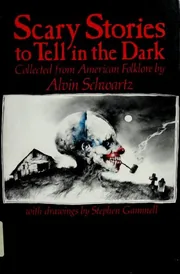
Scary stories to tell in the dark
by Alvin Schwartz · 1981
Written for young readers, it suits kids who enjoy being a little scared and anyone who likes short tales.
111 pages, about 2 to 2.5 hours.
Folklore chills in short bursts, made for reading aloud. 47% taste match
The story
Scary Stories to Tell in the Dark, by Alvin Schwartz, was first published in 1981. It is a collection of American horror tales and ghost stories drawn from folklore, written for young readers. The book gathers short pieces that range across several kinds of frightening material, including tales of ghosts and witches, stories built to make a listener jump, scary songs, and stories set in the present day. One of its openings follows a boy digging at the edge of a garden who comes across a big toe.
The material is rooted in American oral tradition, and the book points to the days when pioneers entertained themselves by telling scary stories. Many of the entries are meant to be read aloud or passed along from person to person, much as folk tales have always traveled. At a median length of about 111 pages, it is a compact volume, and it has appeared in 32 editions, including Spanish-language translations. Readers interested in folklore, ghost stories, and short horror fiction for younger audiences will find the book a natural fit.
A boy was digging at the edge of the garden when he saw a big toe.
Setting
United StatesAmerica
Themes
Cuentos de terror estadounidensesAmerican Ghost storiesAmerican Horror talesCuentos de fantasmas estadounidensesTalesFolkloreCuentos popularesHorror stories
- Want to read 424
- Reading now 16
- Read 58
Most people shelving it are saving it for later.
Of 498 readers who put it on a shelf, 85% want to read it, 3% are reading it now, 12% have finished it and 0% stopped before the end.
By the numbers
- The median edition runs 111 pages. Counting about 275 words a page and an adult reading pace of 250 words a minute, that is about 2.0 hours of reading.
- Open Library tracks 32 editions from 18 publishers, the earliest dated 1981 and the latest 2019, across 2 languages.
- On reader demand it ranks in the top 1% of the modern books in our catalog (15,152 of them).
- Libraries shelve it under Dewey 398.2 and Library of Congress class PZ-0074.10000000.S34 1998.
 BookWard’s take
Folklore chills in short bursts, made for reading aloud
This is a compact collection of American folk horror, and it moves the way campfire stories do. At 111 pages it is short, and each piece gets in and out fast, with no sagging middle to worry about. The opening hooks at once because every story is a self-contained setup built to land. Familiar tropes are part of the point, since ghosts, witches and jump scares come straight from oral tradition, so it leans on them more than I usually like. What it offers instead is staying power: these tales have been passed along for generations. Character depth is thin by design, and there is almost no exposition because the telling does the work. Pick it for the shiver, not for surprise.
At 111 pages of short pieces, it is as tight as a collection gets, which suits BookWard's taste for brevity.
Short pieces built to land quickly keep things moving, close to BookWard's fast-paced taste.
These are retellings of traditional tales, so the material is familiar even when the delivery is sharp.
The language is plain and conversational, built for the ear rather than ornament.
Plot is everything here, with events driving each tale rather than inner lives.
Most tales end badly for someone, so the outlook leans bleak rather than hopeful.
A collection of separate stories grouped by kind, with songs mixed in, is a little different from a standard narrative.
Some tales carry a wry or playful edge, but the book is mainly there to unsettle.
Ghosts and gruesome imagery give it real darkness, tempered by a young audience.
The feeling is mostly fear and suspense in short bursts rather than deep emotion.
See all 50 dialsEvery position, side by side with this book
Where it lines up
- LengthBookWard 1 · book 1
- SentimentBookWard 8 · book 8
- ExpositionBookWard 2 · book 2
Where it pulls apart
- Familiar tropesBookWard 10 · book 3
- Internal logicBookWard 10 · book 4
- OriginalityBookWard 9 · book 3
At 111 pages of short pieces, it is as tight as a collection gets, which suits BookWard's taste for brevity.
Each story opens straight into its creepy setup, so there is no warm-up and the collection earns its place at the top.
Ghosts, witches and jump stories are the stock of folklore, so familiar tropes are the raw material here, unlike BookWard's usual preference.
Folk tales run on dream logic and abrupt reversals, so the rules are loose, which sits below BookWard's airtight standard.
Short pieces built to land quickly keep things moving, close to BookWard's fast-paced taste.
These are retellings of traditional tales, so the material is familiar even when the delivery is sharp.
Characters are sketches that exist to meet something frightening, well short of the depth BookWard values.
Many tales close on a sting or a punchline rather than a full resolution, leaving some ambiguity.
There is little softness in these stories, so they stay mostly restrained, in line with BookWard.
The scares are the point, and many come from sudden reveals, so the darkness is more for effect than earned slowly.
Not applicable, since this is a collection of fiction and folklore.
The plain, spoken-aloud tone has a recognisable storyteller feel, though it is not a sharply individual style.
These are story-led pieces with no argument to make, which fits BookWard's lean toward story.
Stories are told in scene and anecdote with almost no explaining, matching BookWard's preference.
With each tale this brief there is no middle to sag, so energy holds throughout.
The language is plain and conversational, built for the ear rather than ornament.
Plot is everything here, with events driving each tale rather than inner lives.
Most tales end badly for someone, so the outlook leans bleak rather than hopeful.
A collection of separate stories grouped by kind, with songs mixed in, is a little different from a standard narrative.
Some tales carry a wry or playful edge, but the book is mainly there to unsettle.
Short, simple and readable, it asks almost nothing of the reader.
Many different tales mean many different perspectives, though none are developed.
Each story runs straight through, so time is mostly linear.
Ghosts, witches and the supernatural drive most entries, so it sits well toward the fantastical.
Dozens of stories bring a large cast of one-off characters, though none recur.
The stories are small and personal, centred on a single scare at a time.
Action and incident dominate, with little time spent inside anyone's head.
Dialogue appears in the tales but the telling leans on narration and incident.
Romance is not a concern of these stories.
Settings are everyday American places like homes and roads, so the world feels familiar.
Many tales draw on older folk traditions, with some set in modern times.
Folk tales passed down through generations, with 32 editions, show real staying power.
The storyteller is a straightforward, trustworthy teller of the tale.
Tales tend to be clear about what is frightening, with a simple sense of right and wrong where it appears.
Description is kept spare, just enough to set the scene for the scare.
It stands alone as a single volume, though other collections exist.
Many tales hinge on a sudden turn or sting at the end.
It is meant as entertainment to be shared, not a test of the reader.
Ghosts and gruesome imagery give it real darkness, tempered by a young audience.
The feeling is mostly fear and suspense in short bursts rather than deep emotion.
Some entries use broad, silly punchlines alongside the scares.
Violence is present in several tales but mostly brief and implied.
There is no sexual content in a book written for young readers.
Politics does not feature in these folk tales.
The language is plain and easy to read aloud.
Narration stays neutral and simply tells the story.
The material is rooted in old oral tradition, so it looks backward.
The tales lean toward a cynical view, where danger and bad luck are never far off.
Review written by BookWard, dial version 1, November 2026.
Who is Scary stories to tell in the dark right for?
Written for young readers, it suits kids who enjoy being a little scared and anyone who likes short tales. Some stories involve death and gruesome imagery that may unsettle sensitive children.
Short, simple and readable, it asks almost nothing of the reader.
Ghosts and gruesome imagery give it real darkness, tempered by a young audience.
The feeling is mostly fear and suspense in short bursts rather than deep emotion.
Violence is present in several tales but mostly brief and implied.
Book CompanionScary stories to tell in the dark: ideas, characters, themes
American folklore, ghost stories and scary songs gathered into short pieces made for telling aloud to a listener.
- Rooted in oral tradition. The book points back to pioneers who entertained themselves by telling scary stories.
- Many kinds of fright. It mixes ghost and witch tales, jump stories, scary songs and modern-day scary stories.
- Built to be told. Many entries are meant to be read aloud or passed from person to person.
- Compact format. At about 111 pages, it works for quick reading or dipping into.
- Wide reach. It has appeared in 32 editions, including Spanish-language translations.
Themes
The stories exist to give a safe, shared shiver.
Tales passed down by word of mouth keep changing as they travel.
Ghosts and witches intrude on ordinary life.
Delivery and timing matter as much as the plot.
Discussion questions
- Which story is scariest when read aloud, and why?
- How does a jump story differ from a ghost story?
- Why do frightening tales survive for generations?
- What makes a short scary story land its ending?
- How might these stories change each time they are retold?
Personalize your Book Companion
This is the general edition. In BookWard, the Companion is written for you: your reading profile, your notes, and spoiler-safe to the page you are on.
Buy, listen or borrow Scary stories to tell in the dark
Each link opens a search for this book on that store, in a new tab.
Read on a device
Borrow
Reviews and community
If you liked Scary stories to tell in the dark
A condemned woman, a dead husband who may not be dead
Just After SunsetStephen KingStephen King's short-story set: thirteen tales, mostly dark, mostly fast
Say Cheese and Die!Robert Lawrence StineA fast, cursed-camera Goosebumps tale built for young readers
The SleepwalkerRobert Lawrence StineA quick Fear Street chiller about sleepwalking and a suspicious old woman
Sources: Open Library.
Track Scary stories to tell in the dark and find your next favorite
Add it to your shelf, rate what you have read, and BookWard will recommend what fits you.
Free to start. No credit card needed.