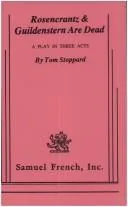
Rosencrantz & Guildenstern are dead
by Tom Stoppard, Fay Kanin · 1967
It suits teens and adults, especially anyone who knows Hamlet or studies drama.
125 pages, about 2 to 3 hours.
Two bit players stranded inside Hamlet, and the best jokes in drama. 62% taste match
What is inside
Tom Stoppard's play, first published in 1967, is a work of English drama that takes Shakespeare's Hamlet as its starting point. It follows Rosencrantz and Guildenstern, two minor figures from that tragedy, and places them at the center of the action. The two are Elizabethans who begin by passing time in a setting with no visible character, and the play keeps them in view as events at the Danish court unfold around them.
The play belongs to the 20th century and is often discussed in connection with existentialism. It draws on the politics and government of Denmark in the period of the original tragedy, and Hamlet appears within its world. It was also adapted as a motion picture. Editions of the script run to roughly 125 pages, and the text has been issued many times, including in theater programs and other specimens of the stage version. Readers interested in drama, in retellings of Shakespeare, or in the work of Tom Stoppard will find a compact script built around two bewildered companions caught inside a larger story.
TWO ELIZABETHANS passing the time in a place without any visible character.
Characters
RosencrantzGuildensternTom Stoppard
Setting
Israel
Period
20th century
Themes
English dramaMotion picture playsDramaHamlet (Legendary character)ExistentialismHamlet (Legendary character) -- DramaExistentialism -- DramaPolitics and government
- Want to read 81
- Reading now 1
- Read 39
Most people shelving it are saving it for later.
Of 121 readers who put it on a shelf, 67% want to read it, 1% are reading it now, 32% have finished it and 0% stopped before the end.
By the numbers
- The median edition runs 125 pages. Counting about 275 words a page and an adult reading pace of 250 words a minute, that is about 2.3 hours of reading.
- Open Library tracks 55 editions from 25 publishers, the earliest dated 1967 and the latest 2023, across 4 languages.
- On reader demand it ranks in the top 9% of the classic books in our catalog (8,749 of them).
- Libraries shelve it under Dewey 822.914 and Library of Congress class PR-6069.00000000.T6 R6 1991x.
 BookWard’s take
Two bit players stranded inside Hamlet, and the best jokes in drama
Stoppard takes the two throwaway courtiers from Hamlet and makes them the leads, and the result is a comedy of confusion that keeps tilting toward dread. It is driven by its ideas more than its story, which I usually resist, but the logic is airtight and the premise is original enough to earn the exception. The opening hooks at once, the dialogue carries nearly everything, and the pace stays quick across a short script. Exposition is the weak spot: the characters talk their predicament out loud rather than letting scenes show it. Still, the voice is unmistakable and the humor has real teeth. At 125 pages, nothing sags, and the ending is fixed by Shakespeare, so it lands as inevitable rather than evasive.
At about 125 pages it is a compact script, which suits BookWard's preference for tight books.
Rapid-fire exchanges keep it moving, though the talk occasionally stalls on purpose, slightly below BookWard's pace.
Seeing Hamlet from the worm's-eye view of its minor figures is a genuinely fresh conceit, fully in line with BookWard.
The language is polished and playful, with a literary shine slightly more ornate than BookWard's usual plain lean.
Events are mostly borrowed from Hamlet, so the play leans on its two characters' bafflement as much as plot.
The characters drift toward a fate they cannot escape, so the outlook is bleak, below BookWard's hopeful side.
Placing its heroes in the wings of another play is a formally daring choice, more experimental than BookWard's norm.
It is a comedy of mistaken identity and verbal games, funnier than BookWard's typical balance.
Dark ideas run under the jokes, though the tone remains lighter than a grim tragedy.
Feeling is held back behind banter, so the intensity stays modest compared with BookWard's middle.
See all 50 dialsEvery position, side by side with this book
Where it lines up
- LengthBookWard 1 · book 1
- EndingBookWard 8 · book 8
- Shock for effectBookWard 9 · book 9
Where it pulls apart
- Story or ideasBookWard 3 · book 9
- ExpositionBookWard 2 · book 8
- Internal logicBookWard 10 · book 8
At about 125 pages it is a compact script, which suits BookWard's preference for tight books.
Two men killing time with an absurd game gets the play moving immediately, which BookWard rewards.
Retelling a classic from the sidelines avoids the usual tropes, so it sits close to BookWard's taste.
The play follows a strict internal scheme tied to Hamlet's events, which matches BookWard's love of airtight logic.
Rapid-fire exchanges keep it moving, though the talk occasionally stalls on purpose, slightly below BookWard's pace.
Seeing Hamlet from the worm's-eye view of its minor figures is a genuinely fresh conceit, fully in line with BookWard.
The two leads are sharply distinct and quietly moving, though drawn more by wit than deep interiority.
The fate of the pair is set by the source tragedy, so it feels resolved and inevitable, close to BookWard's preference.
Stoppard keeps feeling at arm's length and lets jokes do the work, which suits BookWard's restraint.
Whatever darkness arrives is built into the premise and earned rather than dropped in for effect.
This is a stage play, so rigor as a nonfiction measure does not apply.
Stoppard's wordplay and rhythm are unmistakable, giving the play a voice BookWard prizes.
The play is driven by its philosophical premise more than by plot, the opposite of BookWard's story-led lean.
The two men often explain their predicament aloud rather than letting scenes show it, a mark against it for BookWard.
Short and relentlessly inventive, it stays sustained from start to finish, in step with BookWard.
The language is polished and playful, with a literary shine slightly more ornate than BookWard's usual plain lean.
Events are mostly borrowed from Hamlet, so the play leans on its two characters' bafflement as much as plot.
The characters drift toward a fate they cannot escape, so the outlook is bleak, below BookWard's hopeful side.
Placing its heroes in the wings of another play is a formally daring choice, more experimental than BookWard's norm.
It is a comedy of mistaken identity and verbal games, funnier than BookWard's typical balance.
The wordplay and philosophical turns ask for attention, a bit more effort than BookWard's usual reading.
The action stays fixed on the two leads, a narrow focus compared with BookWard's taste for many viewpoints.
Events run in a straightforward line alongside Hamlet, so the timeline is close to linear.
The setting bends reality in dreamlike ways without becoming outright fantasy.
Nearly all of it is two men in a bare setting, far from epic and more intimate than BookWard's middle.
Talk and reflection fill the stage while little physically happens, leaning to inner thought over BookWard's balance.
Almost everything is spoken, so dialogue-heavy that it tops even BookWard's high preference.
Romance barely registers in this story of two bewildered courtiers.
A shadowy version of the Danish court gives an unfamiliar frame, though Hamlet readers will recognize it.
Set in the Elizabethan-era story world and written in the 1960s, it sits in the past, unlike BookWard's present-day lean.
Its questions about fate and purpose have kept it staged and read for decades, in line with BookWard.
A stage script has no narrator, so the question of reliability barely arises.
The play tends toward uncertainty about right and wrong rather than a clear lesson, though it stays less ambiguous than BookWard's lean.
A script holds little scene-setting prose, so description stays sparse compared with BookWard's richer lean.
It stands alone as a complete play.
Hamlet's plot is already known, so surprises come from method and wit rather than from plot.
It poses unsettling questions about fate and meaning, challenging while remaining entertaining.
Dark ideas run under the jokes, though the tone remains lighter than a grim tragedy.
Feeling is held back behind banter, so the intensity stays modest compared with BookWard's middle.
The humor is dry, built on wordplay and deadpan exchange, drier than BookWard's middle.
Violence mostly stays offstage in this talky play.
Sexual content is minimal.
The court's politics sit in the background while the two leads grapple with their own fate.
The language is clever but not difficult, only mildly dense.
Stoppard keeps a light, ironic distance rather than pressing a firm stance.
Fixed to events already written in Hamlet, it looks backward rather than forward.
A fatalistic, cynical view of free will runs through it, lower than BookWard's hopeful lean.
Review written by BookWard, dial version 1, November 2026.
Who is Rosencrantz & Guildenstern are dead right for?
It suits teens and adults, especially anyone who knows Hamlet or studies drama. The tone is witty, with philosophical themes of death and fate but little explicit content.
The wordplay and philosophical turns ask for attention, a bit more effort than BookWard's usual reading.
Dark ideas run under the jokes, though the tone remains lighter than a grim tragedy.
Feeling is held back behind banter, so the intensity stays modest compared with BookWard's middle.
Violence mostly stays offstage in this talky play.
Book CompanionRosencrantz & Guildenstern are dead: ideas, characters, themes
Two minor figures from Hamlet take the lead and try to make sense of events they cannot control.
- Hamlet from the margins. The play places two bit players at the center of Shakespeare's tragedy and watches the court around them.
- Echoes of Waiting for Godot. Its pair of bewildered companions passing time recalls Beckett's theatre of waiting.
- Reality and illusion. The line between what is staged and what is real keeps blurring as the story moves.
- Fate as destination. The ending is set by the source play, so tension comes from how the pair meets it.
- Built for the stage. As a script of roughly 125 pages, it is meant to be performed and read quickly.
Characters
Rosencrantz
One of the two leads
A bewildered courtier from Hamlet who gets his own turn at center stage.
Guildenstern
One of the two leads
Rosencrantz's partner, equally lost, who tries to reason about what is happening.
Hamlet
Figure from the source play
The Danish prince appears within the world of the play, seen from the edges.
Themes
Whether the characters can escape an outcome already written for them.
The search for purpose in a world that gives no clear answers.
How theatre and life blur when roles are assigned for you.
Two companions leaning on each other while confused.
What it is like to be a supporting figure in someone else's story.
Discussion questions
- Why does Stoppard choose two minor characters instead of the prince as his focus?
- Is the pair's fate tragic if it was fixed from the start?
- How does knowing Hamlet change how you watch the play?
- Where does the humor end and the dread begin?
- What does the play suggest about free will?
Personalize your Book Companion
This is the general edition. In BookWard, the Companion is written for you: your reading profile, your notes, and spoiler-safe to the page you are on.
Buy, listen or borrow Rosencrantz & Guildenstern are dead
Each link opens a search for this book on that store, in a new tab.
Read on a device
Borrow
Reviews and community
If you liked Rosencrantz & Guildenstern are dead
A short Gothic fable that trades on wit, not dread
The Daughter of TimeJosephine TeyA bedridden detective cracks a 500-year-old case, and it's gripping
MetamorphosisFranz KafkaA salesman wakes as an insect, and the logic never blinks
Uno, nessuno e centomilaLuigi PirandelloOne man unravels his own identity, one nose-tilt at a time
Sources: Open Library.
Track Rosencrantz & Guildenstern are dead and find your next favorite
Add it to your shelf, rate what you have read, and BookWard will recommend what fits you.
Free to start. No credit card needed.