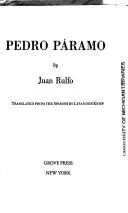
Pedro Páramo
by Juan Rulfo · 1955
Suited to adult and mature teen readers comfortable with demanding, fragmentary fiction.
131 pages, about 2 to 3 hours.
A short ghost-town novel that rewired Latin American fiction. 64% taste match
The story
Pedro Páramo is a short novel by the Mexican writer Juan Rulfo, first published in 1955. It belongs to literary fiction and blends ghost story with rural family drama, running to roughly 131 pages in its usual editions. The book has been translated widely, with more than 30 languages to its name, and is available in well over a hundred editions.
The story follows Juan Preciado, who makes a promise to his dying mother to find the father he has never met. He travels to Comala, a town in the south of Jalisco, only to find it inhabited by spectral figures. As these ghostly residents speak, they tell of life and afterlife in the town and of Pedro Páramo, the father Juan has come to find, whose domineering presence shaped Comala and the peasants who lived there. Set in rural Mexico in the twentieth century, the novel opens with its narrator arriving in Comala because he was told his father lived there. It has been named as an influence by Latin American writers, including Gabriel García Márquez.
Vine a Comala porque me dijeron que acá vivía mi padre, un tal Pedro Páramo.
Characters
Juan Rulfo
Setting
MexicoMéxico
Themes
FicciónReadersSpanish languageJalisco (México)PeasantsCampesinosDespotismeRomans, nouvelles
- Want to read 259
- Reading now 22
- Read 51
Most people shelving it are saving it for later.
Of 332 readers who put it on a shelf, 78% want to read it, 7% are reading it now, 15% have finished it and 0% stopped before the end.
By the numbers
- The median edition runs 131 pages. Counting about 275 words a page and an adult reading pace of 250 words a minute, that is about 2.4 hours of reading.
- Open Library tracks 135 editions from 53 publishers, the earliest dated 1955 and the latest 2024, across 8 languages.
- On reader demand it ranks in the top 3% of the classic books in our catalog (8,749 of them).
- Libraries shelve it under Dewey 863.6 and Library of Congress class PQ-7297.00000000.R89 P413 1994.
 BookWard’s take
A short ghost-town novel that rewired Latin American fiction
Pedro Páramo runs 131 pages, and it states its premise in the opening line: a man comes to Comala because he was told his father lived there. The hook lands immediately, and that earns a lot of goodwill. From there Rulfo builds a ghost story and a rural family drama out of voices rather than explanation. Almost nothing is spelled out for the reader, because the dead tell the story themselves. The structure and the handling of time are daring, since the book moves between speakers and moments without any signposting. It is tight, with no sag, and the prose is spare rather than ornate. The ending is less tidy than I would like, and the demanding shifts mean the reading takes real effort. Its influence on García Márquez is well documented, and its originality still shows.
At 131 pages it is about as compact as a landmark novel gets, which suits BookWard's taste for the short.
Short fragments keep it moving, though the drifting between voices slows any sense of straight-line momentum.
Few novels have matched this blend of ghost town, family search and fragmented voices, and its influence on later writers shows it.
The sentences are plain and economical, with poetry coming from rhythm and image rather than ornament.
The search for a father drives the opening, but it gives way to portraits of the town's dead.
This is a bleak book about a ruined town and a ruinous man, with little consolation, more downbeat than BookWard's hopeful lean.
The fragmentary, shifting design is the book's signature, and it sits well past BookWard's conventional-leaning taste.
Humor is nearly absent; this is a somber, haunted book.
Death, domination and a ruined town make this a dark book, yet the darkness is earned.
Grief and longing are felt strongly, though the telling stays controlled.
See all 50 dialsEvery position, side by side with this book
Where it lines up
- LengthBookWard 1 · book 1
- OpeningBookWard 10 · book 9
- Familiar tropesBookWard 10 · book 9
Where it pulls apart
- Internal logicBookWard 10 · book 5
- EndingBookWard 8 · book 5
- StructureBookWard 4 · book 10
At 131 pages it is about as compact as a landmark novel gets, which suits BookWard's taste for the short.
A son arriving in Comala to find his father is stated in the first sentence, and the strangeness follows fast.
Its fusion of ghost story and rural drama avoided the standard shapes of its day, and it still feels unfamiliar.
Its rules belong to the dead rather than to explanation, so the logic is felt more than mapped, which loosens BookWard's airtight preference.
Short fragments keep it moving, though the drifting between voices slows any sense of straight-line momentum.
Few novels have matched this blend of ghost town, family search and fragmented voices, and its influence on later writers shows it.
Characters come through what they say and what they withhold, which is deeply felt even when little is spelled out.
It closes on its own terms and leaves some questions unanswered, short of the full resolution BookWard favors.
Grief and longing run through it, but Rulfo declines to sweeten them, which suits BookWard's liking for restraint.
Its darkness comes from the town's history and the weight of the dead, not from effects added for impact.
This is a novel, so rigor does not apply.
Rulfo's spare, haunted register is unmistakable, and it is the main reason the book is still talked about.
Story carries it, but the mood and the idea of a town of the dead lean toward the abstract.
The dead reveal the past in their own voices, and nothing is explained from outside, which BookWard values.
At this length there is no room to sag, and the intensity holds from arrival to close.
The sentences are plain and economical, with poetry coming from rhythm and image rather than ornament.
The search for a father drives the opening, but it gives way to portraits of the town's dead.
This is a bleak book about a ruined town and a ruinous man, with little consolation, more downbeat than BookWard's hopeful lean.
The fragmentary, shifting design is the book's signature, and it sits well past BookWard's conventional-leaning taste.
Humor is nearly absent; this is a somber, haunted book.
The jumps between voices ask for attention and rereading, making it more demanding than BookWard usually prefers.
Many voices, living and dead, tell the story of Comala, which BookWard enjoys.
Past and present blur as the dead speak, so the timeline is deliberately unstable.
Ghosts populate the town, though the setting itself is rooted in rural Jalisco.
Comala holds a sizable crowd of voices, more than a book this short might suggest.
The canvas is one town and one family, though the effect carries a larger weight.
Memory, longing and whispered testimony matter more here than action.
Much of the book is carried by what people say, whether to the narrator or to each other.
Desire and obsession figure in Pedro Páramo's story, but romance is not the book's center.
A ghost town in rural Jalisco will be unfamiliar territory for many readers, which BookWard welcomes.
Set in twentieth-century rural Mexico, it is firmly a book about the past.
Published in 1955, it only gained standing over time, with wide translation and lasting influence.
Juan Preciado is the guide, but the dead tell their stories their own way, so what we are told is never quite settled.
Pedro Páramo's dominance is clear, but the dead complicate judgment of the town and its people.
Rulfo evokes the place in brief, sharp strokes rather than lavish portrayal.
This is a novel, so this dial does not apply.
This is a novel, so this dial does not apply.
It stands alone as a single, self-contained novel.
Revelations arise as the dead speak, but the book is not built on a sequence of reversals.
It asks readers to piece the story together, which is rewarding and a little demanding.
Death, domination and a ruined town make this a dark book, yet the darkness is earned.
Grief and longing are felt strongly, though the telling stays controlled.
Whatever humor exists is dry and grim at most.
Violence is part of the town's history and is more often reported than dwelt on.
Desire and exploitation are part of Pedro Páramo's story but are handled with restraint.
Power and the peasants' fate give it a political undercurrent, though it is not polemical.
The language is plain, but the fragmentary voices can feel dense to follow.
The book lets its voices speak without editorializing.
It looks backward, to the town's history and the dead who remain.
It offers little idealism and leans toward a cynical view of power and its legacy.
Review written by BookWard, dial version 1, November 2026.
Who is Pedro Páramo right for?
Suited to adult and mature teen readers comfortable with demanding, fragmentary fiction. It deals with death, domination and desire, handled without graphic detail.
The jumps between voices ask for attention and rereading, making it more demanding than BookWard usually prefers.
Death, domination and a ruined town make this a dark book, yet the darkness is earned.
Grief and longing are felt strongly, though the telling stays controlled.
Violence is part of the town's history and is more often reported than dwelt on.
Book CompanionPedro Páramo: ideas, characters, themes
A son searching for his father enters a town of the dead and pieces together the history of the man who ruined it.
- The promise. Juan Preciado promises his dying mother he will find the father he has never met, which sets the story moving.
- Arrival in Comala. He comes to the town in the south of Jalisco expecting to find his father and finds something else entirely.
- A town of voices. The inhabitants are spectral, and their testimony shapes what we learn about life and afterlife in Comala.
- The shadow of Pedro Páramo. The father Juan seeks looms over the town and its peasants, his presence central to everything that happened there.
- A slow reputation. The novel sold modestly at first and was later acclaimed, going on to influence Latin American writers such as García Márquez.
Characters
Juan Preciado
Narrator and son
He comes to Comala to find his father after promising his dying mother.
Pedro Páramo
The absent father
A domineering figure whose presence shaped Comala and its people.
Themes
The dead remain present and speak, blurring the line between past and present.
A child's search for a parent exposes what that parent left behind.
One man's dominance leaves a lasting mark on a town and its people.
What the dead withhold is as telling as what they say.
The setting grounds the story in the peasant world of twentieth-century Jalisco.
Discussion questions
- Why might Rulfo have chosen to have the dead tell the story rather than a conventional narrator?
- How does the fragmented structure change the way you read the opening promise?
- What does Comala as a ghost town suggest about the effects of one man's power?
- How do silence and reticence work as storytelling tools in the book?
- Why do you think the novel's reputation grew slowly rather than at once?
Personalize your Book Companion
This is the general edition. In BookWard, the Companion is written for you: your reading profile, your notes, and spoiler-safe to the page you are on.
Buy, listen or borrow Pedro Páramo
Each link opens a search for this book on that store, in a new tab.
Read on a device
Borrow
Reviews and community
If you liked Pedro Páramo
A strange Kent tideline, and an object that won't hold still
The King in YellowRobert W. ChambersA slim 1895 horror collection built around a play that ruins its readers
BelovedToni MorrisonA haunted house, a scarred past, and prose that refuses to look away
JazzToni MorrisonA murder told in the improvised rhythm of Harlem jazz
Sources: Open Library.
Track Pedro Páramo and find your next favorite
Add it to your shelf, rate what you have read, and BookWard will recommend what fits you.
Free to start. No credit card needed.